Microsoft AZ-104 Online Practice
Questions and Exam Preparation
AZ-104 Exam Details
Exam Code
:AZ-104
Exam Name
:Microsoft Azure Administrator
Certification
:Microsoft Certifications
Vendor
:Microsoft
Total Questions
:852 Q&As
Last Updated
:May 28, 2026
Microsoft AZ-104 Online Questions &
Answers
Question 441:
Note: This question is part of a series of questions that present the same scenario. Each question in the series contains a unique solution that might meet the stated goals. Some question sets might have more than one correct solution, while others might not have a correct solution.
After you answer a question in this section, you will NOT be able to return to it. As a result, these questions will not appear in the review screen.
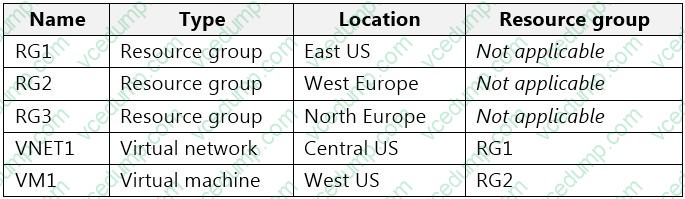
You have an Azure subscription named Subscription1 that contains the resources shown in the following table.
VM1 connects to a virtual network named VNET2 by using a network interface named NIC1.
You need to create a new network interface named NIC2 for VM1.
To attach NIC2 to VM1, NIC2 must be in the same region as VM1 (West US). The proposed solution creates NIC2 in Central US, which is a different region. Because VNets, NICs, and VMs are regional resources, this prevents attaching NIC2 to VM1, so the solution does not meet the goal.
Why the alternative is not correct:
- Yes: Incorrect because NIC2 in Central US cannot be attached to a VM in West US.
References:
[1] Microsoft. "Virtual network overview." Microsoft Learn. Date modified: Unable to locate. Date accessed: 2026-01-25. https://learn.microsoft.com/en-us/azure/virtual-network/virtual-networks-overview [2] Microsoft. "Create a network interface." Microsoft Learn. Date modified: Unable to locate. Date accessed: 2026-01-25. https://learn.microsoft.com/en-us/azure/virtual-network/create-network-interface-portal
Microsoft Exam Tips:
- Always validate "Location/Region" alignment for VM NIC VNet; mismatched regions is a common trick.
Summary:
Confirmed that creating NIC2 in a different region than VM1 prevents meeting the attachment requirement.
AZ-104 Exam Objective Hierarchy:
4.0 Implement and manage virtual networking (15?0%) |__ 4.1 Configure and manage virtual networks in Azure |__ 4.1.1 Create and configure virtual networks and subnets
Question 442:
HOTSPOT
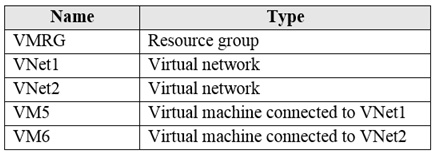
You have an Azure subscription that contains the resources in the following table:
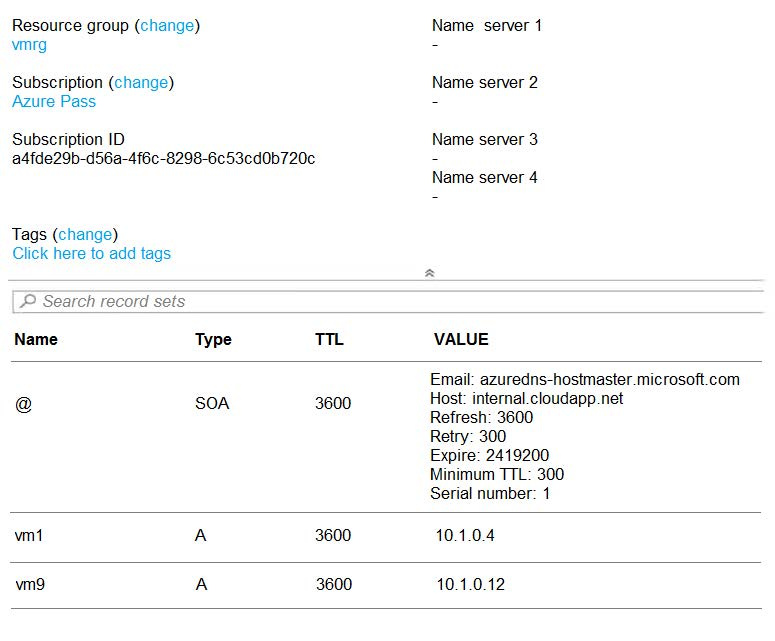
In Azure, you create a private DNS zone named adatum.com. You set the registration virtual network to VNet2. The adatum.com zone is configured as shown in the following exhibit:
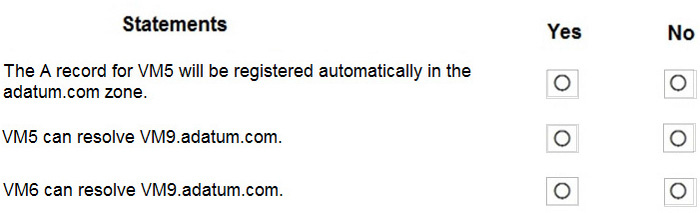
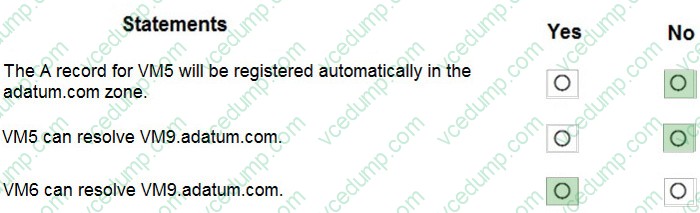
For each of the following statements, select Yes if the statement is true. Otherwise, select No.
NOTE: Each correct selection is worth one point.
(Statements from left-to-right, top-to-bottom):
1. The A record for VM5 will be registered automatically in the adatum.com zone: No
2. VM5 can resolve VM9.adatum.com: No
3. VM6 can resolve VM9.adatum.com: Yes
Why this is correct:
- The private DNS zone adatum.com is configured with the "registration virtual network" set to "VNet2".
- Only VMs in the registration-enabled VNet can auto-register records.
- VM5 is connected to "VNet1", so it will "not" auto-register --> (1) No.
- Name resolution for a private DNS zone works only for VNets that are linked to that zone.
- Since VNet2 is the registration VNet (and therefore linked), VM6 (in VNet2) can resolve VM9.adatum.com --> (3) Yes.
- VNet1 is not linked in the exhibit’s setup, so VM5 (in VNet1) cannot resolve VM9.adatum.com --> (2) No.
Why the other options are not correct:
- Any “Yes” for (1) ignores that auto-registration is only for the registration-linked VNet.
- Any “Yes” for (2) assumes VNet1 has a DNS link to the private zone (it does not in this setup).
- Any “No” for (3) ignores that VNet2 is linked/registration-enabled.
Microsoft Exam Tips
- “Registration VNet” answers two exam questions:
(1) where A records auto-register, and
(2) which VNet is definitely linked for name resolution.
Summary
- Hot Area Tracking (delta): Attempted +1 | Correct +1 | Incorrect +0 | Skipped +0
4.0 - Implement and manage virtual networking (15–20%) |__ 4.3 - Configure name resolution and load balancing |__ |__ 4.3.1 - Configure Azure DNS
Question 443:
You have an Azure subscription that contains a virtual machine named VM1. VM1 hosts a line-of-business application that is available 24 hours a day. VM1 has one network interface and one managed disk. VM1 uses the D4s v3 size.
You plan to make the following changes to VM1:
1. Change the size to D8s v3.
2. Add a 500-GB managed disk.
3. Add the Puppet Agent extension.
4. Enable Desired State Configuration Management.
Which change will cause downtime for VM1?
A. Enable Desired State Configuration Management B. Add a 500-GB managed disk C. Change the size to D8s v3 D. Add the Puppet Agent extension
Resizing a VM (changing its size/SKU) causes the VM to restart, which is downtime for an always-on application. Adding a managed disk and adding extensions/configuration management can typically be performed without requiring the VM to be deallocated in the same way resizing does (though extensions may cause transient workload impact, they are not generally treated as the mandatory restart/downtime operation in AZ-104). :contentReference[oaicite:27]{index=27}
Why the other selections are not correct:
- Add a 500-GB managed disk:
Data disks can be attached online without stopping the VM in most scenarios.
- Add the Puppet Agent extension:
VM extensions can be installed while the VM is running; not typically "the" downtime answer compared to resizing.
- Enable Desired State Configuration Management:
Configuration management changes do not inherently require a VM restart.
References:
1. Change the size of a virtual machine (running VM size change causes restart) https://learn.microsoft.com/en-us/azure/virtual-machines/sizes/resize-vm Date Modified: 11/10/2025 :contentReference[oaicite:28]{index=28} Date Access: 01/24/2026 2. Supporting reference (restart required when resizing a running VM) https://stackoverflow.com/questions/68093545/adjusting-azure-vm-size-without-rebooting-vm Date Modified: Unable to locate date modified :contentReference[oaicite:29]{index=29} Date Access: 01/24/2026
---------------------------------------------------------------------------------------------------- Microsoft Exam Tips:
- Any change that forces a VM restart/deallocation is "downtime" in exam terms.
- VM sizing questions frequently test whether you recognize the restart requirement.
Summary:
VM resizing causes a restart and therefore downtime.
Your company's Azure subscription includes Azure virtual machines (VMs) that run Windows Server 2016.
One of the VMs is backed up every day using Azure Backup Instant Restore.
When the VM becomes infected with data encrypting ransomware, you decide to recover the VM's files.
Which of the following is TRUE in this scenario?
A. You can only recover the files to the infected VM. B. You can recover the files to any VM within the company's subscription. C. You can only recover the files to a new VM. D. You will not be able to recover the files.
B. You can recover the files to any VM within the company's subscription.
Azure VM file recovery works by running a Microsoft-provided script/executable that mounts a recovery point as a volume on a machine so you can copy files out. The process can be performed on a different VM (not only the infected VM), provided it is within the subscription/environment and can run the recovery script and access the recovery point. This supports recovering files without interacting directly with the infected VM.
Why the other choices are not correct:
- Only recover files to the infected VM: not required; recovery can be performed on another VM.
- Only recover files to a new VM: not strictly true; it can be any suitable VM.
- You will not be able to recover the files: file-level recovery is supported.
References:
1. Microsoft Learn. "Recover files from Azure VM backup." https://learn.microsoft.com/en-us/azure/backup/backup-azure-restore-files-from-vm. Accessed 2026-01-25.
2. Microsoft Learn. "Azure Backup for Azure VMs." https://learn.microsoft.com/en-us/azure/backup/backup-azure-vms-introduction. Accessed 2026-01-25.
Microsoft Exam Tips:
- Ransomware scenario: separate "file recovery" (mount/copy files) from "VM restore" (replace/restore VM). The exam often tests the distinction.
Summary:
Azure Backup file-level recovery behavior and where recovery can be performed.
AZ-104 Exam Objective Hierarchy:
5.0 Monitor and maintain Azure resources (10?5%) |__ 5.2 Implement backup and recovery |__ 5.2.4 Perform backup and restore operations by using Azure Backup
Question 445:
HOTSPOT
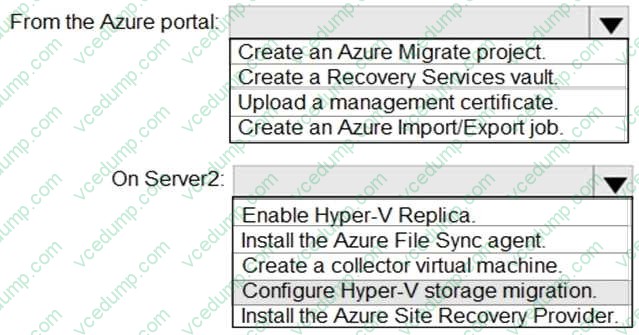
You need to the appropriate sizes for the Azure virtual for Server2.
What should you do? To answer, select the appropriate options in the answer area.
NOTE: Each correct selection is worth one point.
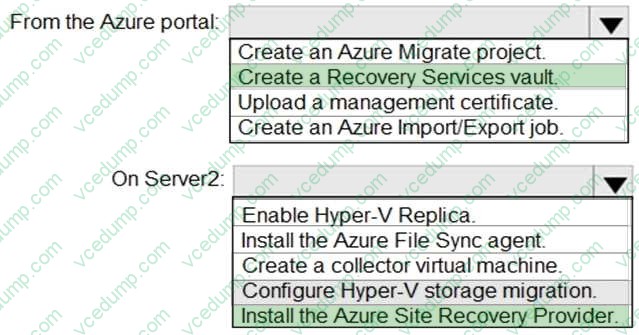
- From the Azure portal: Create a Recovery Services vault.
- On Server2: Install the Azure Site Recovery Provider.
Hyper-V to Azure replication/migration using Azure Site Recovery is orchestrated through a Recovery Services vault, and requires the Azure Site Recovery Provider installed on the Hyper-V host (or relevant server) to enable replication.
References Prepare Azure for disaster recovery of on-premises machines. (Last updated 2023-02-27). Retrieved 2026-01-31 from https://learn.microsoft.com/en-us/azure/site-recovery/hyper-v-azure-tutorial-prepare-azure Replicate Hyper-V virtual machines to Azure. (Last updated 2025-09-17). Retrieved 2026-01-31 from https://learn.microsoft.com/en-us/azure/site-recovery/hyper-v-azure-tutorial
AZ-104 Exam Objective Hierarchy (Mapped to this question) 5.0 Monitor and maintain Azure resources (10–15%) |__5.2 Implement backup and recovery |__|__5.2.1 Create a Recovery Services vault |__|__5.2.5 Configure Azure Site Recovery for Azure resources
Question 446:
Note: This question is part of a series of questions that present the same scenario. Each question in the series contains a unique solution that might meet the stated goals. Some question sets might have more than one correct solution, while others might not have a correct solution.
After you answer a question in this section, you will NOT be able to return to it. As a result, these questions will not appear in the review screen.
You have an Azure container registry named Registry1 that contains an image named image1.
You receive an error message when you attempt to deploy a container instance by using image1.
You need to be able to deploy a container instance by using image1.
Solution: You select Use dedicated data endpoint for Registry1.
Does this meet the goal?
A. Yes B. No
B. No
No
Selecting "Use dedicated data endpoint" for an Azure Container Registry does not address the root requirement for Azure Container Instances (ACI) to successfully pull an image from the registry. Dedicated data endpoints are a networking/ configuration option for registry data-plane access patterns, but they do not, by themselves, provide ACI with valid authentication/authorization to pull images.
To deploy a container instance from an ACR image, you must ensure the container group has permission to pull from the registry (for example, by providing credentials or using an identity with pull permissions). Therefore, the proposed solution does not meet the stated goal.
Microsoft Exam Tips:
- For ACI pulling from ACR, think "authentication and pull permissions" first (credentials/identity + AcrPull), then network path (public vs private endpoints/DNS).
Summary:
- Azure Container Instances deployment prerequisites with Azure Container Registry (authn/authz vs networking).
AZ-104 Exam Objective Hierarchy:
3.0 Deploy and manage Azure compute resources 3.3 Provision and manage containers in the Azure portal 3.3.1 Create and manage an Azure container registry 3.3.2 Provision a container by using Azure Container Instances
Question 447:
You need to define a custom domain name for Azure AD to support the planned infrastructure.
Which domain name should you use?
A. ad.humongousinsurance.com B. humongousinsurance.onmicrosoft.com C. humongousinsurance.local D. humongousinsurance.com
D. humongousinsurance.com
Explanation
Every Azure AD directory comes with an initial domain name in the form of domainname.onmicrosoft.com. The initial domain name cannot be changed or deleted, but you can add your corporate domain name to Azure AD as well. For example, your organization probably has other domain names used to do business and users who sign in using your corporate domain name. Adding custom domain names to Azure AD allows you to assign user names in the directory that are familiar to your users, such as '[email protected].' instead of 'alice@domain name.onmicrosoft.com'.
Scenario:
Network Infrastructure: Each office has a local data center that contains all the servers for that office. Each office has a dedicated connection to the Internet. Humongous Insurance has a single-domain Active Directory forest named humongousinsurance.com Planned Azure AD Infrastructure: The on-premises Active Directory domain will be synchronized to Azure AD.
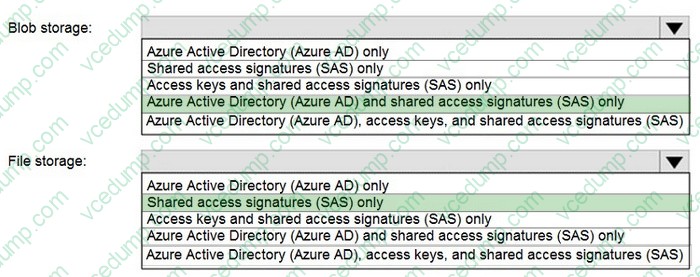
You have an Azure Storage account named storage1 that uses Azure Blob storage and Azure File storage.
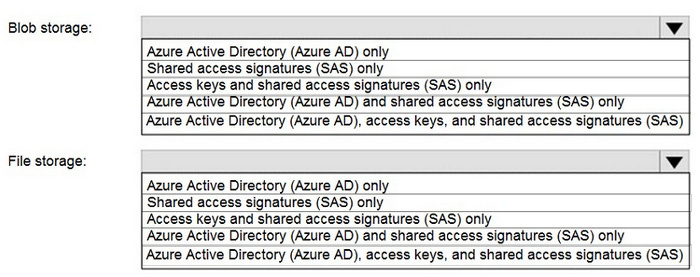
You need to use AzCopy to copy data to the blob storage and file storage in storage1.
Which authentication method should you use for each type of storage? To answer, select the appropriate options in the answer area.
NOTE: Each correct selection is worth one point.
Question 449:
You have an Azure subscription that contains a storage account named storage1 in the North Europe Azure region.
You need to ensure that when blob data is added to storage1, a secondary copy is created in the East US region. The solution must minimize administrative effort.
What should you configure?
A. operational backup B. object replication C. geo-redundant storage (GRS) D. a lifecycle management rule
B. object replication
object replication
To create an automatic secondary copy of blob data in a specific different region (East US) with minimal ongoing effort, configure object replication from the source storage account or container to a destination storage account or container in the target region.
Why the other selections are not correct:
operational backup: This is for backup and restore, not near-real-time replication to a specific target region.
geo-redundant storage (GRS): Replicates to the paired region (not a user-selected region such as East US), so it does not satisfy the explicit destination region requirement.
a lifecycle management rule: Moves, tiers, or deletes blobs within an account; it does not replicate blobs to another region or account.
Microsoft Exam Tips:
If the stem says “replicate blobs to a specific other region,” think object replication (account-to-account, container-to-container).
If it says “paired region,” think GRS or RA-GRS.
Summary:
Cross-region blob replication by using Storage object replication.
AZ-104 Exam Objective Hierarchy:
2.0 Implement and manage storage (15–20%)
|__ 2.2 Configure and manage storage accounts
|__ 2.2.3 Configure object replication
Question 450:
Note: This question is part of a series of questions that present the same scenario goals. Some question sets might have more than one correct solution, while othersion in the series contains a unique solution that might meet the stated not have a correct solution.
After you answer a question in this section, you will NOT be able to return to it. As a result, these questions will not appear in the review screen.
You have an Azure web app named Appl. App1 runs in an Azure App Service plan named Plan1. Plan1 is associated to the Free pricing tier.
You discover that App1 stops each day after running continuously for 60 minutes.
You need to ensure that App1 can run continuously for the entire day.
A triggered WebJob does not prevent an App Service running in the **Free** tier from stopping due to platform limits/quotas. Free tier apps can be suspended and are not intended for "always-on" continuous execution for an entire day. To keep the app running continuously, you would typically need to move to a tier that supports continuous/Always On behavior (for example, Basic or higher, depending on the requirement).
Why the other selection is incorrect:
Yes: Adding a triggered WebJob does not change the App Service plan tier limitations that cause the app to stop.
1. Azure App Service plan overview https://learn.microsoft.com/en-us/azure/app-service/overview-hosting-plans Date Modified: Unable to locate exact date in this session Date Access: 01/25/2026
-------------------------------------------------------------------------------- Microsoft Exam Tips:
- When a question mentions **Free/Shared** App Service tiers and "runs continuously," immediately think **tier limitation** (often requires scaling up to a paid tier).
Summary:
App Service plan tier constraints and continuous execution expectations.
AZ-104 Exam Objective Hierarchy:
3.0 Deploy and manage Azure compute resources |__ 3.4 Create and configure App Service |_3.4.2 Configure scaling for an App Service plan
Nowadays, the certification exams become more and more important and required by more and more
enterprises when applying for a job. But how to prepare for the exam effectively? How to prepare
for the exam in a short time with less efforts? How to get a ideal result and how to find the
most reliable resources? Here on Vcedump.com, you will find all the answers.
Vcedump.com provide not only Microsoft exam questions,
answers and explanations but also complete assistance on your exam preparation and certification
application. If you are confused on your AZ-104 exam preparations
and Microsoft certification application, do not hesitate to visit our
Vcedump.com to find your solutions here.