ASCP-MLT Exam Details
-
Exam Code
:ASCP-MLT -
Exam Name
:MEDICAL LABORATORY TECHNICIAN - MLT(ASCP) -
Certification
:ASCP Certifications -
Vendor
:ASCP -
Total Questions
:572 Q&As -
Last Updated
:Jul 14, 2026
ASCP ASCP-MLT Online Questions & Answers
-
Question 501:
The second choice is correct. Standard Precautions means to treat blood, all body fluids, all secretions (except sweat), all excretions, non-intact skin, and mucous membranes as if they were infectious. The purpose of this rule is to ensure the safety of and to protect those who come into contact with potentially infectious material.
Which one statement about Standard Precautions is most correct?
A. Standard Precautions means to treat all patients as if they were infectious.
B. Standard Precautions means to treat blood, all body fluids, all secretions (except sweat), all excretions, non-intact skin, and mucous membranes as if they were infectious.
C. Standard Precautions do not apply to feces or urine.
D. Standard Precautions do not apply to pleural fluid or semen. -
Question 502:
Basophilic stippling is the term used to describe red blood cells that contain tiny particles of RNA within their cytoplasm. Basophilic stippling is associated with many conditions, but is strongly associated with lead poisoning. Multiple small, dark blue particles scattered throughout the cytoplasm of erythrocytes is/are called:
A. Pappenheimer bodies
B. Basophilic stippling
C. Heinz bodies
D. Howell-Jolly bodies -
Question 503:
One method of calculating a glomerular filtration rate is using creatinine and urine volume to determine creatinine clearance. The equation is as follows:
Creatinine Clearance = (urine creatinine X urine flow rate) / plasma creatinine; where urine flow rate = volume in mL /24 hours x h/60 min)
In this case = creatinine clearance = 124 X (2200/24 x hour/60) / 2 = 94.7 or 95 ml/min
What is the glomerular filtration rate for a patient with a serum creatinine of 2 mg/dL, if the urine creatinine was 124 mg/dL and the urine volume was 2.2 L/24 hrs?
A. 9.5 mL/min
B. 13.6 mL/min
C. 95 mL/min
D. 136 mL/min
E. 1.36 mL/min -
Question 504:
The intended response is Vitamin B12 and folate deficiencies. Each of these conditions lead to a megaloblastic production of the red blood cells in the bone marrow. Since vitamin B12 and folate are needed in order to produce a synchronous development of the nucleus with the cytoplasm in hematologic cells, oval-macrocytosis often occurs if these nutrients are not in adequate supply within the body. This can also affect neutrophils, allowing for the characteristic hypersegmented nucleus.
The photographic field contains several oval-macrocytes and a hypersegmented neutrophil with greater than 5 nuclear segments. Oval macrocytes are most commonly associated with pernicious anemia and malabsorption syndromes leading to vitamin B12 and folic acid deficiencies.
Clinical information relating to chronic infection, aplastic anemia, and other hematologic maligancies provide the context for the presence of the oval macrocyte.
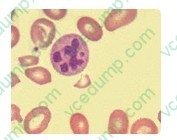
Macrocytic erythrocytes and hypersegmented neutrophils are not present in thalassemias or in Pelger-Huet anomaly (hyposegmented neutrophils). Conditions suggested by the macrocytes and the neutrophil in the photograph to the right include which of the following?
A. Thalassemia
B. Vitamin B12 deficiency
C. Pelger-Huet anomaly
D. Folate deficiency -
Question 505:
The clue to the identification of the colony seen in the upper frame is the gram stain in the lower frame, in which are seen short, rounded, gram positive bacilli, many of which possess distinct spores. As the colonies grew aerobically, the presence of spores indicates Bacillus species. The colonies are spreading, smooth, yellow-white and non-hemolytic. The lack of hemolysis and the small size of the bacterial cells suggests a species other than Bacillus cereus, the species causing most human infections. The isolate was identified as Bacillus circulans, which is consistent with the gram stain morphology. Clostridium septicum also produces spores; however, this species is an anaerobe and would grow poorly if at all and not produce spores aerobically. Listeria monocytogenes and Lactobacillus species are gram positive bacilli; however, neither of these produce spores.
The colonies seen in the upper frame, grown after 48 hours incubation aerobically at 35°C, and the accompanying gram stain in the lower frame are uncommonly associated with human disease, but have been associated with septicemia, bronchopneumonia, osteomyelitis and other infections, particularly in intravenous drug users. The most likely identification is:
A. Clostridium septicum
B. Bacillus circulans
C. Listeria monocytogenes
D. Lactobacillus species -
Question 506:
The part of the microscope that holds the objective lenses is called the _______________.
A. objective
B. condenser
C. revolving nosepiece
D. fine adjustment -
Question 507:
Macroamylasemia can be diagnosed by measuring amylase levels in the urine and serum. In patients with macroamylasemia, there will be high levels of amylase in the serum. However, macroamylasemia can look similar to acute pancreatitis, which also causes high levels of amylase in the blood. To help differentiate, we measure amylase levels in the urine. Urine levels of amylase are low in people with macroamylasemia, but high in patients with pancreatitis.
The results which would be MOST consistent with macro-amylasemia are?
A. Normal serum amylase and elevated urine amylase values
B. Increased serum amylase and normal to low urine amylase values
C. Increased serum and increased urine amylase values
D. Normal serum and normal urine amylase values -
Question 508:
Skeletal deformations result from the increased erythropoiesis that occurs in beta thalassemia major. Children with beta thalassemia intermedia may demonstrate some facial bone deformity, however this is not common. Beta thalassemia minor rarely causes any physical signs or symptoms and beta thalassemia minima is completely asymptomatic.
Skeletal deformations are most commonly present in which of the following beta thalassemias?
A. Beta thalassemia minor
B. Beta thalassemia intermedia
C. Beta thalassemia major
D. None of the beta thalassemias
E. All of the beta thalassemias equally -
Question 509:
A key laboratory characteristic by which Mycobacterium bovis can be separated from Mycobacterium tuberculosis is:
A. Niacin accumulation when grown on egg based medium
B. Ability to take up iron salts from the culture medium
C. Growth inhibition by thiopine-2-carboxylic acid hydrazide (T2H)
D. Semiquantitative catalase -
Question 510:
Conversion of only the slant to a pink color in a Christensen's urea agar slant is produced by bacterial species that have weak urease activity. The reaction in the slant to the right is often produced by Klebsiella species, as an example. Strong urease activity is indicated by conversion of the slant and the butt of the tube to a pink color, as seen in the tube to the left. The slant only reaction in the right tube may be seen early on if only the slant had been inoculated; however, with a strong urease producer, both the slant and the butt would turn. Therefore, the reaction is dependent on the strength of urease activity. If the media had outdated for a prolonged period, either there would be no reaction or the appearance of only a faint pink tinge, either in the slant, the butt or both, again depending on the strength of urease production by the unknown organism.
The urease reaction seen in the Christensen's urea agar slant on the far right indicates:
A. Weak activity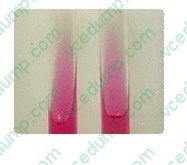
B. Strong activity
C. Slant only inoculated
D. Use of outdated medium
Related Exams:
Tips on How to Prepare for the Exams
Nowadays, the certification exams become more and more important and required by more and more enterprises when applying for a job. But how to prepare for the exam effectively? How to prepare for the exam in a short time with less efforts? How to get a ideal result and how to find the most reliable resources? Here on Vcedump.com, you will find all the answers. Vcedump.com provide not only ASCP exam questions, answers and explanations but also complete assistance on your exam preparation and certification application. If you are confused on your ASCP-MLT exam preparations and ASCP certification application, do not hesitate to visit our Vcedump.com to find your solutions here.