ASCP-MLT Exam Details
-
Exam Code
:ASCP-MLT -
Exam Name
:MEDICAL LABORATORY TECHNICIAN - MLT(ASCP) -
Certification
:ASCP Certifications -
Vendor
:ASCP -
Total Questions
:572 Q&As -
Last Updated
:Jul 14, 2026
ASCP ASCP-MLT Online Questions & Answers
-
Question 471:
Refrigerated temperatures, those close to 4 °C, are recommended for the preservation of enzyme activity in a patient sample.
Chemistry
The recommended storage temperature for the preservation of activity for MOST enzymes is:
A. 0 °C
B. 4 °C
C. 25 °C
D. 37 °C -
Question 472:
1+ reaction has numerous small clumps and cloudy red supernatant 2+ has many medium-sized clumps and clear supernatant. 3+ has several large clumps and clear supernatant 4+ has one solid clump, no free cells, and clear supernatant BB Tube-based agglutination reactions in blood bank are graded from negative (0) to 4+. A reaction that has numerous small clumps in a cloudy, red background is:
A. 1+
B. 2+
C. 3+
D. 4+ -
Question 473:
The newest direction for laboratory testing procedures is
A. Larger automated instruments
B. Networked systems for point-of-care testing
C. Molecular diagnostic techniques in various laboratory departments
D. Robotic specimen handling -
Question 474:
The most likely causes of delayed hemolytic reactions are Kidd system antibodies. Both jka and jkb are often responsible for delayed hemolytic transfusion reactions.
Blood Bank
Delayed hemolytic transfusion reactions are usually caused by antibodies directed against what blood group system?
A. MNS
B. Kidd.
C. Kell.
D. Rh.
E. ABO -
Question 475:
If your reactions are strong at immediate spin (3+) and then get weaker at AHG (w+), it could mean the presence of a strong cold antibody.
Cold antibodies tend to be IgM and their optimum phase for reactivity is immediate spin. Incubation and washing of the sample may cause the agglutination that occurred at room temperature to break down. This would appear as a weaker
reaction at AHG.
If the reaction strengths varied in each panel cell then that could be an indication that there are multiple antibodies present.
Your screen cells are 3+ at immediate spin and weak (W)+ at AHG. Your auto control is negative for both phases. Some of your antibody panel cells are 3+ at immediate spin and negative at AHG.
What should you suspect?
A. A warm autoantibody is present
B. A cold antibody may be present
C. Bad specimen draw -
Question 476:
The Fc portion of immunoglobulin can activate the classical complement pathway, where the heavy chains, light chains, hinge regions and Fab portions cannot.
Which part of the immunoglobulin molecule is responsible for activating complement?
A. Fc
B. Fab
C. heavy chains
D. light chains
E. Hinge regions -
Question 477:
The indole (modified Kovacs' reagent) is used to assess the ability of certain bacteria to produce indole by the deamination of tryptophan. Indole reacts with aldehyde in the Kovac's reagent to produce a red color. An alcoholic layer holds the red color as a ring at the top of the tube used for the idole test.
If a bacteria produces the enzyme tryptophanase to break down the amino acid tryptophan, which of the following tests will be positive with Kovac's reagent?
A. oxidase test
B. esculin test
C. catalase test
D. citrate test
E. indole test -
Question 478:
hs-CRP is a recent marker of chronic inflammation. New measurements of CRP in lower levels (hs-CRP) are now measured to monitor risk of cardiovascular disease.
Select the statement that best describes hs-CRP?
A. hs-CRP is a measurement of acute inflammation and is used to monitor these conditions
B. hs-CRP is an anti-inflammatory adipokine synthesized by adipocytes
C. hs-CRP is a marker of chronic inflammation and measured to predict the risk of cardiovascular disease
D. hs-CRP is decreased in inflammatory conditions and measured to predict a return of inflammation -
Question 479:
The production of long, tapered phialides is one of the key identifying features of Trichoderma species. In contrast, Penicillium species, produce phialides with blunt ends.
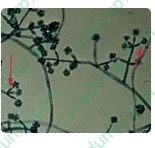
The phialides of Beauveria species are geniculate, forming a zig-zag pattern.
The arrows in the image on the right point to single, long, tapered phialides that extend laterally from either side of the hyphae. This is an identifying feature of which of the fungi listed below?
A. Trichoderma species
B. Penicillium species
C. Beauveria species -
Question 480:
Blood plasma will contain coagulation proteins, but not in a clotted tube where serum is present. Blood serum contains each of the following substances except:
A. Water
B. Sugars
C. Coagulation proteins
D. Electrolytes
Related Exams:
Tips on How to Prepare for the Exams
Nowadays, the certification exams become more and more important and required by more and more enterprises when applying for a job. But how to prepare for the exam effectively? How to prepare for the exam in a short time with less efforts? How to get a ideal result and how to find the most reliable resources? Here on Vcedump.com, you will find all the answers. Vcedump.com provide not only ASCP exam questions, answers and explanations but also complete assistance on your exam preparation and certification application. If you are confused on your ASCP-MLT exam preparations and ASCP certification application, do not hesitate to visit our Vcedump.com to find your solutions here.