ASCP-MLT Exam Details
-
Exam Code
:ASCP-MLT -
Exam Name
:MEDICAL LABORATORY TECHNICIAN - MLT(ASCP) -
Certification
:ASCP Certifications -
Vendor
:ASCP -
Total Questions
:572 Q&As -
Last Updated
:Jul 14, 2026
ASCP ASCP-MLT Online Questions & Answers
-
Question 391:
Provide the equivalent measurement for 1 ounce.
A. 10 grams
B. 5.7 grams
C. 100 grams
D. 28.35 grams -
Question 392:
Rule-out is a process by which antibodies are identified as being unlikely in a given sample because of the absence of an expected antigen-antibody reaction. In other words, the absence of a reaction is noted with a cell that is positive for the
corresponding antigen.
Although rule-out procedures may vary somewhat from institution to institution, the following general principles apply:
Non-reactive cells are selected for rule-out. To be classified as non-reactive, a cell must NOT have reacted at any phase of testing in a given panel or screen.
Using the logic that if the rule-out cell is positive for a given antigen, it should have reacted with the corresponding antibody, you can rule-out antibodies that correspond to antigen positive cells.
To increase the probability that rule-out will not mistakenly eliminate a weakly-reacting antibody that exhibits dosage*, use only cells that are homozygous for the corresponding antigen for those systems that generally show dosage. Generally
these include: C, c, E, e, Fya, Fyb, Jka, Jkb, M, N, S, and s.
In this case, it is only possible to rule out on screening cell 2 since it demonstrates a negative reaction with the patient serum. Anti-C cannot be ruled out since the C antigen is heterozygous on screening cell 2 with c. Anti-Fya cannot be ruled
out since this antigen is not present on screening cell 2. Anti-M and anti-Jka can be ruled out since the antigens are homozyous while demonstrating a negative reaction on screening cell 2.
Rule-out, while very useful, can lead to error. Ruling out an antibody should be combined with other supporting data to increase confidence in the solution; the more data collected, the higher the probability that the final solution is correct.
*Dosage means that there are two "doses" of the same antigen present on the red cells . Antibodies that exhibit dosage react more strongly with homozygous cells (e.g., Jka Jka) than with heterozygous cells (e.g., Jka Jkb) .
Based on the phenotype of the RBC screening cells, and patient results shown on the right, which of the following antibodies CANNOT be ruled out?
A. Anti-C
B. Anti-Jka
C. Anti-M
D. Anti-Fya -
Question 393:
A phlebotomist draws an outpatient without wearing gloves. The outpatient displays a badge and cites the laboratory for not following the law. The outpatient is an employee of the:
A. National Fire Protection Association (NFPA)
B. Joint Commission (JC)
C. OSHA
D. Centers for Disease Control and Prevention (CDC) -
Question 394:
Since cimetidine inhibits CYP2D6, less amphetamine will probably need to be given since it will not be able to be metabolized as readily.
Most drug interactions are like this: one drug inhibits or competes with the same CYP450 as another drug. The end result is that higher concentrations of one, or both, drugs are present, leading to potential toxicity.
A patient is taking cimetidine for a stomach ulcer. This drug inhibits CYP2D6. The patient is now prescribed amphetamine for narcolepsy. Amphetamine is metabolized by CYP2D6.
What would you predict?
A. The dose for the amphetamine needs to be lower than normal.
B. The dose for amphetamine needs to be higher than normal.
C. Nothing can be assumed until you know the patient's status (PM, EM, UM).
D. The two drugs can never be given together since they interact. -
Question 395:
In DNA complementary base pairing, guanine and cytosine pair and adenine and thymine base pair. Remembering the phrase "G-CAT" helps one recollect correct pairing.
Which nitrogen base would bind with a guanine nucleotide in forming double-stranded DNA?
A. Cytosine
B. Uracil
C. Thymine
D. Adenine -
Question 396:
UA and Body Fluids
What is the identification of this crystal seen in a urine with an alkaline pH?
A. Uric acid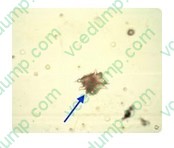
B. Ammonium biurate
C. Triple phosphate
D. Calcium carbonate -
Question 397:
The presence of a clot is acceptable in:
A. red stopper tubes
B. lavender stopper tubes
C. green stopper tubes
D. light blue stopper tubes -
Question 398:
Eosinophils do not have cytoplasm containing large purple/blue-staining granules. Instead, their granules are large but are orange/red in color. These granules are very distinctive for this type of cell, typically making their identification simple.
ll of the following statements describe an eosinophil EXCEPT:
A. Cytoplasm contains large purple/blue-staining granules.
B. May be called an "eo"
C. Is a member of the granulocyte series
D. Cytoplasm contains large reddish-orange granules. -
Question 399:
The two main areas of the clinical laboratory are:
A. cytology and histology.
B. chemistry and hematology.
C. urinalysis and microbiology.
D. anatomical and clinical. -
Question 400:
n reporting out Gram stains, one should not go beyond what objective observation will allow. In this case, bacterial cells are observed, which are spherical and gram-positive. Their arrangement in tetrads and clusters might be helpful to the physician, suggesting staphylococci. However, one should stop short of naming staphylococci in an official report, as the large gram-positive cocci in tetrads is also suggestive of Micrococcus species, for which human infections have not been reported.
A Gram stain of the serous exudate is shown in the image. The appropriate report would read:
A. Gram-positive cocci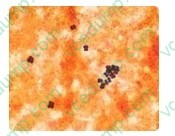
B. Gram-positive cocci in tetrads and clusters
C. Gram-positive cocci suggestive of Staphylococcus species
D. Smear positive for bacteria
Related Exams:
Tips on How to Prepare for the Exams
Nowadays, the certification exams become more and more important and required by more and more enterprises when applying for a job. But how to prepare for the exam effectively? How to prepare for the exam in a short time with less efforts? How to get a ideal result and how to find the most reliable resources? Here on Vcedump.com, you will find all the answers. Vcedump.com provide not only ASCP exam questions, answers and explanations but also complete assistance on your exam preparation and certification application. If you are confused on your ASCP-MLT exam preparations and ASCP certification application, do not hesitate to visit our Vcedump.com to find your solutions here.