ASCP-MLT Exam Details
-
Exam Code
:ASCP-MLT -
Exam Name
:MEDICAL LABORATORY TECHNICIAN - MLT(ASCP) -
Certification
:ASCP Certifications -
Vendor
:ASCP -
Total Questions
:572 Q&As -
Last Updated
:Jul 14, 2026
ASCP ASCP-MLT Online Questions & Answers
-
Question 21:
The identification of the crystals depicted in this image are triple phosphate crystals. Triple phosphate crystals may be normal but are usually associated with alkaline urine. These colorless crystals have a characteristic "coffin lid" appearance.
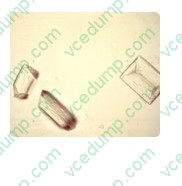
What is the identification of these crystals seen in urine with an alkaline pH?
A. Uric acid
B. Calcium oxalate
C. Triple phosphate
D. Calcium carbonate -
Question 22:
Convert the following temperature from Celsius to Fahrenheit 8 degrees C
A. 77 degrees F
B. 68 degrees F
C. 46.4 degrees F
D. 14 degrees F -
Question 23:
Transmission-based precautions isolation categories include all of the following except:
A. airborne.
B. droplet.
C. blood and body fluids.
D. contact. -
Question 24:
Enterobius vermicularis infection occurs through swallowing ova. Pinworm infections including those caused by Enterobius vermicularis, usually occur due to a fecal-oral route of transmission. According to the CDC, "Eggs are deposited on perianal folds. Self- infection occurs by transferring infective eggs to the mouth with hands that have scratched the perianal area. Person-to-person transmission can also occur through handling of contaminated clothes or bed linens. Enterobiasis may also be acquired through surfaces in the environment that are contaminated with pinworm eggs (e.g. , curtains, carpeting). Some small number of eggs may become airborne and inhaled. These would be swallowed and follow the same development as ingested eggs. Following ingestion of infective eggs, the larvae hatch in the small intestine and the adults establish themselves in the colon. The time interval from ingestion of infective eggs to oviposition by the adult females is about one month. The life span of the adults is about two months. Gravid females migrate nocturnally outside the anus and oviposit while crawling on the skin of the perianal area. The larvae contained inside the eggs develop (the eggs become infective) in 4 to 6 hours under optimal conditions . Retroinfection, or the migration of newly hatched larvae from the anal skin back into the rectum, may occur but the frequency with which this happens is unknown."
Enterobius vermicularis infection occurs through:
A. penetration of larvae through skin
B. penetration of adult through skin an resulting production of larvae
C. ingesting or inhaling ova
D. ingesting a segment of the adult worm -
Question 25:
The concentration of circulating ferritin is proportional to the size of iron stores.
Which of the following will give the best overall picture of a patient's iron stores:
A. Albumin
B. Transferrin
C. Haptoglobin
D. Ferritin -
Question 26:
A patient with influenza would be placed in:
A. airborne isolation.
B. droplet isolation.
C. protective isolation.
D. body fluid isolation -
Question 27:
A positive spot test shows agglutination of horse erythrocytes when added to patient serum previously absorbed with guinea pig kidney, but not when added to patient serum previously absorbed with beef erythrocyte stroma. The test is generally simple, sensitive, and specific, but false negative are common in young children with mononucleosis.
The most common rapid slide test (MONOSPOT? for infectious mononucleosis employs:
A. Horse erythrocytes
B. Sheep erythrocytes
C. Intact beef erythrocytes
D. None of the above -
Question 28:
The cells indicated by the arrows in the image are spherocytes. Spherocytes have a decreased surface to volume ratio and are therefore smaller with an increased MCHC. Spherocytes have lost their bi-concave shape and are spherical in shape, hence the name.
What are the cells that are indicated by the arrows in this peripheral blood smear image?
A. Echinocytes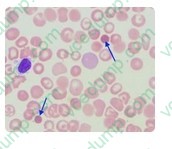
B. Elliptocytes
C. Spherocytes
D. Stomatocytes -
Question 29:
The type of isolation category that always requires a HEPA mask or respirator to be worn is:
A. contact
B. droplet
C. airborne
D. blood and body fluid -
Question 30:
The combination of complement C4, C2 and C3 that binds to the antigen-antibody complex in the initial reaction step in the classical pathway of complement activation is called the activation unit. Which of the following is the "activation unit" in the classical complement pathway?
A. C1
B. C2
C. C4, C2, C3
D. C5, C6, C7, C8, C9
E. C1, C2, C9
Related Exams:
Tips on How to Prepare for the Exams
Nowadays, the certification exams become more and more important and required by more and more enterprises when applying for a job. But how to prepare for the exam effectively? How to prepare for the exam in a short time with less efforts? How to get a ideal result and how to find the most reliable resources? Here on Vcedump.com, you will find all the answers. Vcedump.com provide not only ASCP exam questions, answers and explanations but also complete assistance on your exam preparation and certification application. If you are confused on your ASCP-MLT exam preparations and ASCP certification application, do not hesitate to visit our Vcedump.com to find your solutions here.