ASCP-MLT Exam Details
-
Exam Code
:ASCP-MLT -
Exam Name
:MEDICAL LABORATORY TECHNICIAN - MLT(ASCP) -
Certification
:ASCP Certifications -
Vendor
:ASCP -
Total Questions
:572 Q&As -
Last Updated
:Jul 14, 2026
ASCP ASCP-MLT Online Questions & Answers
-
Question 221:
Vitamin K dependent factors are those that require Vitamin K for their synthesis in the liver. Vitamin K is an important factor to gamma-glutamyl carboxylase which adds a carboxyl group to glutamic acid residues on factors II, VII, IX and X, as well as Protein S, Protein C. In adding the gamma-carboxyl group to glutamate residues on the immature clotting factors Vitamin K is itself oxidized. Deficiency of Vitamin K due to malabsorption, liver disease, etc. may contribute to bleeding disorders because clotting factor maturation depends on Vitamin K.
Which of these coagulation factors are referred to as "vitamin-K dependent?"
A. I, V, VIII, XIII
B. II, V, IX, XII
C. II, VII, IX, X
D. XI, XII, Fletcher, Fitzgerald -
Question 222:
Blood Bank
What other component(s) can be shipped together with Fresh Frozen Plasma (FFP)?
A. frozen RBC's and cryoprecipitate
B. platelets
C. packed RBC's and granulocytes
D. whole blood
E. none -
Question 223:
The intended response is "transfusion dimorphism". The microcytic, hypochromic erythrocytes suggests iron deficiency anemia. Interspersed among these cells are normocytic, normochromic erythrocytes suggesting two populations of red cells following transfusion. This was a case of severe iron deficiency treated with red cell transfusions and iron supplement.
The condition most likely associated with the peripheral blood picture in the photograph is:
A. Hereditary spherocytosis
B. Lead poisoning
C. Transfusion dimorphism
D. Folic acid deficiency -
Question 224:
The image shown in this question is depicting a rosette formation. Here the red blood cells are surrounding and adhering to the outside of the white blood cell.
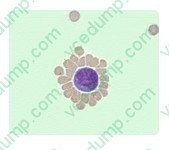
What is the best description of the phenomenon seen in this illustration?
A. Rouleau formation
B. Cold agglutination
C. Rosette formation
D. Monocyte activation -
Question 225:
The best course of action when entering an isolation room is:
A. following the directions from the sign on the door
B. wearing a gown, a mask, and gloves
C. wearing only a gown
D. wearing only a mask -
Question 226:
Which of the following CD markers is NOT present on a normal mature T cell?
A. CD20
B. CD7
C. CD3
D. CD5 -
Question 227:
Match each virus with its appropriate nucleic acid content.
1.
Paramyxovirus
2.
Rhabdovirus
3.
Poxvirus
4.
Orthomyxovirus
A. RNA
B. DNA -
Question 228:
Dce is found in 4% of whites and 44% of blacks.
DCe is found in 42% of whites and 17% of blacks.
DcE is found in 14% of whites and 11% of blacks.
dce is found in 37% of whites and 26% of blacks.
Blood bank
The most common Rh haplotype among whites is:
A. Dce
B. DCe
C. DcE
D. dce -
Question 229:
All of the following activities are associated with platelets EXCEPT:
A. Aggregation
B. Adhesion
C. Lysis
D. Release of granules -
Question 230:
First, the RBC indices must be calculated. The MCV ((Hct/RBC) x 10) = 71 fL. Since the reference range for the MCV is 80-100 fL, this anemia would be classified as microcytic. The MCH ((Hgb/RBC) x 10) = 19.3 pg. Since the reference range for the MCH is 27-33 pg, this would be considered hypochromic. Finally, the MCHC ((Hgb/Hct) X 100) = 27%. Since the normal range for the MCHC is 33%-36%, this would indicate hypochromia which correlates with the MCH findings. The correct answer is therefore microcytic, hypochromic anemia.
A patient is admitted to the emergency room with lethargy and pallor. The CBC results are as follows:
RBC = 4.1 x 10¹²/L
Hemoglobin = 7.9 g/cL
Hematocrit = 29%
How would you classify this anemia?
A. microcytic, hypochromic
B. normocytic, normochromic
C. macrocytic, normochromic
D. microcytic, hyperchromic
Related Exams:
Tips on How to Prepare for the Exams
Nowadays, the certification exams become more and more important and required by more and more enterprises when applying for a job. But how to prepare for the exam effectively? How to prepare for the exam in a short time with less efforts? How to get a ideal result and how to find the most reliable resources? Here on Vcedump.com, you will find all the answers. Vcedump.com provide not only ASCP exam questions, answers and explanations but also complete assistance on your exam preparation and certification application. If you are confused on your ASCP-MLT exam preparations and ASCP certification application, do not hesitate to visit our Vcedump.com to find your solutions here.