ASCP-MLT Exam Details
-
Exam Code
:ASCP-MLT -
Exam Name
:MEDICAL LABORATORY TECHNICIAN - MLT(ASCP) -
Certification
:ASCP Certifications -
Vendor
:ASCP -
Total Questions
:572 Q&As -
Last Updated
:Jul 14, 2026
ASCP ASCP-MLT Online Questions & Answers
-
Question 151:
An antithetical relationship exists between the antigens M and N. Antithetical relationships occur in situations where for a given locus, only one of two genes may be inherited, the alleles are termed antithetical alleles. In immunohematology, an antithetical relationship exists between M antigen and which of these antigens?
A. K
B. S
C. Vw
D. N -
Question 152:
1.
A
2.
A
3.
B
4.
A
5.
B
6.
B
A cardiovascular risk marker is an analyte in a body fluid that can be measured by the clinical laboratory and has been associated with the development of cardiovascular disease. Examples of risk markers include: LDL-C, triglycerides, and
hs-CRP.
A cardiovascular risk factor is a condition (not a laboratory analyte) that is associated with an increased risk of developing cardiovascular disease. Examples of risk factors include:
smoking, obesity, diabetes and hypertension.
Determine if each of the following is a cardiovascular risk marker or a cardiovascular risk factor.
1.
Smoking
2.
Obesity
3.
Low density lipoprotein (LDL)
4.
Hypertension
5.
Triglycerides
6.
High sensitivity-C-reactive protein (hsCRP)
A. Cardiovascular risk factor
B. Cardiovascular risk marker -
Question 153:
The cell shown in this image is a myelocyte. Myelocytes typically have an eccentric nucleus with cytoplasm similar to a mature neutrophils with a slightly bluer tint due to the cell's immaturity.
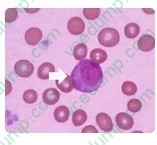
Myelocytes have both primary and secondary granules present in the cytoplasm. The nucleus is less mature and therefore has a loose chromatin clumping pattern. Identify the cell in this illustration indicated by the arrow:
A. Myelocyte
B. Monocyte
C. Metamyelocyte
D. Lymphocyte -
Question 154:
The governmental agency that oversees public health care matters in the United States is:
A. Center for Disease Control and Prevention (CDC)
B. Department of Health and Human Services (DHHS)
C. Food and Drug Administration (FDA)
D. Clinical and Laboratory Standards Institute (CLSI) -
Question 155:
One of the following may cause a laboratory acquired infection (LAI):
A. Needlestick exposure
B. Cut on the employee's hand that is not covered
C. Applying chapstick in the laboratory
D. All of the above -
Question 156:
Thyroid-stimulating immunoglobulins, or TSI's, are IgG antibodies that can bind to thyrotropin (TSH) receptors on the thyroid gland. TSIs mimic the action of TSH, causing excess secretion of thyroxine and triiodothyronine. The TSI level is abnormally high in persons with hyperthyroidism due to Graves' disease. Which of the following is an autoantibody that binds to TSH receptor sites on thyroid cell membranes preventing thyroid-stimulating hormone binding?
A. Antithyroglobulin
B. Antimicrosomal antibodies
C. Thyroid-stimulating immunoglobulins
D. Thyroxin-binding globulins
E. Lupus erythematosus -
Question 157:
Patients with antibody to the following antigen are immune to Hepatitis B:
A. Core antigen
B. Surface antigen
C. antigen
D. Delta antigen -
Question 158:
Failure to deliver glucose drawn in a serum separator tube (SST) to the laboratory within the recommended time will cause: Question options:
A. a falsely decreased glucose value
B. a falsely increased glucose value
C. glycolysis
D. both A and C -
Question 159:
A cardiac risk profile is performed in:
A. hematology.
B. serology.
C. coagulation.
D. chemistry. -
Question 160:
The recommended disinfectant for blood and body fluid contamination is:
A. sodium hydroxide.
B. antimicrobial soap.
C. hydrogen peroxide.
D. sodium hypochlorite.
Related Exams:
Tips on How to Prepare for the Exams
Nowadays, the certification exams become more and more important and required by more and more enterprises when applying for a job. But how to prepare for the exam effectively? How to prepare for the exam in a short time with less efforts? How to get a ideal result and how to find the most reliable resources? Here on Vcedump.com, you will find all the answers. Vcedump.com provide not only ASCP exam questions, answers and explanations but also complete assistance on your exam preparation and certification application. If you are confused on your ASCP-MLT exam preparations and ASCP certification application, do not hesitate to visit our Vcedump.com to find your solutions here.