ASCP-MLT Exam Details
-
Exam Code
:ASCP-MLT -
Exam Name
:MEDICAL LABORATORY TECHNICIAN - MLT(ASCP) -
Certification
:ASCP Certifications -
Vendor
:ASCP -
Total Questions
:572 Q&As -
Last Updated
:Jul 14, 2026
ASCP ASCP-MLT Online Questions & Answers
-
Question 131:
Medical ethics
A. Includes situational ethics
B. has strict guidelines
C. Applies to laboratory professionals and includes situational ethics
D. Applies to laboratory professionals -
Question 132:
The correct answer is Trichophyton rubrum. The tiny microconidia are lined up in a "birds on the fence" arrangement along the hyphal strand transversing the field of view (yellow arrows). Two pencil-shaped, smooth walled macroconidia are
also seen in the lower left field of view (red arrows).
Trichophyton verrucosum may produce microconidia in small quantities. However, they are irregularly arranged with little tendency to line up along the hyphae. Antler hyphae and string bean macroconidia are characteristic of this species.
One of the key characteristics in the identification of Epidermophyton floccosum is the inability of this dermatophyte to produce microconidia. Two to four-celled, club-shaped macroconidia are produced, usually in clusters of two or three.
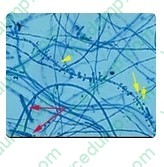
The profusion of tiny microconidia lining up along the hyphae in this photomicrograph is characteristic of which of the following organisms?
A. Epidermophyton floccosum
B. Trichophyton verrucosum
C. Trichophyton rubrum -
Question 133:
Albumin is a "negative" acute phase protein since it is found in decreased levels during acute phase response. Alpha-1-antitrypsin, fibrinogen, and ceruloplasmin are all "positive" acute phase proteins that are found in increased levels during acute phase response.
Which one of the following usually shows a decrease during an acute phase response?
A. Albumin
B. Alpha-1 Antitrypsin
C. Fibrinogen
D. Ceruloplasmin -
Question 134:
This type of laboratory professional is responsible for the technical aspects of managing the operation of the laboratory and is most likely an MLS with additional education in administration:
A. Laboratory Director
B. Laboratory Manager
C. Pathologist
D. Laboratory Technologist -
Question 135:
Valine substitutes for glutamic acid in the Beta 6 position to produce HbS.
To produce hemoglobin S, glutamic acid that is normally present in the sixth position on the beta globin chain is substituted with which of the following?
A. Cystine
B. Guanine
C. Thyamine
D. Valine -
Question 136:
Transport media are required for throat culture swabs but not for rapid strep tests.
A. True
B. False -
Question 137:
Francisella is slow growing on primary isolation culture media and produces poorly-staining coccobacilli on Gram stain. Because Francisella tularensis is included on the list of bioterrorism agents, suspicious isolates should be referred immediately to a public health laboratory in lieu of attempting an in-laboratory identification.
One of the BIGGEST problems with isolating Francisella is that these organisms:
A. produce wide zones of hemolysis
B. grow so slowly
C. overgrow other organisms
D. produce greenish colonies like E. coli -
Question 138:
As maturation continues in the granulocytic series the nucleus of the metamyelocyte becomes kidney or bean shaped. Identify the cell in this illustration indicated by the arrow:
A. Monocyte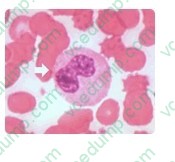
B. Myeloblast
C. Promonocyte
D. Metamyelocyte -
Question 139:
Using the formula on the right,
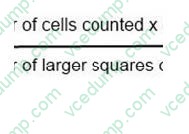
Cells/μL = 370 x 100 / 18 x 0.1 Cells/μL = 37000 / 1.8 Cells/μL = 20556 or 2.06 x 10⁴ A sample of cerebrospinal fluid is diluted 1:100; the standard 9 squares of a hemocytometer are counted on each side for a total of 18 large squares. Side 1-- 186 nucleated cells counted Side 2-- 184 nucleated cells counted total nucleated cells = 370 Using the standard hemocytometer formula shown on the right, what is the nucleated cell count per microliter (μL)?
A. 1.03 x 10^4
B. 2.06 x 10^4
C. 4.62 x 10^4
D. 9.25 x 10^4 -
Question 140:
Howell-Jolly bodies are composed of DNA and appear as small round ball-like inclusions inside the red cells. Usually only one Howell-Jolly body will be present in each red cell.
Single erythrocyte inclusions which are large, round, smooth and purplish-blue staining are most likely:
A. Howell-Jolly bodies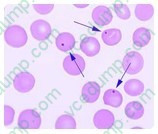
B. Heinz bodies
C. Basophilic stippling
D. Cabot rings
Related Exams:
Tips on How to Prepare for the Exams
Nowadays, the certification exams become more and more important and required by more and more enterprises when applying for a job. But how to prepare for the exam effectively? How to prepare for the exam in a short time with less efforts? How to get a ideal result and how to find the most reliable resources? Here on Vcedump.com, you will find all the answers. Vcedump.com provide not only ASCP exam questions, answers and explanations but also complete assistance on your exam preparation and certification application. If you are confused on your ASCP-MLT exam preparations and ASCP certification application, do not hesitate to visit our Vcedump.com to find your solutions here.