ACLS Exam Details
-
Exam Code
:ACLS -
Exam Name
:Advanced Cardiac Life Support -
Certification
:Test Prep Certifications -
Vendor
:Test Prep -
Total Questions
:301 Q&As -
Last Updated
:May 24, 2026
Test Prep ACLS Online Questions & Answers
-
Question 211:
SIMULATION
A patient complains of nausea, weakness, and shortness of breath. The patient is cool and clammy. BP is 70/50, pulse is 30, respirations 28. The monitor shows the following rhythm. What is the order of treatment?

A. O2, atropine, external pacemaker, dopamine, epinephrine, transvenous pacemaker (The rhythm above is third-degree AV block.)
-
Question 212:
SIMULATION
Identify those questions that are important to ask regarding a patient suffering from exposure to the environment.
A. What is the source of their exposure? What particular environment where they in? Have they experienced any loss of consciousness? What effects are they feeling in their body?
-
Question 213:
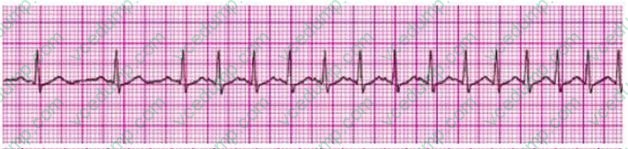
A 45-year-old woman with a history of palpitations develops lightheadedness and palpitations. She has received adenosine 6 mg IV for the rhythm shown above without conversion of the rhythm. She is now extremely apprehensive. Blood pressure is 108/70 mmHg. The next appropriate intervention is
A. Perform vagal maneuvers and repeat adenosine 6 mg IV
B. Perform immediate unsynchronized cardioversion
C. Repeat adenosine 12 mg IV
D. Repeat adenosine 3 mg IV
E. Sedate and perform synchronized cardioversion -
Question 214:
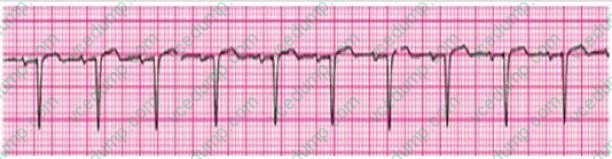
Identify the rhythm by selecting the best single answer:
A. Normal sinus rhythm
B. Sinus tachycardia
C. Sinus bradycardia
D. Reentry supraventricular tachycardia
E. First-degree AV Block
F. Second-degree AV Block (Mobitz 1 Wenckebach)
G. Second-degree AV Block (Mobitz II Block)
H. Third-degree AV Block
I. Atrial fibrillation
J. Atrial flutter -
Question 215:
SIMULATION
Identify the function of veins within the cardiovascular system.
A. Veins are vessels that carry deoxygenated blood back to the heart. The only exception to this is the pulmonary veins, which carry oxygenated blood from the lungs back to the heart.
-
Question 216:
T/F: A poor result after resuscitation is evidence of negligence.
A. False
B. True -
Question 217:
SIMULATION
What local issues may affect consent for treating children and mentally incompetent adults?
A. Emancipation issues and state regulations regarding the age of minors.
-
Question 218:
Traumatic injuries may include all of the following except:
A. cardiac tamponade
B. hyperkalemia
C. shock
D. tension pneumothorax -
Question 219:
A patient with a possible acute coronary syndrome has ongoing chest discomfort unresponsive to 3 sublingual nitroglycerin tablets. There are no contraindications and 4 mg of morphine sulfate was administered. Shortly, blood pressure falls to 88/60 mmHg and the patient complains of increased chest discomfort. You would:
A. Give nitroglycerin 0.4 mg sublingually
B. Give normal saline 250 ml_ to 500 ml_ fluid bolus
C. Start dopamine at 2 ug/kg per minute and titrate to BP 100 mmHg systolic
D. Give an additional 2 mg of morphine sulfate -
Question 220:
T/F: Infectious complications of intravenous cannulas should be prevented by using systemic antibiotics.
A. True
B. False
Related Exams:
-
AACD
American Academy of Cosmetic Dentistry -
ACLS
Advanced Cardiac Life Support -
ASSET
ASSET Short Placement Tests Developed by ACT -
ASSET-TEST
ASSET Short Placement Tests Developed by ACT -
BUSINESS-ENVIRONMENT-AND-CONCEPTS
Certified Public Accountant (Business Environment amd Concepts) -
CBEST-SECTION-1
California Basic Educational Skills Test - Math -
CBEST-SECTION-2
California Basic Educational Skills Test - Reading -
CCE-CCC
Certified Cost Consultant / Cost Engineer (AACE International) -
CGFNS
Commission on Graduates of Foreign Nursing Schools -
CLEP-BUSINESS
CLEP Business: Financial Accounting, Business Law, Information Systems & Computer Applications, Management, Marketing
Tips on How to Prepare for the Exams
Nowadays, the certification exams become more and more important and required by more and more enterprises when applying for a job. But how to prepare for the exam effectively? How to prepare for the exam in a short time with less efforts? How to get a ideal result and how to find the most reliable resources? Here on Vcedump.com, you will find all the answers. Vcedump.com provide not only Test Prep exam questions, answers and explanations but also complete assistance on your exam preparation and certification application. If you are confused on your ACLS exam preparations and Test Prep certification application, do not hesitate to visit our Vcedump.com to find your solutions here.