How should the trigger be positioned on a flow-restricted oxygen-powered ventilation device?
Show answer and explanation
Accepted answer: In such a way that both hands of the EMT can remain on the mask to hold it in position.
ACLS Real Exam Questions
301 questions available · Page 1 of 31
Updated Exam DumpsVerified AnswersPass Guarantee
How should the trigger be positioned on a flow-restricted oxygen-powered ventilation device?
Accepted answer: In such a way that both hands of the EMT can remain on the mask to hold it in position.
T/F: Brain damage, after resuscitation, is evidence of negligence:
Correct answer: B
What is the mechanism of action of adenosine on the heart?
Accepted answer: Depresses sinus node and AV node activity.
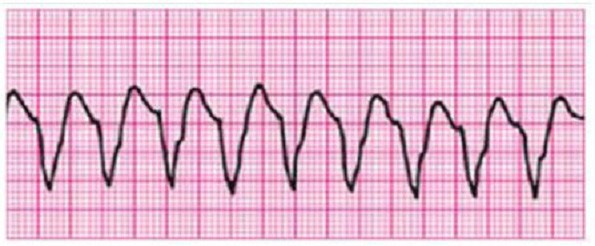
You are monitoring a patient. Chest discomfort has been relieved with sublingual nitrates and morphine sulfate 4 mg IV. He suddenly has the above persistent rhythm. You ask about symptoms and he reports mild palpitations, but otherwise he is clinically stable with unchanged vital signs. Your next action is:
Correct answer: B
T/F: Epinephrine increases peripheral vascular resistance and increases myocardial contractility.
Correct answer: B

A patient with an acute Ml on a 12-lead ECG transmitted by the paramedics has the above findings on a rhythm strip when a monitor is placed in the ED. The patient had resolution of moderate (5/10) chest pain with three doses of sublingual nitroglycerin. Blood pressure is 104/70 mmHg.
Which intervention below is most important, reducing in-hospital and 30-day mortality?
Correct answer: C
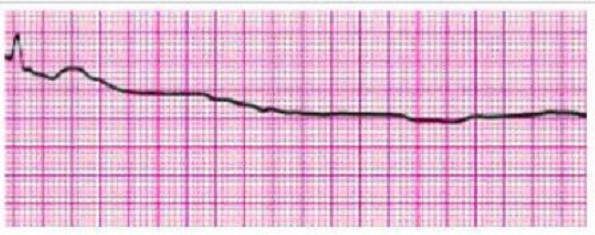
Identify the rhythm by selecting the best single answer:
Correct answer: O
Nitroglycerin:
Correct answer: E
What is the effect of dopamine at intermediate doses (5?
0 mcg/kg/min)?
Accepted answer: Cardiac dose Beta-1 and alpha-adrenergic effect causing enhanced myocardial contractility, increased cardiac output, and a very slight rise in blood pressure.
If while ventilating a patient the chest does not rise and fall, what should you do after checking for obstruction?
Accepted answer: Use alternative method of artificial ventilation, e.g., pocket mask, manually triggered device. If necessary, consider the use of adjuncts such as oral or nasal airways.