AB-100 Exam Details
-
Exam Code
:AB-100 -
Exam Name
:Agentic AI Business Solutions Architect -
Certification
:Microsoft Certifications -
Vendor
:Microsoft -
Total Questions
:136 Q&As -
Last Updated
:Jul 13, 2026
Microsoft AB-100 Online Questions & Answers
-
Question 101:
What should you configure for the custom AI agent?
A. AI-assisted evaluators
B. classic orchestration
C. generative orchestration
D. Azure OpenAI reasoning models -
Question 102:
A company has an AI agent that automates the review of customer feedback stored in a cloud database.
You plan to generate monthly reports from the agent's output to provide insights into customer sentiment and guide product development and marketing.
You need to ensure that the data ingested by the agent is clean and suitable for the intended use.
What should you do to prepare the data?
A. Create a workflow in Microsoft Power Automate.
B. Identify and address biased data.
C. Create an agent flow in Microsoft Copilot Studio.
D. Sort the database by customer last name. -
Question 103:
HOTSPOT
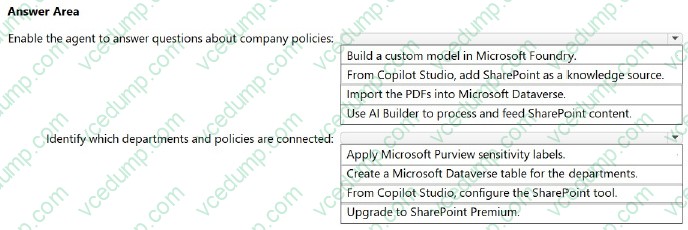
A company has a Microsoft 365 E5 subscription and uses Microsoft Copilot Studio.
The company has a Microsoft SharePoint Online library that contains 10,000 policy PDFs from various departments. The library contains a populated column named Department for each PDF.
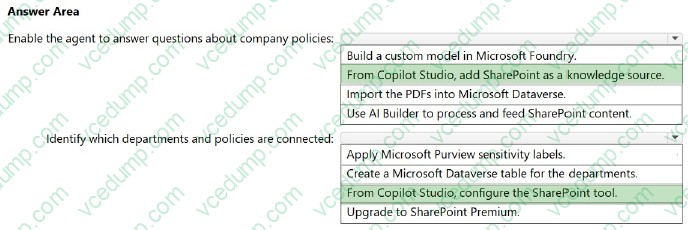
You need to design a Copilot Studio agent that will use the SharePoint library as a knowledge source. The solution must meet the following requirements:
1. Enable the agent to answer user questions about company policies.
2. Ensure that the agent can identify which departments and policies are connected.
What should you include in the design for each requirement? To answer, select the appropriate options in the answer area.
NOTE: Each correct selection is worth one point.
-
Question 104:
A company has Microsoft Copilot Studio agents.
The company plans to deploy custom connectors across development, test and production environments.
You need to design an application lifecycle management (ALM) process to ensure consistency and prevent direct editing in production.
Which two actions should you include in the design? Each correct answer presents part of the solution.
NOTE: Each correct selection is worth one point.
A. Deploy managed solutions to production.
B. Deploy unmanaged solutions to production.
C. Manually rebuild the agents in each environment.
D. Move the agents between the environments by using data export and import.
E. Include agents and connectors in a solution. -
Question 105:
Which template should you use for the AI agent to meet the requirements for the sales executives?
A. IT Helpdesk in Microsoft Copilot Studio
B. AI agents in Microsoft Foundry
C. Voice in Microsoft Copilot Studio
D. AI chat in Microsoft Foundry -
Question 106:
DRAG DROP
A company plans to implement an AI business solution for a consumer goods company.
You need to create agents that meet the following requirements:
1. Orchestrate the sales order fulfillment and shipping of goods to customers.
2. Analyze historical data and trends to replenish stock.
Which type of agent should you use for each requirement? To answer, drag the appropriate agent types to the correct requirements. Each agent type may be used once, more than once, or not at all. You may need to drag the split bar between panes or scroll to view content.
NOTE: Each correct selection is worth one point.
Select and Place:

-
Question 107:
A retrieval-augmented generation solution sometimes produces answers that include details not present in the retrieved context. You need an evaluation metric that measures whether generated responses align with the grounding source and avoid fabricating unsupported content.
Which evaluator should you use?
A. Groundedness
B. Token throughput
C. Escalation rate
D. Cost analysis -
Question 108:
A team needs to build, deploy, and scale a code-first agent that uses models from the Foundry model catalog. The team wants the platform to handle hosting, scaling, identity, observability, and enterprise security so developers can focus on agent logic.
Which service should you recommend?
A. Microsoft Forms
B. Azure Boards
C. Microsoft Foundry Agent Service
D. Microsoft Stream -
Question 109:
A company has a Microsoft Copilot Studio agent that uses custom connectors to interact with enterprise APIs.
You need to recommend an application lifecycle management (ALM) process to ensure that the connectors are deployed consistently across development, test, and production environments and meet governance and traceability requirements.
What should you recommend?
A. Deploy the APIs as Azure Functions.
B. Manage the connectors as solution components and deploy the components by using ALM pipelines.
C. Maintain connector definitions in environment variables.
D. Export and import the connectors between the environments as unmanaged solutions. -
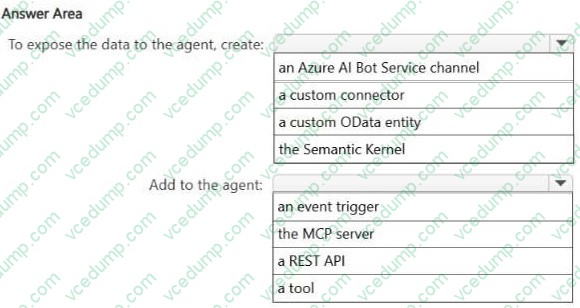
Question 110:
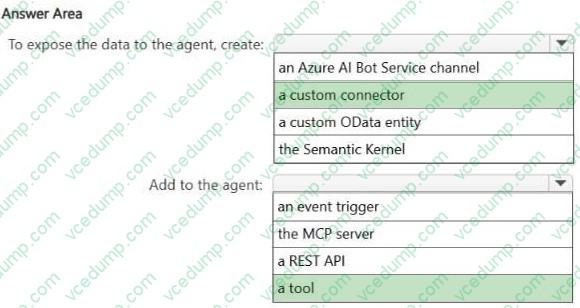
HOTSPOT
What should you include in the custom AI agent design to meet the R&D product specifications and the compliance information requirements? To answer, select the appropriate options in the answer area.
NOTE: Each correct selection is worth one point.

Related Exams:
-
62-193
Technology Literacy for Educators -
70-243
Administering and Deploying System Center 2012 Configuration Manager -
70-355
Universal Windows Platform – App Data, Services, and Coding Patterns -
77-420
Excel 2013 -
77-427
Excel 2013 Expert Part One -
77-725
Word 2016 Core Document Creation, Collaboration and Communication -
77-726
Word 2016 Expert Creating Documents for Effective Communication -
77-727
Excel 2016 Core Data Analysis, Manipulation, and Presentation -
77-728
Excel 2016 Expert: Interpreting Data for Insights -
77-731
Outlook 2016 Core Communication, Collaboration and Email Skills
Tips on How to Prepare for the Exams
Nowadays, the certification exams become more and more important and required by more and more enterprises when applying for a job. But how to prepare for the exam effectively? How to prepare for the exam in a short time with less efforts? How to get a ideal result and how to find the most reliable resources? Here on Vcedump.com, you will find all the answers. Vcedump.com provide not only Microsoft exam questions, answers and explanations but also complete assistance on your exam preparation and certification application. If you are confused on your AB-100 exam preparations and Microsoft certification application, do not hesitate to visit our Vcedump.com to find your solutions here.