AB-100 Real Exam Questions

Agentic AI Business Solutions Architect

136 questions available · Page 1 of 14

Updated Exam DumpsVerified AnswersPass Guarantee

Get Complete Exam Dumps
Question 1 Single choice

A company has an AI business solution.

You need to extend the solution so that Microsoft 365 Copilot can invoke external logic hosted in Azure services.

What should you include in the solution?

  1. A

    Microsoft Copilot Studio skills

  2. B

    Microsoft Power Platform connectors

  3. C

    custom engine agents

Show answer and explanation

Correct answer: B

Explanation

Microsoft Power Platform connectors are the appropriate extension point because Microsoft 365 Copilot and Copilot Studio solutions can use connectors to invoke external business logic. The external logic is already hosted in Azure services, so the solution needs a secure integration surface rather than a new search index or unrelated channel. Connectors also support authentication and reuse across Power Platform assets. In exam scenarios, external API or Azure logic that must be called from a copilot usually maps to a connector or tool.

Question 2 Single choice

A team needs to build, deploy, and scale a code-first agent that uses models from the Foundry model catalog. The team wants the platform to handle hosting, scaling, identity, observability, and enterprise security so developers can focus on agent logic.

Which service should you recommend?

  1. A

    Microsoft Forms

  2. B

    Azure Boards

  3. C

    Microsoft Foundry Agent Service

  4. D

    Microsoft Stream

Show answer and explanation

Correct answer: C

Explanation

Microsoft Foundry Agent Service is the platform for building, deploying, and operating code-first agents with enterprise hosting, identity, observability, and scaling. The team wants to use models from the Foundry model catalog and have the platform handle operational concerns. Copilot Studio is better for low-code agents, while a general app platform would require more custom work. Choose Foundry Agent Service when the agent is code-first and enterprise-operated.

Question 3 Hotspot

HOTSPOT

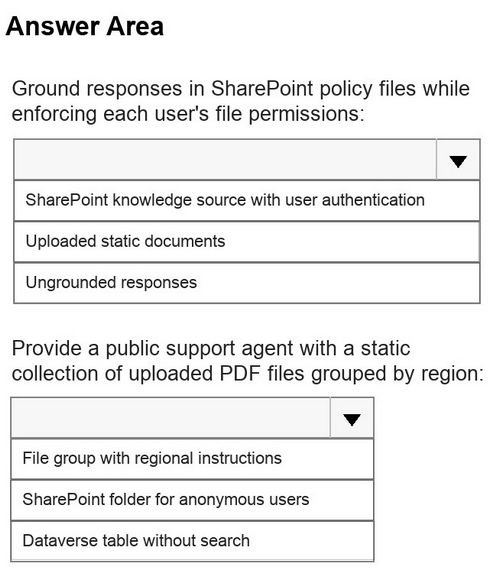
You are designing knowledge grounding for two Copilot Studio agents.

The first agent must answer employee policy questions from SharePoint files and must respect each user's existing file permissions.

The second agent is a public support agent that must answer from a static collection of uploaded PDF files grouped by region.

What should you recommend for each requirement? To answer, select the appropriate options in the answer area.

NOTE: Each correct selection is worth one point.

Question diagram
Show answer and explanation
Correct answer diagram
Explanation

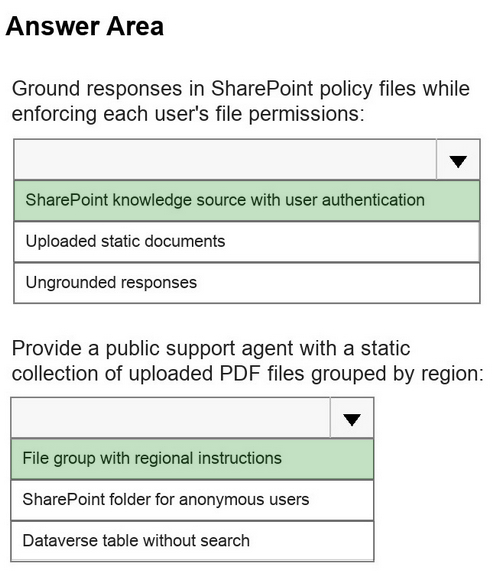
The completed hotspot maps employee policy grounding with file permissions to a SharePoint knowledge source with user authentication and maps public static regional PDFs to a file group with regional instructions. The answer image separates permission-sensitive internal content from public static content.
SharePoint authentication preserves each user's file permissions, while uploaded file groups are simpler for public, static documents that do not need per-user authorization. Choose the grounding source based on both content location and permission behavior.

Case Study 2

Background

Fabrikam, Inc., is a global consumer goods company that is undergoing a digital transformation initiative to migrate its entire infrastructure to the Microsoft Cloud. As a key element of this cloud migration, the company will implement Microsoft Dynamics 365 Sales, moving away from the current on-premises proprietary technologies used by its business-to-business (B2B) sales team.

As part of the cloud migration, Fabrikam will adopt an AI-first approach to its business solutions and implement AI solutions wherever possible to streamline operations.

Problem Statements

Fabrikam's infrastructure currently relies on various on-premises systems that require sales executives to use corporate computers with physical keyboards to access business information during customer interactions. Mobile phones cannot be used for these purposes, as the systems depend on keyboard input.

As a result, the sales executives spend a lot of time using keyboards to search for data across several disparate systems and file servers, rather than focusing on the customers. This affects the customer experience.

Fabrikam stakeholders are concerned that users will be hesitant to adopt AI. If the AI initiatives are NOT adopted, cost savings will never be realized. Additionally, funding for future AI initiatives will depend on demonstrating a month-over-month increase in AI adoption. As the AI agent initiative for the sales team will be the first for Fabrikam, the rapid adoption of the agent is a high priority.

Planned Initiatives

General

Fabrikam management has prioritized AI-driven projects to improve efficiency, customer engagement, and responsible AI adoption. The current application infrastructure is on-premises and must be migrated to the cloud to support the adoption of these technologies.

Infrastructure Migration

Fabrikam plans to migrate from its current on-premises infrastructure to a completely cloud-based topology. This will include user authentication, the security framework, and, primarily, the adoption of the services by end users.

All the data from the different systems will be consolidated into a single data source: a common data model that will use a Microsoft Dataverse environment as a single source of truth (SSOT) for the sales team.

Sales Cycle Enablement

To achieve the company's objectives, Fabrikam intends to implement the following strategies to enhance the sales cycle:

1. Use low-code development to create a single AI agent that has Dataverse as its core component.
2. Ensure that sales managers can access unanswered correspondence from prospects and intervene as appropriate.
3. Replace the previous proprietary software with Dynamics 365 Sales to track sales cycles and customer interactions.
4. Have the sales executives use Dynamics 365 Sales to track interactions for open opportunities and send follow-up communications to prospects.
5. Have the sales executives use hands-free headsets to interact with an AI agent when they have questions about internal policies or customer data.

Requirements

Infrastructure Migration

Fabrikam has identified the following infrastructure migration requirements:

1. Azure must be used for all future infrastructure workloads.
2. The company must follow Microsoft-recommended methodologies for infrastructure migration to the cloud.
3. Any created AI agents must have their return on investment (ROI) calculated to ensure that the solution will save the company money.

Sales Cycle Enablement

Fabrikam has identified the following requirements for sales cycle enablement:

1. The final AI agent must follow Microsoft recommendations for a conversational user experience.
2. A designated checklist must be reviewed to ensure that the AI agent follows Microsoft deployment recommendations for a compliant solution.
3. Detailed telemetry must be logged for the first created AI agent to help troubleshoot and optimize the agent during the initial AI agent adoption process.
4. Unexpected AI agent actions must result in an escalation to a live representative. For example, a sales executive must be routed to a representative if the agent cannot answer a question after two failed attempts.
5. The return on investment (ROI) of switching from the current process to the future process is required for stakeholder sign-off.
6. The sales team must use Dynamics 365 Sales to correspond with prospects more quickly and efficiently than they currently do.
7. Sales managers must report on the adoption of the AI agent to key Fabrikam stakeholders on a monthly basis.
8. Any sensitive information, such as user IDs and names, shared via the AI agent must be tracked for future auditing.
Question 4 Single choice

Which tool should you recommend to help secure funding for future AI agent development?

  1. A

    Evaluations in Microsoft Foundry

  2. B

    the Azure Cost Optimization workbook

  3. C

    Azure Operator Insights

  4. D

    the Analytics tab in Microsoft Copilot Studio

  5. E

    Direct Preference Optimization (DPO)

Show answer and explanation

Correct answer: D

Explanation

The Analytics tab in Microsoft Copilot Studio helps secure funding because it provides measurable evidence about usage, sessions, outcomes, satisfaction, and agent performance. Funding decisions need operational and business impact data, not only infrastructure cost or model evaluation artifacts. Cost workbooks and Foundry evaluations can support parts of a broader review, but the scenario asks for evidence from the deployed agent. For stakeholder funding, use analytics that show adoption, effectiveness, and user outcomes.

Question 5 Single choice

A company has an AI agent that automates the review of customer feedback stored in a cloud database.

You plan to generate monthly reports from the agent's output to provide insights into customer sentiment and guide product development and marketing.

You need to ensure that the data ingested by the agent is clean and suitable for the intended use.

What should you do to prepare the data?

  1. A

    Create a workflow in Microsoft Power Automate.

  2. B

    Identify and address biased data.

  3. C

    Create an agent flow in Microsoft Copilot Studio.

  4. D

    Sort the database by customer last name.

Show answer and explanation

Correct answer: C

Explanation

Creating an agent flow in Copilot Studio is appropriate because the monthly report requires an automated process based on the agent's output. Agent flows can coordinate deterministic actions and backend work that an agent invokes or uses as part of a business process. A prompt alone would not create a reusable reporting process. The key distinction is that generated insights may come from AI, but scheduled or repeatable downstream processing belongs in a flow.

Question 6 Multiple choice

A company has Microsoft 365 Copilot agents.

You need to design a security solution for the agents. The solution must meet the following requirements:

1. Identify and mitigate potential risks that relate to AI use.
2. Protect AI apps and the sensitive data processed or generated by the agents.
3. Support responsible AI governance by retaining and logging interactions, detecting policy violations, and investigating incidents.

Which two components should you include in the design? Each correct answer presents part of the solution.
NOTE: Each correct selection is worth one point.

  1. A

    Microsoft Purview

  2. B

    Azure AI Content Safety

  3. C

    role-based access control (RBAC) in Microsoft Foundry

  4. D

    Microsoft Defender

Show answer and explanation

Correct answers: A, D

Explanation

Microsoft Purview and Microsoft Defender together address governance, compliance, and protection for Microsoft 365 Copilot agents. Purview helps with sensitive data, retention, audit, eDiscovery, and compliance investigation, while Defender helps detect and mitigate security risks and incidents. Content Safety and Foundry RBAC cover narrower controls and do not provide the full Microsoft 365 governance and protection scope requested. Use Purview for data compliance and Defender for threat protection.

Question 7 Hotspot

HOTSPOT

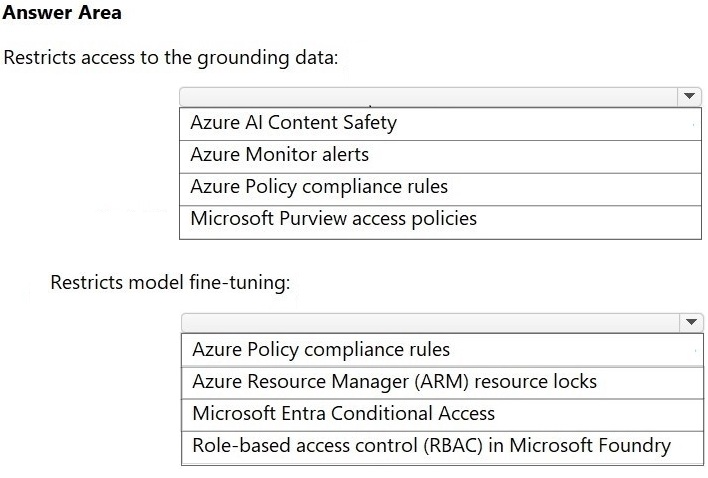
A company uses Azure OpenAI models that use grounding data from Microsoft Fabric for agents. The models are fine-tuned by using proprietary datasets.

You need to design a governance solution that meets the following requirements:

1. Restricts access to the grounding data to only assigned roles
2. Restricts model fine-tuning to only the AI engineering team.

What should you include in the design? To answer, select the appropriate options in the answer area.

NOTE: Each correct selection is worth one point.

Question diagram
Show answer and explanation
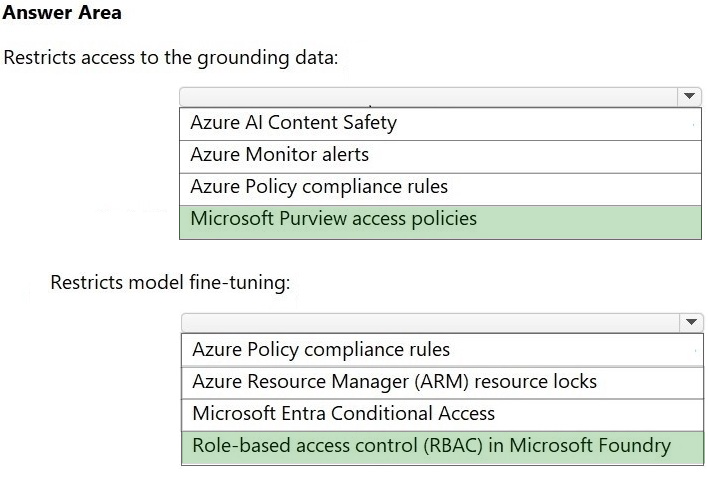
Correct answer diagram
Explanation

The completed hotspot maps grounding-data access restriction to Microsoft Purview access policies and fine-tuning restriction to role-based access control in Microsoft Foundry. The answer image separates data-governance control from model-operation authorization. Purview helps govern access to protected enterprise data, while Foundry RBAC controls who can perform model and project operations such as fine-tuning. Content Safety and Monitor do not restrict access to data or fine-tuning permissions.

Question 8 Hotspot

HOTSPOT

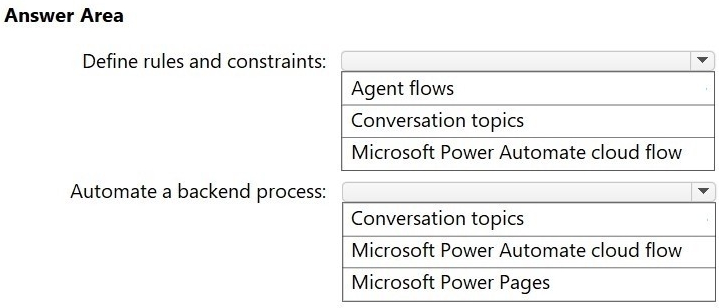
You need to design a multi-agent solution that will include a custom agent. The solution must meet the following requirements:

1. Define the rules and constraints that the agent must follow.

2. Automate a backend process that involves data movement between services and runs independently of the agent's reasoning steps.

What should you include in the design for each requirement? To answer, select the appropriate options in the answer area.

NOTE: Each correct selection is worth one point.

Question diagram
Show answer and explanation
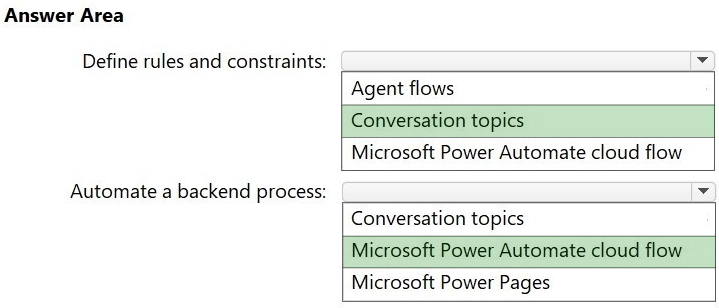
Correct answer diagram
Explanation

The completed hotspot uses conversation topics to define the agent's rules and constraints and a Microsoft Power Automate cloud flow to automate the backend process. The answer image separates conversational design from process automation. Topics control how the agent behaves in the conversation, while cloud flows execute reusable backend work across services. Agent flows may be useful in some designs, but the listed backend automation requirement is best matched to Power Automate.

Case Study 1

Overview

Contoso, Ltd. is a high-tech manufacturing company that uses Microsoft Dynamics 365 Finance. Dynamics 365 Supply Chain Management, and Dynamics 365 Commerce for its North American operations. The company designs and develops innovative products that have many patents and proprietary technologies.
The patents and engineering designs are closely guarded secrets.

Contoso executives want to integrate and adopt AI solutions to help scale the company in preparation for an anticipated period of rapid growth.

The company has multiple legal entities and Azure subscriptions that will be used in the adopted AI solutions.

Requirements

AI Adoption

The following executives will have specific responsibilities in the overall AI adoption:

1. Chief Technology Officer (CTO): Select one Dynamics 365 Finance, Dynamics 365 Supply Chain
Management, or Dynamics 365 Commerce prebuilt AI agent and one custom Microsoft Copilot Studio AI agent to prioritize and deploy during the initial AI adoption phase.
2. Chief Information Officer (CIO): Ensure that appropriate sensitivity labels are assigned to the data used by the AI agents.
3. Chief Financial Officer (CFO): Analyze the return on investment (ROI) for the AI agents being deployed.
4. Chief Information Security Officer (CISO): Discover and inventory AI resources for auditing.
5. Chief Executive Officer (CEO): Ensure that all solutions adhere to industry-standard responsible AI practices.

All AI initiatives and agents will have a detailed business use case, a defined audience profile, and an estimated ROI that compares the cost savings of the current process against the estimated costs of using the new AI solutions.

The company's research and development (R&D) department already has a custom Model Context Protocol (MCP) server that contains comprehensive product specifications and compliance data.

Prebuilt AI Agent

The CTO has NOT yet selected which prebuilt AI agent to use in Dynamics 365 Supply Chain Management. The CTO wants to view available agent templates to identify which agent will add the most business value.

Depending on which high-priority AI agents are identified, the agents' capabilities must be previewed in a discovery meeting with the relevant business operations stakeholders.

Custom AI Agent

Contoso has identified the following custom AI agent requirements:

1. The custom AI agent will be a low-code solution that uses data from Dynamics 365 Supply Chain
Management to answer questions for the manufacturing team.
2. The custom AI agent will be accessible from within Microsoft Teams.
3. The custom AI agent must be designed to eventually connect to other agents that can be selected based on their descriptions.
4. The topics used in the custom AI agent will be selected based NOT on a trigger phrase, but on a description of the purpose of the query, to make the interactions more conversational.
5. The custom AI agent must be able to answer questions about product specifications by using existing technologies. The product specifications are maintained by the R&D department.
6. The custom AI agent must be integrated with and accessible from Dynamics 365 Supply Chain
Management.
7. The custom AI agent must be able to use Dynamics 365 Supply Chain Management business logic that is stored outside the application.

Analysis, Reporting, and Troubleshooting

Contoso has identified the following analysis, reporting, and troubleshooting requirements:

1. The CISO will audit all the AI solutions monthly for compliance and security.
2. The CFO will analyze all the AI solutions quarterly to compare the estimated ROI against actual measured efficiencies and adoption. The CFO will use the Copilot Studio agent usage estimator to perform this analysis.
3. The CISO wants to identify how much sensitive data was accessed for a given AI agent run and who accessed the data. A high volume of sensitive data accessed by a single user might indicate a high security risk.
4. The CTO wants to track user feedback on the quality of AI agent responses during user interactions with the agents. Consistently poor feedback will trigger an escalated reengineering discussion.
5. The CEO wants a quarterly assessment of all the required metrics for the CEO's specific responsibilities. The tools used for the assessments must be Microsoft-recommended and must verify reliability, interpretability, fairness, and compliance.
6. The CFO wants to identify how many sessions with the AI agents are abandoned on a given day compared to resolved sessions. Too many abandoned sessions might indicate that Copilot Credits are being used inefficiently by end users.

Question 9 Multiple choice

Which two components in the custom AI agent design should the CFO evaluate in the quarterly agent analysis? (Choose Two)

  1. A

    the GPT models used for the agent

  2. B

    the average characters in a chat message

  3. C

    the agent orchestration method

  4. D

    the average session time per agent

Show answer and explanation

Correct answers: C, D

Explanation

The CFO is responsible for comparing estimated ROI against actual efficiencies and adoption, and the scenario states that the Copilot Studio agent usage estimator will be used for that analysis. Agent cost and consumption are affected by the agent configuration and usage pattern, so the orchestration method is relevant because classic and generative orchestration change how the agent plans, invokes topics, uses tools, and consumes generative capabilities. Average session time is also relevant because session length is an operational usage pattern that can affect cost efficiency and the comparison between abandoned and resolved work. The GPT model choice is not the best component here because Copilot Studio credit estimation focuses on the agent type, traffic, orchestration, knowledge, tools, and usage assumptions rather than asking the CFO to compare GPT model internals. Average characters in a chat message is too low-level for the quarterly business analysis described in the case.

Question 10 Single choice

You are designing a declarative agent for Microsoft 365 Copilot. The agent must answer from SharePoint content, selected Teams chats, and enterprise data exposed through Copilot connectors when enabled by the administrator.

Which capability should you configure?

  1. A

    Azure Kubernetes Service node pools

  2. B

    Local browser cookies

  3. C

    Windows scheduled tasks

  4. D

    Knowledge sources for the declarative agent

Show answer and explanation

Correct answer: D

Explanation

Knowledge sources for the declarative agent let it answer from SharePoint content, Teams chats where supported, and enterprise data exposed through connectors. The requirement is grounding the agent in approved organizational content rather than creating a separate app database. Permissions remain tied to the connected Microsoft 365 and enterprise content sources. Choose declarative-agent knowledge configuration when the agent must answer from Microsoft 365 and connector content.