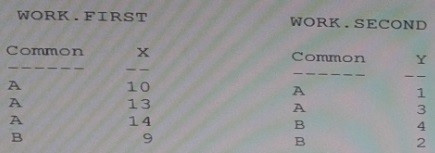
Given the SAS data sets:
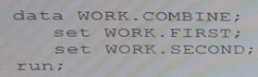
The following SAS program is submitted:
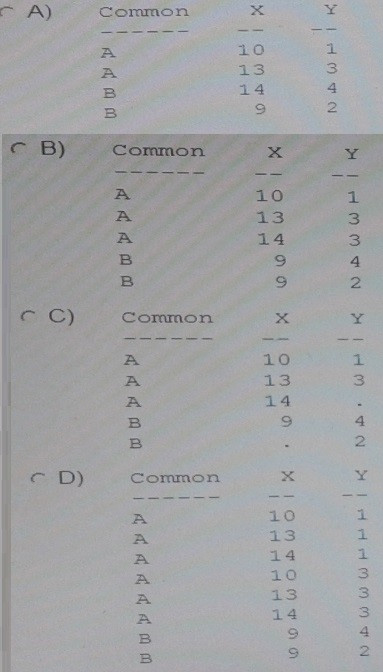
What data values are stored in data set WORK.COMBINE?
Show answer and explanation
Correct answer: A
A00-212 Real Exam Questions
184 questions available · Page 1 of 19
Updated Exam DumpsVerified AnswersPass Guarantee
Given the SAS data sets:
The following SAS program is submitted:
What data values are stored in data set WORK.COMBINE?
Correct answer: A
This question will ask you to provide a segment of missing code.
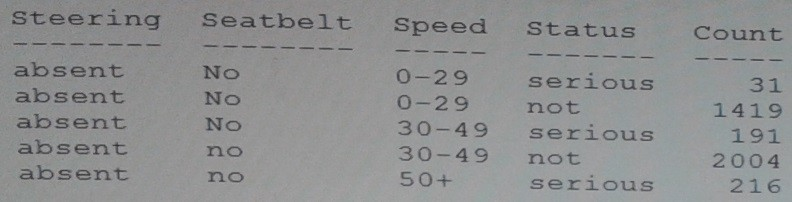
Given the SAS data set SASUSER.HIGHWAY:
The following SAS program is submitted:
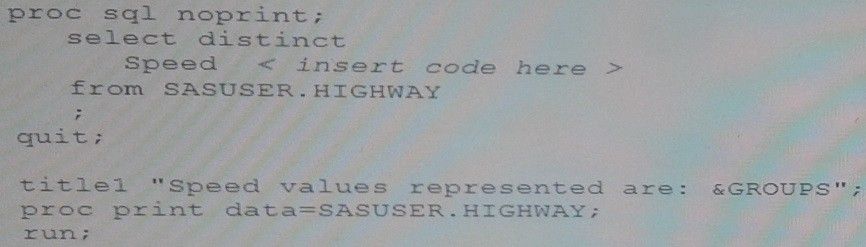
Which SQL clause stores the text 0-29, 30-49, 60+ in the macro variable GROUPS?
Correct answer: A
References:
http://analytics.ncsu.edu/sesug/2006/CC01_06.PDF
(page 2, creating the macro variable)
The SAS data set ONE contains the variables X, Y, Z, and W.
The following SAS program is submitted:
proc transpose data = one
out = trans
name = new;
by x;
var y;
run;
Which one of the following contains all the names of the columns created by the TRANSPOSE procedure?
Correct answer: C
Given the data sets shown on the left, the SAS program shown on the right is submitted.
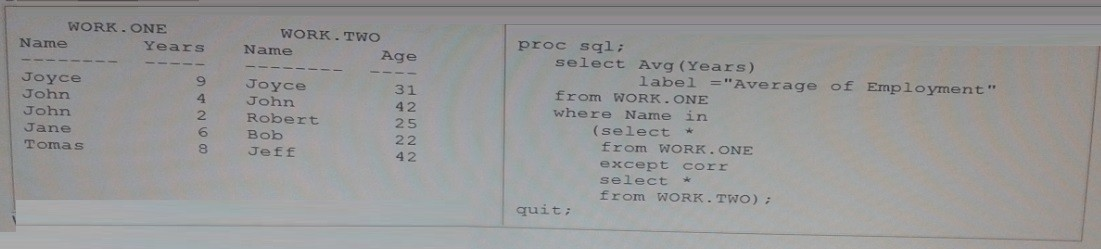
What will be output by the program?
Correct answer: C
This question will ask you to provide a missing reference.
Given the SAS data set SASUSER HIGHWAY:
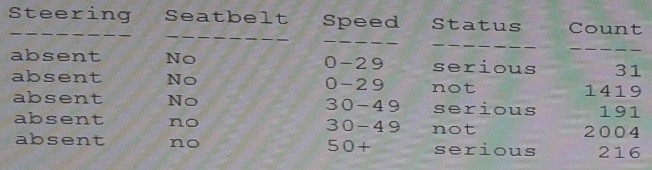
The following SAS program is submitted:
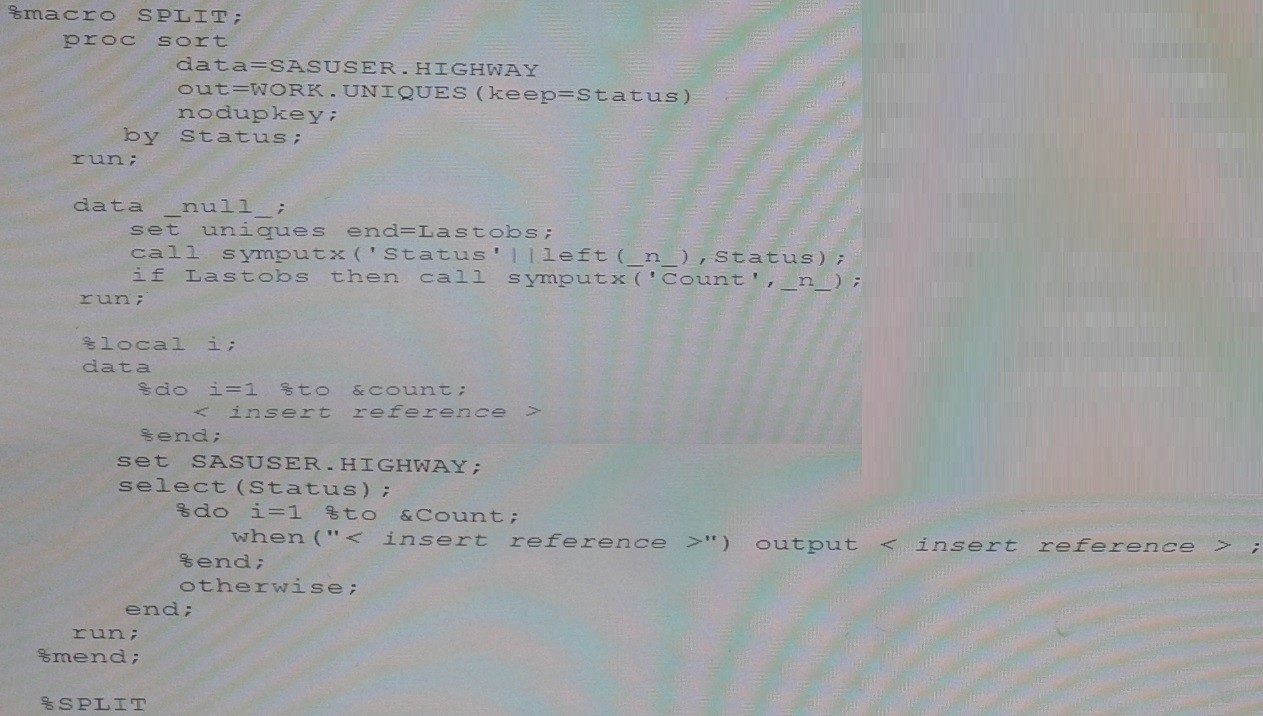
What macro variable reference completes the program to create the WORK.NOT and WORK SERIOUS data sets?
Correct answer: B
Given the following SAS data sets ONE and TWO:
ONE TWO
NUM COUNTRY NUM CITY
1 CANADA 3 BERLIN
2 FRANCE 5 TOKYO
3 GERMANY 4 BELGIUM
5 JAPAN
The following SAS program is submitted:
proc sql;
select country
from one
where not exists
(select *
from two
where one.num = two.num);
quit;
Which one of the following reports is generated?
Correct answer: C
Given the following SAS data set ONE:
ONE
DIVISION SALES
A 1234
A 3654
B 5678
The following SAS program is submitted:
data _null_;
set one;
by division;
if first.division then
call symput('mfirst',sales);
if last.division then
call symput('mlast',sales);
run;
Which one of the following is the value of the macro variable MFIRST when the above program finishes execution?
Correct answer: D
The following SAS program is submitted:
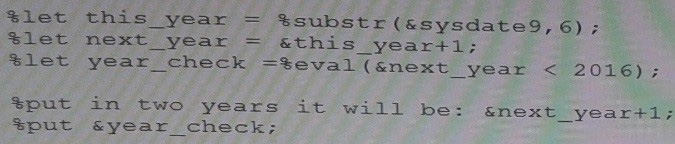
The current system date macro variable is 30JUL2013.
Which output will be written to the log by the program?
Correct answer: D
Given a data set with the following characteristics:
50000 observations
200 character variables
In the text below, enter the compression option that will provide the most compression Case is ignored and
standard SAS syntax rules apply.
Accepted answer: CHAR
The YES or CHAR setting for the COMPRESS= option uses the RLE compression algorithm. RLE compresses observations by reducing repeated consecutive characters (including blanks) to two-byte or three-byte representations. Therefore, RLE is most often useful for character data that contains repeated blanks. The YES or CHAR setting is also good for compressing numeric data in which most of the values are zero
The following SAS program is submitted:
proc sort data = sales tagsort;
by month year;
run;
Which of the following resource(s) is the TAGSORT option reducing?
Correct answer: D