EX300 Exam Details
-
Exam Code
:EX300 -
Exam Name
:Red Hat Certified Engineer (RHCE) -
Certification
:Red Hat Certifications -
Vendor
:Red Hat -
Total Questions
:88 Q&As -
Last Updated
:Jan 22, 2026
Red Hat EX300 Online Questions & Answers
-
Question 1:
SIMULATION
There were two systems: system1, main system on which most of the configuration take place system2, some configuration here
MariaDB Restore a database on serverX from the backup file http://classroom.com/pub/rhce/backup.mdb The database name should be Contacts. It should be access only within the localhost Set a password for root user as "Postroll". Other than the root user, the user Andrew is able to read the query from the above mentioned database. The user should be authenticated with the password as "Postroll".
-
Question 2:
There were two systems: system1, main system on which most of the configuration take place system2, some configuration here
iSCSI Initiator The serverX.example.com provides an iscsi port (3260). Connect the disk with desktopX.example.com and configure filesystem with the following requirements. Create 800 MB partition on iSCSI block device and assign the filesystem as xfs Mount the volume under /mnt/initiator at the system boot time The filesystem should contain the copy of http://station.network0.example.com/pub/iscsi.txt The file should be owned by root with 0644 permission NOTE: the content of the file should not be modified
-
Question 3:
SIMULATION
There were two systems: system1, main system on which most of the configuration take place system2, some configuration here
Configure SCSI storage. Create a new 1 GB target on your serverX.example.com The block device name should be data_block The server should export an iscsi disk called iqn.2014-10.com.example:serverX This target should only be allowed to desktop
-
Question 4:
SIMULATION
There were two systems: system1, main system on which most of the configuration take place system2, some configuration here
Script2. Create a script on serverX called /root/createusers When this script is called with the argument, it should add all the users from the file Download the file from http://station.network0.example.com/pub/testfile All users should have the login shell as /bin/false, password not required When this script is called with any other argument, it should print the message as "Input File Not Found" When this script is run without any argument, it should display "Usage:/root/createusers" NOTE: if the users are added no need to delete
-
Question 5:
SIMULATION
There were two systems:
system1, main system on which most of the configuration take place
system2, some configuration here
Script1.
Create a script on serverX called /root/random with the following details
When run as /root/random postconf, should bring the output as "postroll"
When run as /root/random postroll, should bring the output as "postconf"
When run with any other argument or without argument, should bring any other argument or without argument, should bring the stderr as "/root/random postconf|postroll"
-
Question 6:
SIMULATION
There were two systems: system1, main system on which most of the configuration take place system2, some configuration here
Dynamic Webpage Configuration. Configure website http://wsgiX.example.com:8961 on system1 with the documentroot /var/www/scripts Site should execute webapp.wsgi Page is already provided on http://classroom.example.com/pub/webapp.wsgi Content of the script should not be modified
-
Question 7:
SIMULATION
There were two systems: system1, main system on which most of the configuration take place system2, some configuration here
Virtual hosting. Setup a virtual host with an alternate document root. Extend your web to include a virtual for the site http://vhostsX.example.com Set the document root as /usr/local/vhosts Download http://station.network0.example.com/pub/rhce/vhost/html Rename it as index.html Place this document root of the virtual host Note: the other websites configures for your server must still accessible. vhosts.networkX.example.com is already provided by the name server on example.com
-
Question 8:
SIMULATION
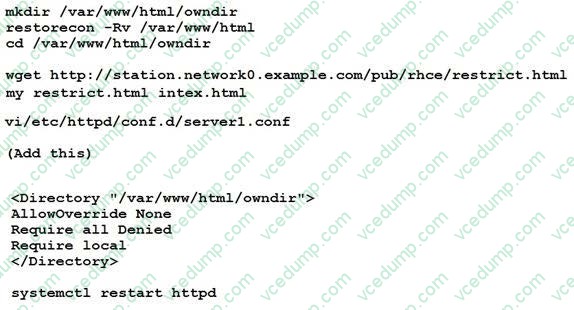
There were two systems: system1, main system on which most of the configuration take place system2, some configuration here Webpage content modification. Implement website for http://serverX.example.com/owndir Create a directory named as "owndir" under the document root of webserver Download http://station.network0.example.com/pub/rhce/restrict.html Rename the file into ondex.html The content of the owndir should be visible to everyone browsing from your local system but should not be accessible from other location
-
Question 9:
SIMULATION
There were two systems: system1, main system on which most of the configuration take place system2, some configuration here
Secured webserver. Configure the website https://serverX.example.com with TLS SSLCertificate file http://classroom.example.com/pub/rhce/tls/certs/system1.networkX.crt SSLCertificatekeyfile http://classroom.example.com/pub/rhce/tls/private/system1.networkX.key SSL CA certificate file http://classroom.example.com/pub/example-ca.crt
-
Question 10:
SIMULATION
There were two systems: system1, main system on which most of the configuration take place system2, some configuration here
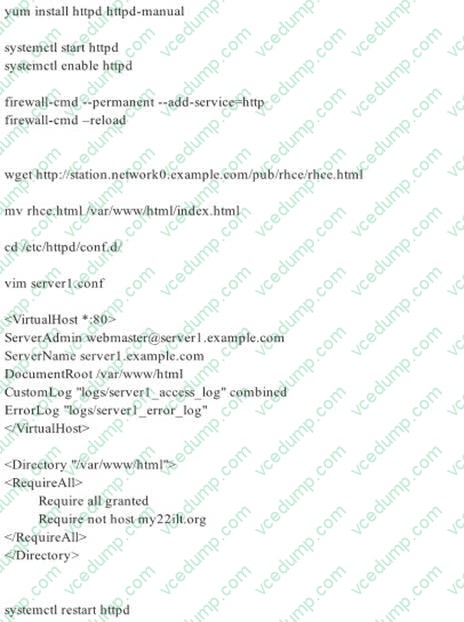
Webserver. Implement a webserver for the site http://serverX.example.com Download the webpage from http://station.network0.example.com/pub/rhce/rhce.html Rename the downloaded file in to index.html Copy the file into the document root Do not make any modification with the content of the index.html Clients within my22ilt.org should NOT access the webserver on your systems


Related Exams:
-
EX200
Red Hat Certified System Administrator (RHCSA) -
EX294
Red Hat Certified Engineer (RHCE) -
EX300
Red Hat Certified Engineer (RHCE) -
EX318
Red Hat Certified Specialist in Virtualization Exam -
EX407
Red Hat Certified Specialist in Ansible Automation -
EX447
Red Hat Certified Specialist in Advanced Automation: Ansible Best Practices -
RH033
Red Hat Linux Essentials -
RH133
Red Hat Linux System Administration -
RH202
Red Hat Certified Technician on Red Hat Enterprise Linux 5 (Labs) -
RH302
Red Hat Certified Engineer on Red Hat Enterprise Linux 5 (Labs)
Tips on How to Prepare for the Exams
Nowadays, the certification exams become more and more important and required by more and more enterprises when applying for a job. But how to prepare for the exam effectively? How to prepare for the exam in a short time with less efforts? How to get a ideal result and how to find the most reliable resources? Here on Vcedump.com, you will find all the answers. Vcedump.com provide not only Red Hat exam questions, answers and explanations but also complete assistance on your exam preparation and certification application. If you are confused on your EX300 exam preparations and Red Hat certification application, do not hesitate to visit our Vcedump.com to find your solutions here.