Avaya 72201X Online Practice
Questions and Exam Preparation
72201X Exam Details
Exam Code
:72201X
Exam Name
:Avaya Aura Core Components Support Certified
Certification
:Avaya Certifications
Vendor
:Avaya
Total Questions
:94 Q&As
Last Updated
:Jan 16, 2026
Avaya 72201X Online Questions &
Answers
Question 1:
When an Avaya SIP Telephone (AST) makes a call to another AST on the same Avaya Aura Communication Manager (CM), which of the following statements is true about the use of SIP trunk?
A. It is used up to the point where calls are shuffled to establish a direct media path. B. It is used just during call establishment and clear down only. C. It is used for the entire duration of the call. D. It is used only when the media path is established. E. It is not used at all.
C. It is used for the entire duration of the call. explanation:
Explanation/Reference:
Question 2:
SIP user 1011111 and SIP user 1011112 are both based on the same Session Manager with access to a CM Evolution server. Given the following actions:
Session Manager searches for the called party in the SIP registry, finds it, registers it and routes the call to it.
SIP user 1011111 calls SIP user 1011112, and an Invite request is sent to Session Manager.
Session Manager verifies SIP user 1011111 in the SIP registry and authenticates it. Session Manager checks the SIP user's profile for sequenced applications and (in this example) routes the request to Communication Manager.
Endpoints negotiate codecs and media, and RTP is sent between endpoints. Communication Manager receives the request from Session Manager, carries out full-call model processing for both endpoints, and routes the call back to Session Manager.
If 1011111 makes a call to 1011112, in which order will the actions take place?
A. 2, 1, 3, 5, 4 B. 2, 3, 5, 1, 4 C. 2, 3, 5, 4, 1 D. 2, 3, 1, 4, 5 E. 1, 2, 3, 5, 4
B. 2, 3, 5, 1, 4
Question 3:
What are two functions performed by System Manager in Avaya Aura
A. It delivers a set of shared management services and a common console. B. It establishes direct media for Direct IP-IP Audio Connections and h.323 two-party calls. C. It provides SIP registration and authentication. D. It enables SIP-SIP two-party calls to use direct media with 'Initial IP-IP Direct Media' enabled. E. It provides centralized management of enterprise-wide dial plans. F. None of the above
A. It delivers a set of shared management services and a common console. E. It provides centralized management of enterprise-wide dial plans. explanation:
Explanation/Reference:
Question 4:
Which three statements describe steps for searching for an Avaya Aura System Manager (SMGR) log containing the phrase 'down'? (Choose three.)
A. Export the entire log file to your local PC, and then locally search with an application. B. Navigate to Home / Services / Events / Logs / Log Viewer, then click on Filter, then Enable, and type 'down' into the Message box, then click on Apply. C. Navigate to Home / Services / Events / Logs / Log Harvester, then click on Harvest logs, then type 'down' into the text contains box, then click on Apply. D. Navigate to Home / Services / Events / Logs / Log Settings, then click on 'text search' and then type 'down' into the text search box, then click on Apply. E. Navigate to Home / Services / Events / Logs / Log Viewer, then click on Filter, then Enable, and type '-m down' into the Message box, then click on Apply. F. Use the Linux command grep -iR "down" /var/log/avaya
A. Export the entire log file to your local PC, and then locally search with an application. B. Navigate to Home / Services / Events / Logs / Log Viewer, then click on Filter, then Enable, and type 'down' into the Message box, then click on Apply. F. Use the Linux command grep -iR "down" /var/log/avaya explanation:
Explanation/Reference:
Question 5:
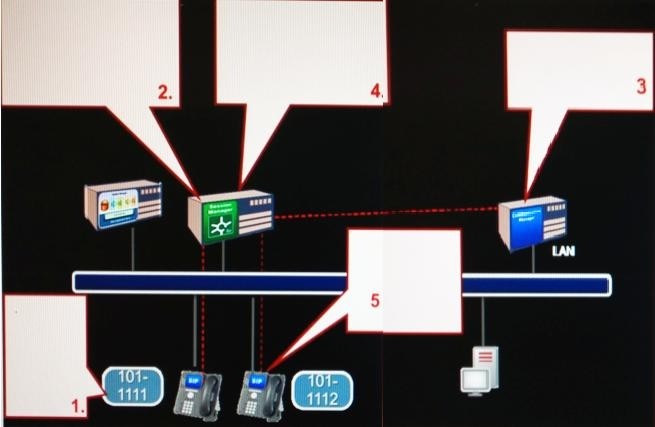
Refer to the Exhibit.
What happens when a call is made from AST 1011111 to AST 1011112? (Choose three.)
A. In step 3, Avaya Aura Communication Manager (CM) sends SIP Options to 1011112 looking for a 200 ok response to check it is reachable. B. In step 2, Avaya Aura Session Manager (SM) matches 1011111 with a Communication Profile, and uses the defined Originating Application Sequence to route the call to Avaya Aura ?Communication Manager. C. In step 1, when 1011111 draws dial tone it sends an Invite to Avaya Aura Session Manager (SM) with the Request URI containing 1011111. D. In step 2, the Avaya Aura Session Manager (SM) uses a dial pattern and routing policy to route the call to Avaya Aura Communication Manager (CM). E. In step 4, Avaya Aura Communication Manager (CM) sets up the media path between the two endpoints. F. In step 5, the call is terminated by either endpoint or by a network failure.
B. In step 2, Avaya Aura Session Manager (SM) matches 1011111 with a Communication Profile, and uses the defined Originating Application Sequence to route the call to Avaya Aura ?Communication Manager. C. In step 1, when 1011111 draws dial tone it sends an Invite to Avaya Aura Session Manager (SM) with the Request URI containing 1011111. E. In step 4, Avaya Aura Communication Manager (CM) sets up the media path between the two endpoints. explanation:
Explanation/Reference:
Question 6:
What information is associated with System manager alarms? (Choose four.)
A. Time Stamp B. Event ID C. Service Affecting Y/N D. Severity E. SIP Domain F. Alarm Description G. Affected Component
A. Time Stamp B. Event ID C. Service Affecting Y/N D. Severity
Question 7:
Which five statements about media-processing resources (DSPs) are true? (Choose five.)
A. Two-party calls originated by SIP stations or trunks, and terminated by H.323 trunks, media gateways, or other vendors' H.323 stations, will typically shuffle if CM is configured to do so. B. Two-party calls originated by H.323 stations, trunks, or media gateways, and terminated by SIP stations or trunks, cannot shuffle. C. SIP-SIP two-party calls will always use SIP Direct Media if Communication Manager (CM) is configured to do so. D. H.323-H.323 two-party calls will always shuffle to establish a direct media path if CM is configured to do so. E. If a direct media path cannot be established between two IP endpoints, the call will fail from release 7.0. F. CM can use DSP resources for features such as conferencing, music-on-hold, and voice messaging. G. SIP-SIP multi-party calls will shuffle to establish a direct media path if CM is configured to do so.
B. Two-party calls originated by H.323 stations, trunks, or media gateways, and terminated by SIP stations or trunks, cannot shuffle. C. SIP-SIP two-party calls will always use SIP Direct Media if Communication Manager (CM) is configured to do so. D. H.323-H.323 two-party calls will always shuffle to establish a direct media path if CM is configured to do so. E. If a direct media path cannot be established between two IP endpoints, the call will fail from release 7.0. F. CM can use DSP resources for features such as conferencing, music-on-hold, and voice messaging. explanation:
Explanation/Reference:
Question 8:
Which three SIP requests are used to allow an AST endpoint to use features provided by an Avaya Aura ?Communication Manager (CM)? (Choose three.)
A. INVITE B. OPTIONS C. REGISTER D. SUBSCRIBE E. NOTIFY F. CANCEL
A customer has just configured Avaya Aura Media Server (AAMS) on their Avaya Aura Communication Manager (CM). They are saying that the AAMS is never being used by CM, but instead is always using the G450 gateways to provide DSP resources. The customer has checked the status of the Media Server and the Signaling Group and both show In-Service. They have also checked that a Media Server License is installed on WebLM, and the status of the Media Server is showing Element Status as being normal. Which statement describes the cause of this problem?
A. The CM license has no CM Media Server VoIP Channels. B. No trunk-group members have been configured. C. The VoIP Channel License Limit has not been set on the media-server CM SAT screen. D. The Dedicated VoIP Channel Licenses has not been set on the media-server CM SAT screen. E. The Media Server is not added as a resource to the call processing entity.
E. The Media Server is not added as a resource to the call processing entity. explanation:
Explanation/Reference:
Question 10:
When viewing Avaya Aura Communication Manager (CM) trusted certificates, you notice that the installed certificates are marked with either A, C, W, or R.
What do these letters stand for?
A. Accepted, Confirmed, Whitelisted, and Rejected B. Accumulated, Compressed, Write, and Read C. Authentication, Authorization, and Accounting Services, Communication Manager, WEB Server, and Remote Logging. D. Authentication, Access, and Accounting Services, Communication Manager, Web Server, and Remote logging. E. Authorized, Certified, Working, and Revoked F. Approved, Checked, Warranted, and Refused
C. Authentication, Authorization, and Accounting Services, Communication Manager, WEB Server, and Remote Logging. explanation:
Nowadays, the certification exams become more and more important and required by more and more
enterprises when applying for a job. But how to prepare for the exam effectively? How to prepare
for the exam in a short time with less efforts? How to get a ideal result and how to find the
most reliable resources? Here on Vcedump.com, you will find all the answers.
Vcedump.com provide not only Avaya exam questions,
answers and explanations but also complete assistance on your exam preparation and certification
application. If you are confused on your 72201X exam preparations
and Avaya certification application, do not hesitate to visit our
Vcedump.com to find your solutions here.