71300X Exam Details
-
Exam Code
:71300X -
Exam Name
:Avaya Aura Communication Applications Integration -
Certification
:Avaya Certifications -
Vendor
:Avaya -
Total Questions
:70 Q&As -
Last Updated
:Jul 15, 2026
Avaya 71300X Online Questions & Answers
-
Question 11:
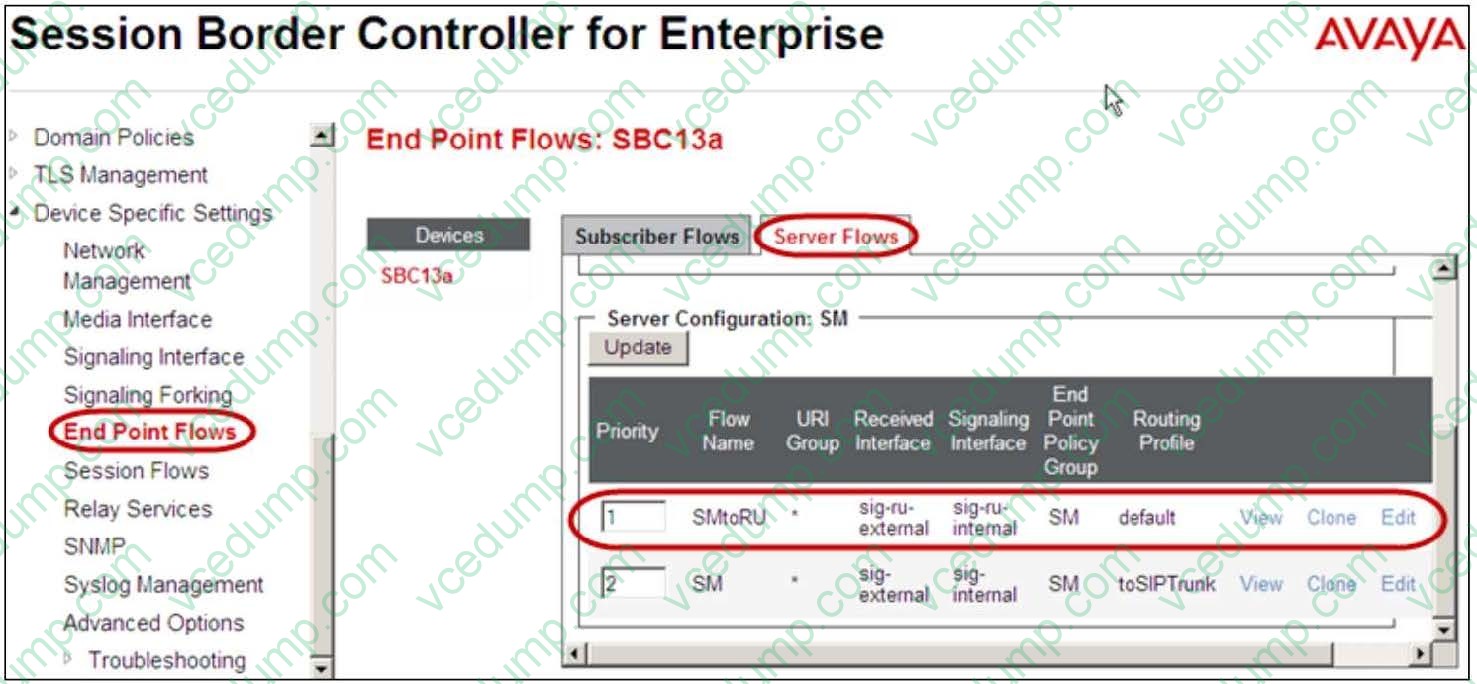
How many Server Flows and/or Subscriber Flows are required for SIP Trunking?
A. one Subscriber Flow and two Server Flows
B. a minimum of two Subscriber Flows
C. one Subscriber Flow and one Server Flow
D. a minimum of two Server Flows -
Question 12:
A field engineer runs the Installation Wizard to install the Avaya Session Border Controller for Enterprise (SBCE). Which statement about the Domain Name Service (DNS) configuration is true?
A. A DNS address always needs to be configured for both the Primary and Secondary DNS, even if only the DNS is available.
B. A DNS address does not need to be configured.
C. A DNS address needs to be configured, even if it is unused and/or unreachable.
D. A DNS address should not be configured here. -
Question 13:
You are creating a SIP Entity for Avaya Aura Engagement Development Platform EDP / Avaya BreezeTM. What do you have to enter in the field labeled FQDN or IP Address?
A. the Management IP-Address or FQDN of the Avaya BreezeTM platform.
B. the SM100 IP-address or FQDN of the Avaya BreezeTM platform
C. the IP-Address or FQDN of Core Platform Cluster
D. the IP-Address or FQDN of general Purpose Cluster -
Question 14:
To which other component does the Avaya Aura Application Enablement Services (AES) Switch Connections connect?
A. Avaya Aura Media Server (AAMS) using H.323
B. Avaya Aura Session Manager (SM) using SIP
C. Avaya Aura Communications Manager (CM) using H.323
D. Avaya Aura Communications Manager (CM) using SIP -
Question 15:
The Avaya WebRTC solution uses the web intensively to make media calls from a standard web browser in the internet, into internal and secure communication premises in the enterprise. Which statement about security between the Enterprise-edge and those standard Web browsers in the internet is true?
A. A trust relationship based on certificates must be built to make WebRTC work.
B. No trust relationship exists between enterprise edge security and web browsers; therefore, the security strategy is based on an Authorization Token instead.
C. There must be a VPN connection between the Web Browser and the Enterprise-edge to build a WebRTC link.
D. WebRTC only works within the Enterprise network. External Web Browsers must connect through an Avaya Session Border Controller for Enterprise (SBCE) via a SIP trunk. -
Question 16:
You are starting the process to create a server certificate so it can be installed in the Avaya Session Border Controller (SBC). What must be done before creating a server certificate for SBC?
A. Generate a Certificate Signing Request (CSR) in SBC.
B. Run initTM -d from SBC CLI.
C. Add End Entity in Session Manager.
D. Download a CA PEM file from System Manager. -
Question 17:
In which two locations is the Switch Password configured?
A. In `ip-services' form on Avaya Aura Communication Manager (CM) and in `TSAPI link' on Avaya Aura Application Enablement Services (AES)
B. In `ip-services' form on Avaya Aura Communication Manager (CM) and in `Switch Connection' on Avaya Aura Application Enablement Services (AES)
C. In `cti-link' form on Avaya Aura Communication Manager (CM) and in `Switch Connection' on Avaya Aura Application Enablement Services (AES)
D. In `cti-link' form on Avaya Aura Communication Manager (CM) and in `TSAPI link' on Avaya Aura Application Enablement Services (AES) -
Question 18:
To allow trust between Avaya Aura System Manager (SMGR) and Avaya Aura Messaging (AAM), there is a password set when you add the Trusted Server on AAM. This password must match with the password also configured in SMGR. Which statement about the password in SMGR is true?
A. It needs to match the Enrollment Password.
B. It needs to match the admin password used to login to SMGR using a web browser.
C. It needs to match the Attributes of the Messaging Managed Element in the Inventory.
D. It needs to match the root password used to login to SMGR command line. -
Question 19:
On Avaya Session Border Controller for Enterprise (SBCE), which statement about how to examine messages with Wireshark is true?
A. You have to start and stop the .pcap file using command line.
B. You can start and stop a Packet Capture in the EMS web GUI and then you can open the .pcap file with Wireshark.
C. Wireshark runs directly on Avaya Session Border Controller for Enterprise (SBCE).
D. They cannot be examined on this version. -
Question 20:
For an Avaya SIP telephone, working as a Remote Worker via the Avaya Session Border Controller for Enterprise (SBCE), which IP address should be configured in the Server List of the one-X?Communicator?
A. the SBCE Internal Interface allocated for Mobile Workspace Endpoint
B. the SBCE External Interface allocated for Mobile Workspace Endpoint
C. the Internal Avaya Aura Session Manager SM100 IP Address
D. the Avaya Aura Session Manager External Interface allocated for Mobile Workspace Endpoints.
Related Exams:
-
3002
Avaya IP Office™ Platform Configuration and Maintenance Exam -
3100
Avaya Aura Contact Recording and Avaya Aura Quality Monitoring Implementation Exam -
3101
Avaya Aura® Communication Manager and CM Messaging - Embedded Maintenance and Troubleshooting Exam -
3102
Avaya IP Office Implementation -
3104
Avaya one-X UC Soft Clients Implementation and Maintenance -
3107
Avaya Session Border Controller Enterprise Implementation and Maintenance -
3108
Avaya Scopia® Solution Implementation and Maintenance Exam -
31860X
Avaya IX Calling Design -
3202
Avaya Aura® Conferencing (R7.x) Implementation and Maintenance -
3203
Avaya Aura Messaging Implementation and Maintenance Exam
Tips on How to Prepare for the Exams
Nowadays, the certification exams become more and more important and required by more and more enterprises when applying for a job. But how to prepare for the exam effectively? How to prepare for the exam in a short time with less efforts? How to get a ideal result and how to find the most reliable resources? Here on Vcedump.com, you will find all the answers. Vcedump.com provide not only Avaya exam questions, answers and explanations but also complete assistance on your exam preparation and certification application. If you are confused on your 71300X exam preparations and Avaya certification application, do not hesitate to visit our Vcedump.com to find your solutions here.