70-762 Exam Details
-
Exam Code
:70-762 -
Exam Name
:Developing SQL Databases -
Certification
:Microsoft Certifications -
Vendor
:Microsoft -
Total Questions
:182 Q&As -
Last Updated
:Jan 29, 2022
Microsoft 70-762 Online Questions & Answers
-
Question 31:
Note: This question is part of a series of questions that present the same scenario. Each question in the series contains a unique solution. Determine whether the solution meets the stated goals.
You need to create a stored procedure that updates the Customer, CustomerInfo, OrderHeader, and OrderDetails tables in order.
You need to ensure that the stored procedure:
Runs within a single transaction.
Commits updates to the Customer and CustomerInfo tables regardless of the status of updates to the OrderHeader and OrderDetail tables.
Commits changes to all four tables when updates to all four tables are successful.
Solution: You create a stored procedure that includes the following Transact-SQL segment:
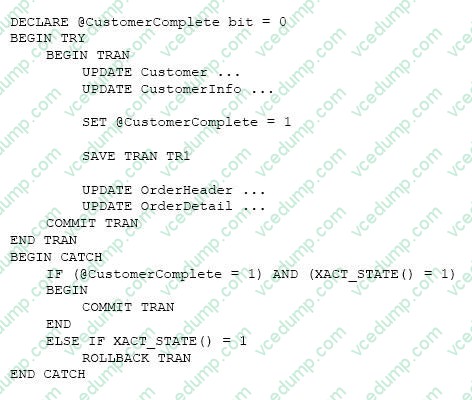
Does the solution meet the goal?
A. Yes
B. No -
Question 32:
Note: This question is part of a series of questions that use the same scenario. For your convenience, the scenario is repeated in each question. Each question presents a different goal and answer choices, but the text of the scenario is exactly the same in each question in the series.
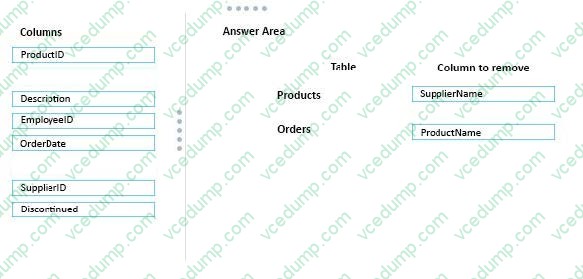
You have a database named Sales that contains the following database tables. Customer, Order, and Products. The Products table and the order table shown in the following diagram.
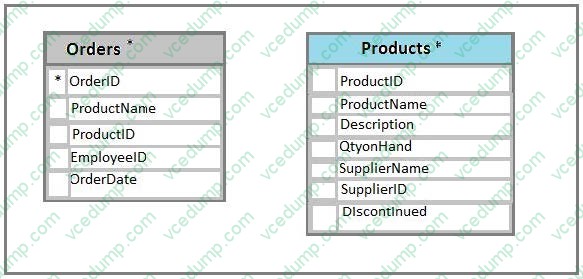
The Customer table includes a column that stores the date for the last order that the customer placed.
You plan to create a table named Leads. The Leads table is expected to contain approximately 20,000 records. Storage requirements for the Leads table must be minimized.
You need to begin to modify the table design to adhere to third normal form.
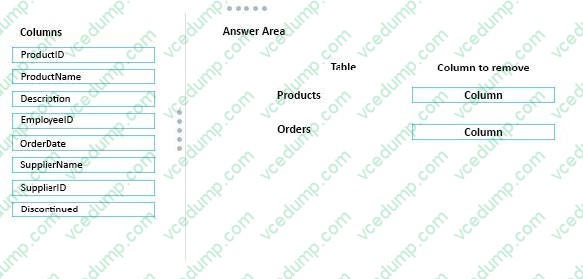
Which column should you remove for each table? To answer? drag the appropriate column names to the correct locations. Each column name may be used once, more than once, or not at all. You may need to drag the split bar between
panes or scroll to view content.
Select and Place:
-
Question 33:
You create a database table named FactSales by running the following Transact-SQL statements:
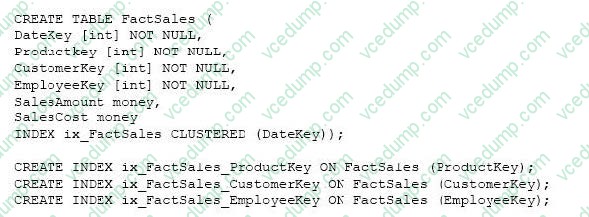
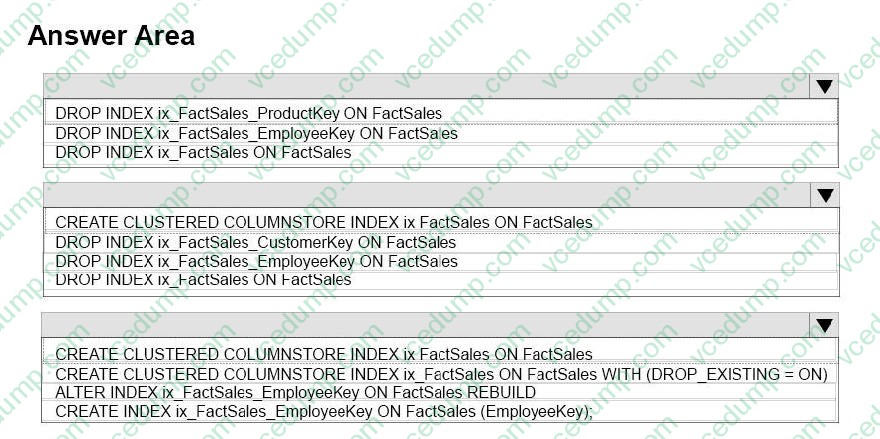
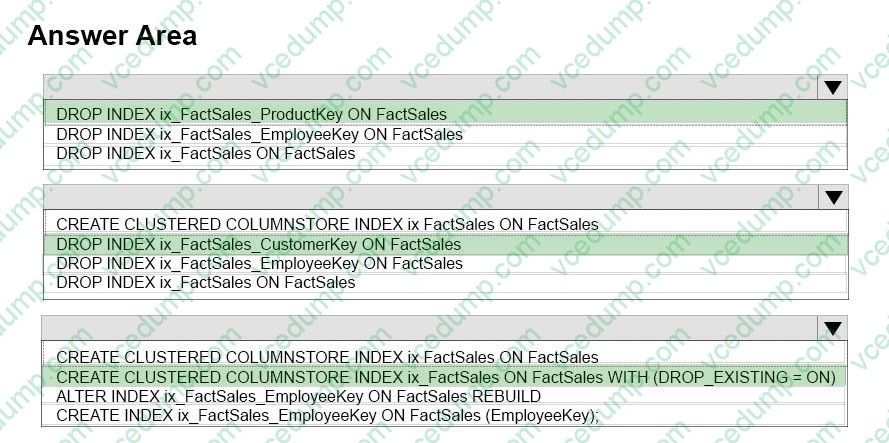
You must optimize the indexes without making changes to the ix_FactSales_EmployeeKey index.
You need to implement a columnstore index for the table.
How should you complete the Transact-SQL code? To answer, select the appropriate Transact-SQL segments in the answer area.
NOTE: Each correct selection is worth one point.
Hot Area:
-
Question 34:
HOTSPOT
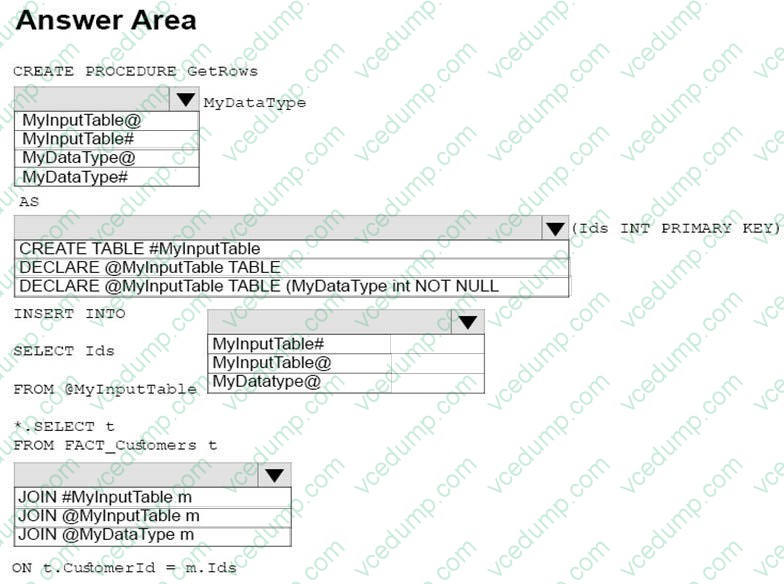
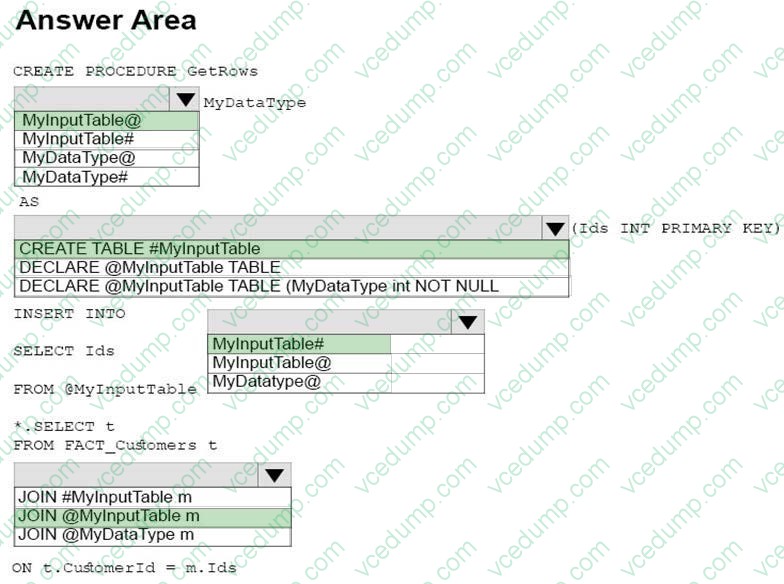
You plan to create a stored procedure that uses a table parameter as an input parameter. The table value parameter may hold between 1 and 10,000 rows when you run the stored procedure.
The stored procedure will use the rows within the table value parameter to filter the rows that will be returned by the SELECT statement.
You need to create the stored procedure and ensure that it runs as quickly as possible.
How should you complete the procedure? To answer, select the appropriate Transact-SQL segments in the answer area.
NOTE: Each correct answer selection is worth one point.
Hot Area:
-
Question 35:
Note: This question is part of a series of questions that present the same scenario. Each question in the series contains a unique solution. Determine whether the solution meets the stated goals. You have a table that has a clustered index and a nonclustered index. The indexes use different columns from the table. You have a query named Query1 that uses the nonclustered index.
Users report that Query1 takes a long time to report results. You run Query1 and review the following statistics for an index seek operation:
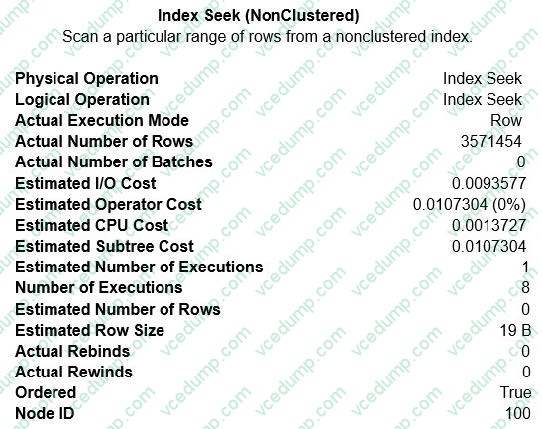
You need to resolve the performance issue.
Solution: You update statistics for the nonclustered index.
Does the solution meet the goal?
A. Yes
B. No -
Question 36:
HOTSPOT
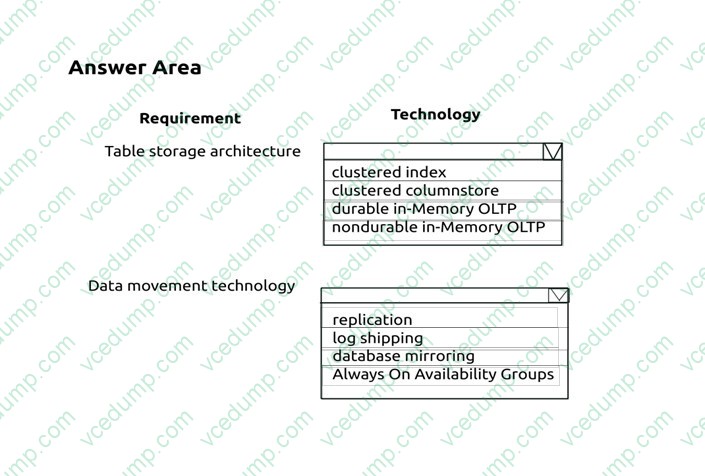
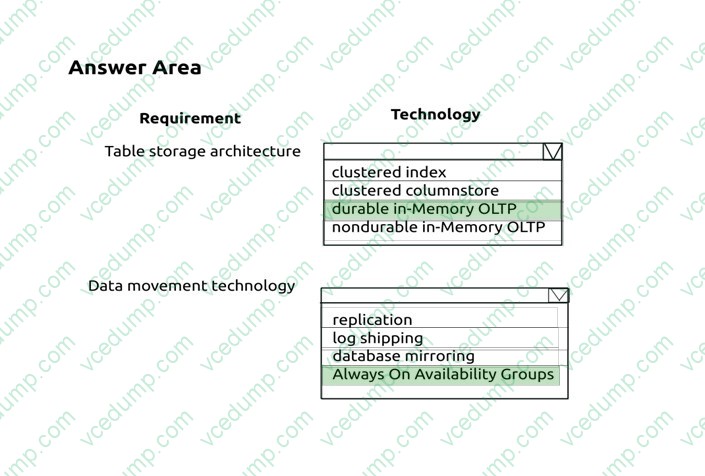
You are designing a data warehouse that will be clustered across four servers. Several of the tables in the data warehouse contain transient data that you can rebuild as needed.
The schema for the data changes periodically. You must minimize the work required to make schema changes and deploy those changes across the server farm. Administrators must be able to make the following schema changes:
Adding columns to tables
Removing columns from tables Adding tables Removing tables
Changes to the transient data are done as singleton operations. You must make the data available on all the servers in the server farm. Data movement between servers must occur in real time or near real time.
You must be able to run SELECT statements against the data from any server at any time.
You need to configure the environment.
Which technologies should you implement? To answer, select the appropriate technologies in the answer area.
NOTE: Each correct selection is worth one point.
Hot Area:
-
Question 37:
You have a nonpartitioned table that has a single dimension. The table is named dim.Products.Projections.
The table is queried frequently by several line-of-business applications. The data is updated frequently throughout the day by two processes.
Users report that when they query data from dim.Products.Projections, the responses are slower than expected. The issue occurs when a large number of rows are being updated.
You need to prevent the updates from slowing down the queries.
What should you do?
A. Use the NOLOCK option.
B. Execute the DBCC UPDATEUSAGE statement.
C. Use the max worker threads option.
D. Use a table-valued parameter.
E. Set SET ALLOW_SNAPSHOT_ISOLATION to ON. -
Question 38:
HOTSPOT
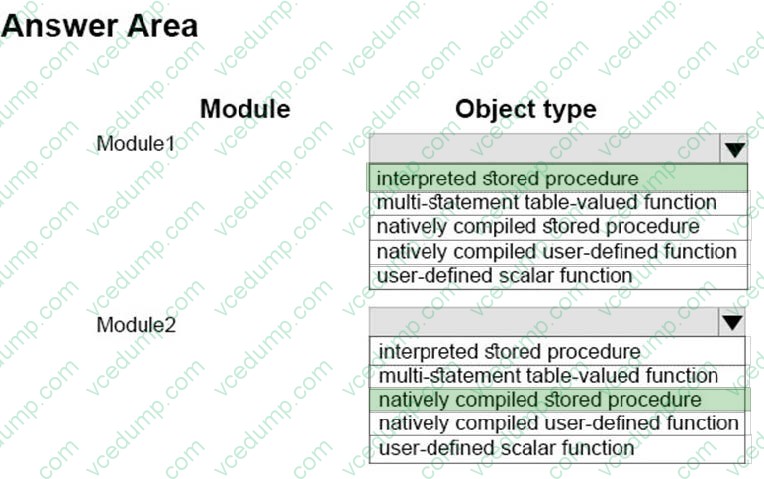
You have a database that contains both disk-based and memory-optimized tables.
You need to create two modules. The modules must meet the requirements described in the following table.
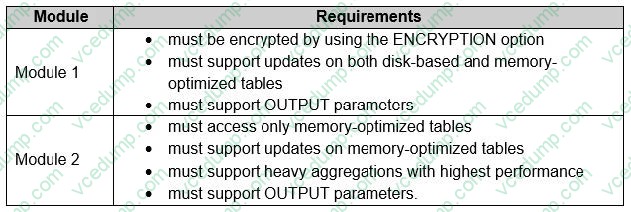
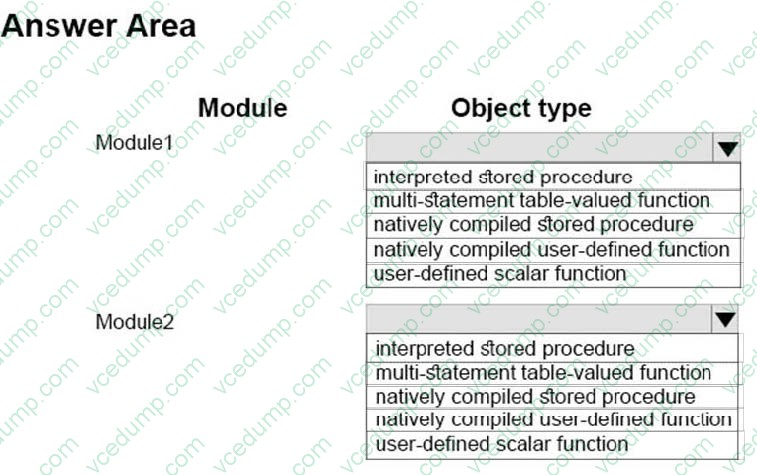
Which programming object should you use for each module? To answer, select the appropriate object types in the answer area.
Hot Area:
-
Question 39:
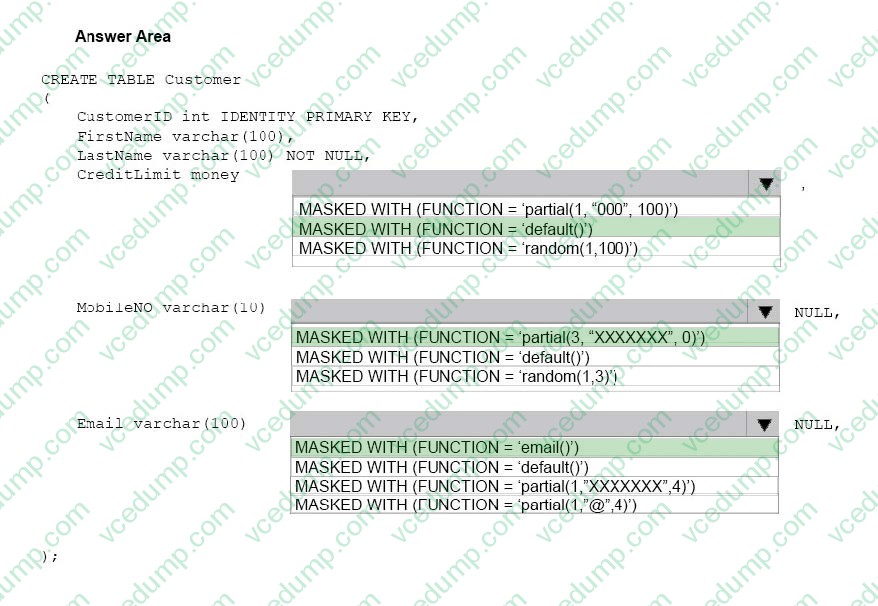
You have a database named Sales.
You need to create a table named Customer that includes the columns described in the following table:
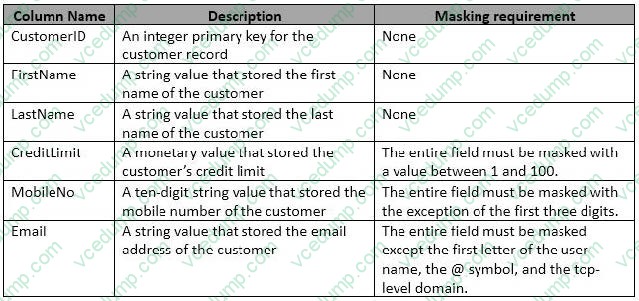
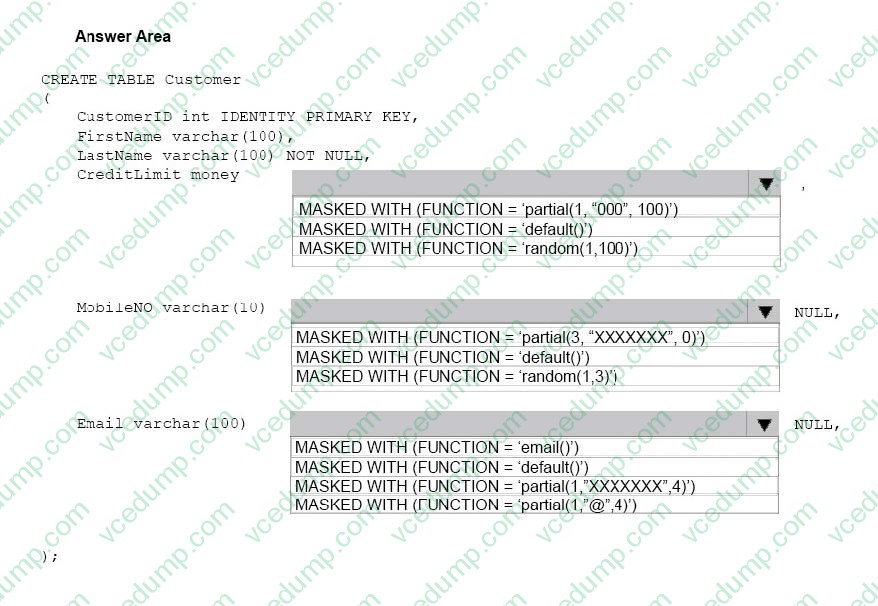
How should you complete the Transact SQL statement? To answer, select the appropriate Transact-SQL segments in the answer area.
Hot Area:
-
Question 40:
You are developing an application that connects to a database. The application runs the following jobs:
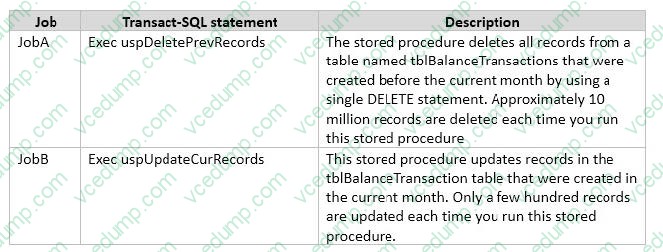
The READ_COMMITTED_SNAPSHOT database option is set to OFF, and auto-content is set to ON. Within the stored procedures, no explicit transactions are defined.
If JobB starts before JobA, it can finish in seconds. If JobA starts first, JobB takes a long time to complete.
You need to use Microsoft SQL Server Profiler to determine whether the blocking that you observe in JobB is caused by locks acquired by JobA.
Which trace event class in the Locks event category should you use?
A. LockAcquired
B. LockCancel
C. LockDeadlock
D. LockEscalation
Related Exams:
-
62-193
Technology Literacy for Educators -
70-243
Administering and Deploying System Center 2012 Configuration Manager -
70-355
Universal Windows Platform – App Data, Services, and Coding Patterns -
77-420
Excel 2013 -
77-427
Excel 2013 Expert Part One -
77-725
Word 2016 Core Document Creation, Collaboration and Communication -
77-726
Word 2016 Expert Creating Documents for Effective Communication -
77-727
Excel 2016 Core Data Analysis, Manipulation, and Presentation -
77-728
Excel 2016 Expert: Interpreting Data for Insights -
77-731
Outlook 2016 Core Communication, Collaboration and Email Skills
Tips on How to Prepare for the Exams
Nowadays, the certification exams become more and more important and required by more and more enterprises when applying for a job. But how to prepare for the exam effectively? How to prepare for the exam in a short time with less efforts? How to get a ideal result and how to find the most reliable resources? Here on Vcedump.com, you will find all the answers. Vcedump.com provide not only Microsoft exam questions, answers and explanations but also complete assistance on your exam preparation and certification application. If you are confused on your 70-762 exam preparations and Microsoft certification application, do not hesitate to visit our Vcedump.com to find your solutions here.