70-762 Exam Details
-
Exam Code
:70-762 -
Exam Name
:Developing SQL Databases -
Certification
:Microsoft Certifications -
Vendor
:Microsoft -
Total Questions
:182 Q&As -
Last Updated
:Jan 29, 2022
Microsoft 70-762 Online Questions & Answers
-
Question 151:
Note: This question is part of a series of questions that use the same answer choices. An answer choice may be correct for more than one question on the series. Each question is independent of the other questions in this series. Information
and details provided in a question apply only to that question.
You work on an OLTP database that has no memory-optimized file group defined.
You have a table names tblTransaction that is persisted on disk and contains the information described in the following table:
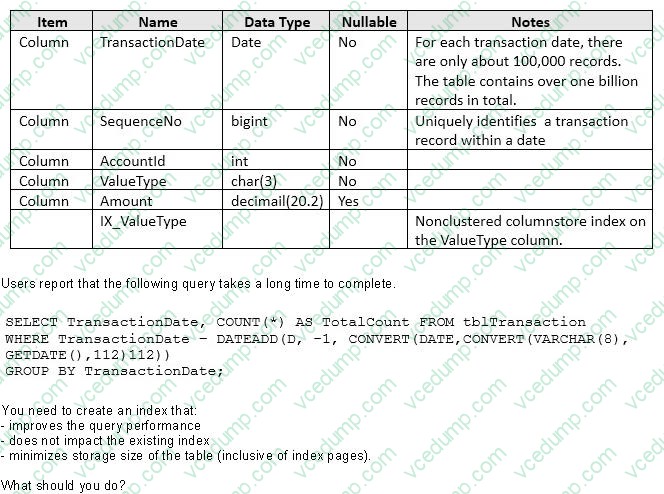
Users report that the following query takes a long time to complete.

You need to create an index that:
-improves the query performance
-does not impact the existing index
- minimizes storage size of the table (inclusive of index pages).
What should you do?
A. Create aclustered index on the table.
B. Create a nonclustered index on the table.
C. Create a nonclustered filtered index on the table.
D. Create a clustered columnstore index on the table.
E. Create a nonclustered columnstore index on the table.
F. Create a hashindex on the table. -
Question 152:
Note: This question is part of a series of questions that present the same scenario. Each question in this series contains a unique solution. Determine whether the solution meets the stated goals.
Your company has employees in different regions around the world. You need to create a database table that stores the following employee attendance information: Employee ID date and time employee checked in to work date and time employee checked out of work
Date and time information must be time zone aware and must not store fractional seconds.
Solution: You run the following Transact-SQL statement:

Does the solution meet the goal?
A. Yes
B. No -
Question 153:
Note: This question is part of a series of questions that present the same scenario. Each question in the series contains a unique solution. Determine whether the solution meets the stated goals.
You have a database that contains a table named Employees. The table stores information about the employees of your company.
You need to implement and enforce the following business rules:
Limit the values that are accepted by the Salary column.
Prevent salaries less than $15,000 and greater than $300,000 from being entered.
Determine valid values by using logical expressions.
Do not validate data integrity when running DELETE statements.
Solution: You implement a foreign key on the table.
Does the solution meet the goal?
A. Yes
B. No -
Question 154:
You have a data warehouse fact table that has a clustered columnstore index.
You have multiple CSV files that contain a total of 3 million rows of data.
You need to upload the data to the fact table. The solution must avoid the delta group when you import the data.
Which solution will achieve the goal in the least amount of time?
A. Load the source data to a staging table. Load the data to the fact table by using the INSERT_SELECT statement and specify the TABLOCK option on the staging table
B. Create a Microsoft SQL Server Integration Services (SSIS) package. Use multiple data flow tasks to load the data in parallel.
C. Load the source data to the fact table by running bcp.exe and specify the
D. Load the source data to the fact table by using the BULK INSERT statement and specify the TABLOCK option -
Question 155:
Note: The question is part of a series of questions that use the same or similar answer choices. An answer choice may be correct for more than one question in the series. Each question is independent of the other question in the series. Information and details provided in a question apply only to that question.
You have a database named DB1. The database does not use a memory-optimized filegroup. The database contains a table named Table1. The table must support the following workloads: You need to add the most efficient index to support the new OLTP workload, while not deteriorating the existing Reporting query performance. What should you do?
A. Create a clustered index on the table.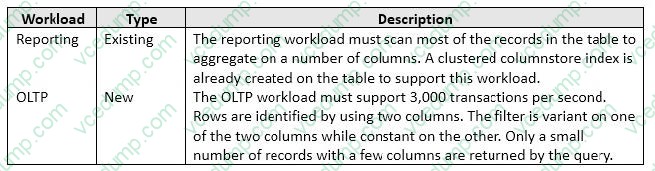
B. Create a nonclustered index on the table.
C. Create a nonclustered filtered index on the table.
D. Create a clustered columnstore index on the table.
E. Create a nonclustered columnstore index on the table.
F. Create a hash index on the table. -
Question 156:
Note: This question is part of a series of questions that present the same scenario. Each question in this series contains a unique solution. Determine whether the solution meets the stated goals. The Account table was created using the following Transact-SQL statement:
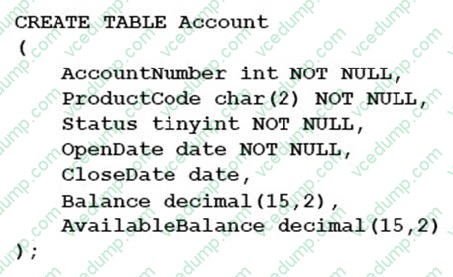
There are more than 1 billion records in the Account table. The Account Number column uniquely identifies each account. The ProductCode column has 100 different values. The values are evenly distributed in the table. Table statistics are refreshed and up to date.
You frequently run the following Transact-SQL SELECT statements:

You must avoid table scans when you run the queries. You need to create one or more indexes for the table. Solution: You run the following Transact-SQL statement:

Does the solution meet the goal?
A. Yes
B. No -
Question 157:
You have a database that contains both disk-based and memory-optimized tables.
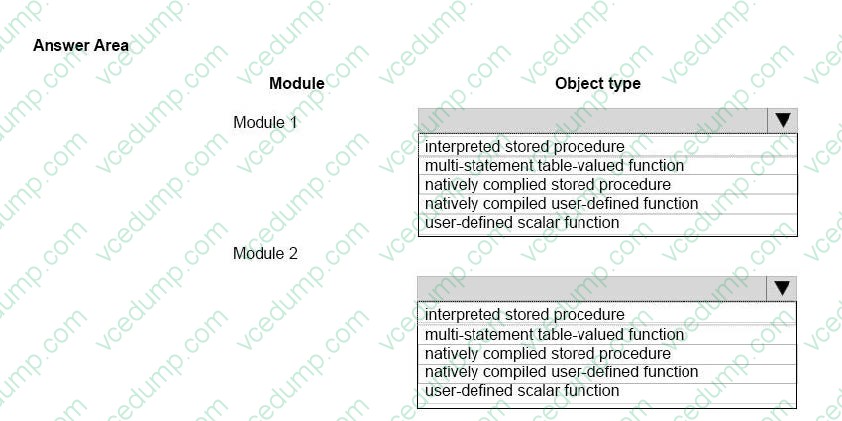
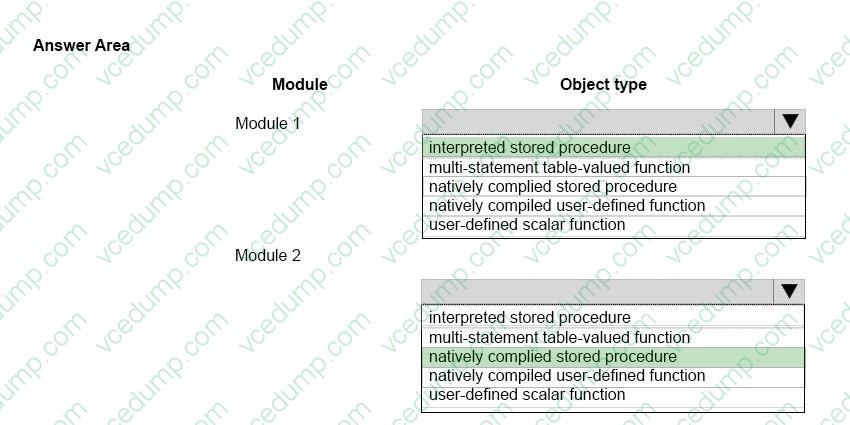
You need to create two modules. The modules must meet the requirements described in the following table.
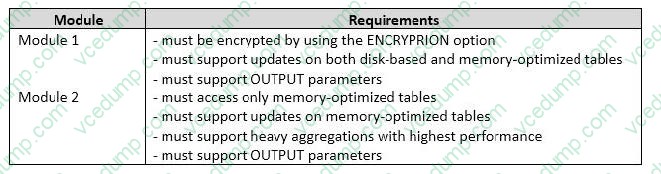
Which programming object should you use for each module? To answer, select the appropriate object types in the answer area.
Hot Area:
-
Question 158:
DRAG DROP
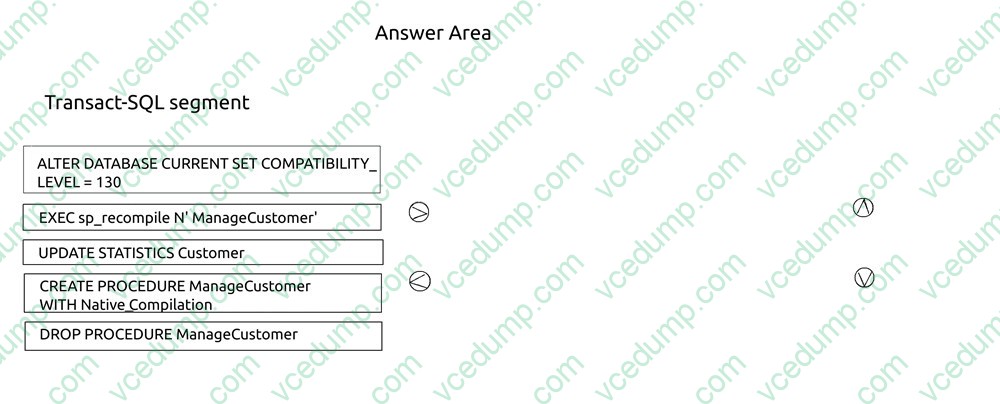
You have a memory-optimized table named Customer. The table is accessed by a stored procedure named ManageCustomer.
The database was created in Microsoft SQL Server 2014. A backup and restore operation was used to move the database to SQL Server 2016.
You have performance issues with the stored procedure.
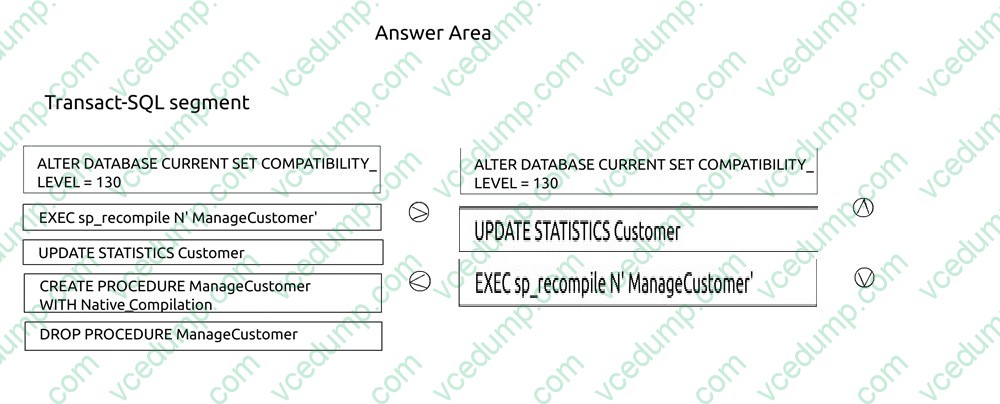
You need to resolve the performance issues and ensure the table statistics are updated automatically.
Which three Transact-SQL segments should you use to develop the solution? To answer, move the appropriate Transact-SQL segments from the list of Transact-SQL segments to the answer area and arrange them in the correct order.
Select and Place:
-
Question 159:
Note: This question is part of a series of questions that present the same scenario. Each question in the series contains a unique solution. Determine whether the solution meets the stated goals.
You have a database that contains a table named Employees. The table stored information about the employees of your company. You need to implement the following auditing rules for the Employees table:
- Record any changes that are made to the data in the Employees table.
-
Customize the data recorded by the audit operations.
Solution: You implement a check constraint on the Employees table.
Does the solution meet the goal?
A. Yes
B. No -
Question 160:
Note: This question is part of a series of questions that present the same scenario. Each question in the series contains a unique solution. Determine whether the solution meets the stated goals.
You have a database that contains a table named Employees. The table stores information about the employees of your company.
You need to implement and enforce the following business rules:
Limit the values that are accepted by the Salary column.
Prevent salaries less than $15,000 and greater than $300,000 from being entered.
Determine valid values by using logical expressions.
Do not validate data integrity when running DELETE statements.
Solution: You implement cascading referential integrity constraints on the table.
Does the solution meet the goal?
A. Yes
B. No
Related Exams:
-
62-193
Technology Literacy for Educators -
70-243
Administering and Deploying System Center 2012 Configuration Manager -
70-355
Universal Windows Platform – App Data, Services, and Coding Patterns -
77-420
Excel 2013 -
77-427
Excel 2013 Expert Part One -
77-725
Word 2016 Core Document Creation, Collaboration and Communication -
77-726
Word 2016 Expert Creating Documents for Effective Communication -
77-727
Excel 2016 Core Data Analysis, Manipulation, and Presentation -
77-728
Excel 2016 Expert: Interpreting Data for Insights -
77-731
Outlook 2016 Core Communication, Collaboration and Email Skills
Tips on How to Prepare for the Exams
Nowadays, the certification exams become more and more important and required by more and more enterprises when applying for a job. But how to prepare for the exam effectively? How to prepare for the exam in a short time with less efforts? How to get a ideal result and how to find the most reliable resources? Here on Vcedump.com, you will find all the answers. Vcedump.com provide not only Microsoft exam questions, answers and explanations but also complete assistance on your exam preparation and certification application. If you are confused on your 70-762 exam preparations and Microsoft certification application, do not hesitate to visit our Vcedump.com to find your solutions here.