70-761 Exam Details
-
Exam Code
:70-761 -
Exam Name
:Querying Data with Transact-SQL -
Certification
:Microsoft Certifications -
Vendor
:Microsoft -
Total Questions
:228 Q&As -
Last Updated
:Jan 21, 2022
Microsoft 70-761 Online Questions & Answers
-
Question 221:
SIMULATION
You have a database that includes the following tables. All of the tables are in the Production schema.
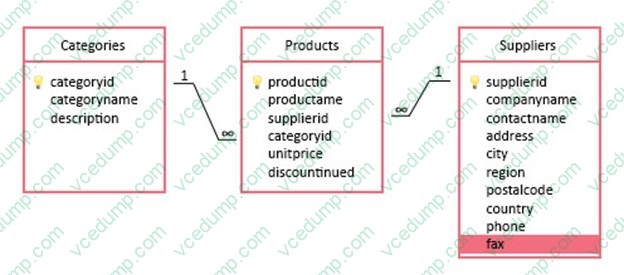
You need to create a query that returns a list of product names for all products in the Beverages category.
Construct the query using the following guidelines:

Use the first letter of the table name as the table alias.
Use two-part column names.
Do not surround object names with square brackets.
Do not use implicit joins.
Do not use variables.
Use single quotes to surround literal values.
Part of the correct Transact-SQL has been provided in the answer area below. Enter the code in the answer area that resolves the problem and meets the stated goals or requirements. You can add code within the code that has been provided as well as below it.

Use the Check Syntax button to verify your work. Any syntax or spelling errors will be reported by line and character position. You may check syntax as many times as needed.
Correct Answer. explanation -
Question 222:
Note: This question is part of a series of questions that present the same scenario. Each question in the series contains a unique solution that might meet the stated goals. Some question sets might have more than one correct solution, while others might not have a correct solution.
After you answer a question in this section, you will NOT be able to return to it. As a result, these questions will not appear in the review screen.
You are building a stored procedure that will be used by hundreds of users concurrently.
You need to store rows that will be processed later by the stored procedure. The object that stores the rows must meet the following requirements:
Be indexable
Contain up-to-date statistics
Be able to scale between 10 and 100,000 rows
The solution must prevent users from accessing one another's data.
Solution: You create a user-defined table in the stored procedure.
Does this meet the goal?
A. Yes
B. No -
Question 223:
DRAG DROP
Note: This question is part of a series of questions that use the same scenario. For your convenience, the scenario is repeated in each question. Each question presents a different goal and answer choices, but the text of the scenario is exactly the same in each question in this series.
Start of repeated scenario
You have a database that contains the tables shown in the exhibit. (Click the Exhibit button.)
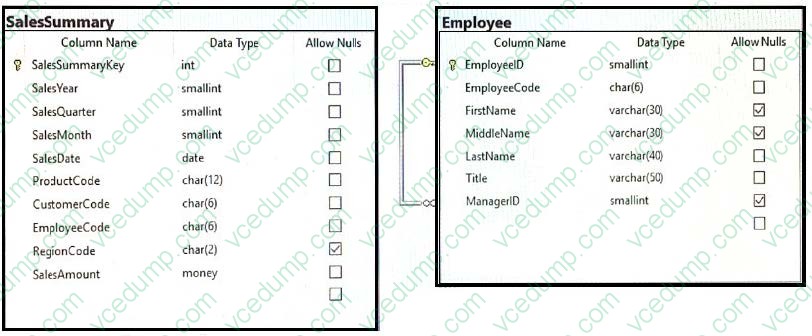
You review the Employee table and make the following observations:
Every record has a value in the ManagerID except for the Chief Executive Officer (CEO).
The FirstName and MiddleName columns contain null values for some records.
The valid values for the Title column are Sales Representative manager, and CEO.
You review the SalesSummary table and make the following observations:
The ProductCode column contains two parts: The first five digits represent a product code, and the last seven digits represent the unit price. The unit price uses the following pattern: ####.##.
You observe that for many records, the unit price portion of the ProductCode column contains values.
The RegionCode column contains NULL for some records.
Sales data is only recorded for sales representatives.
You are developing a series of reports and procedures to support the business. Details for each report or procedure follow.
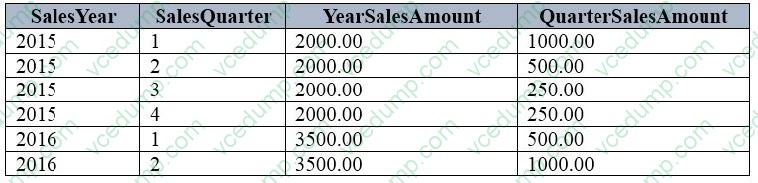
Sales Summary report: This report aggregates data by year and quarter. The report must resemble the following table.
Sales Manager report: This report lists each sales manager and the total sales amount for all employees that report to the sales manager.
Sales by Region report: This report lists the total sales amount by employee and by region. The report must include the following columns: EmployeeCode, MiddleName, LastName, RegionCode, and SalesAmount. If MiddleName is NULL, FirstName must be displayed. If both FirstName and MiddleName have null values, the world Unknown must be displayed/ If RegionCode is NULL, the word Unknown must be displayed.
Report1: This report joins data from SalesSummary with the Employee table and other tables. You plan to create an object to support Report1. The object has the following requirements:
be joinable with the SELECT statement that supplies data for the report
can be used multiple times with the SELECT statement for the report
be usable only with the SELECT statement for the report
not be saved as a permanent object
Report2: This report joins data from SalesSummary with the Employee table and other tables. You plan to create an object to support Report1. The object has the following requirements:
be joinable with the SELECT statement that supplies data for the report
can be used multiple times for this report and other reports
accept parameters
be saved as a permanent object
Sales Hierarchy report: This report aggregates rows, creates subtotal rows, and super-aggregates rows over the SalesAmount column in a single result-set. The report uses SaleYear, SaleQuarter, and SaleMonth as a hierarchy. The result set must not contain a grand total or cross-tabulation aggregate rows.
Current Price Stored Procedure: This stored procedure must return the unit price for a product when a product code is supplied. The unit price must include a dollar sign at the beginning. In addition, the unit price must contain a comma every three digits to the left of the decimal point, and must display two digits to the left of the decimal point. The stored procedure must not throw errors, even if the product code contains invalid data.
End of Repeated Scenario
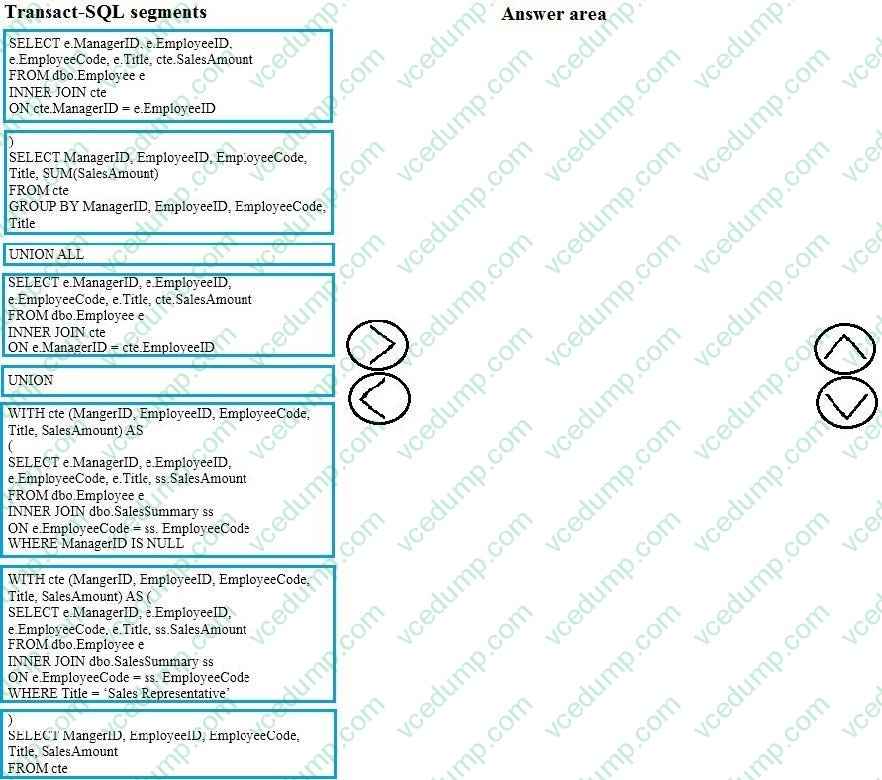
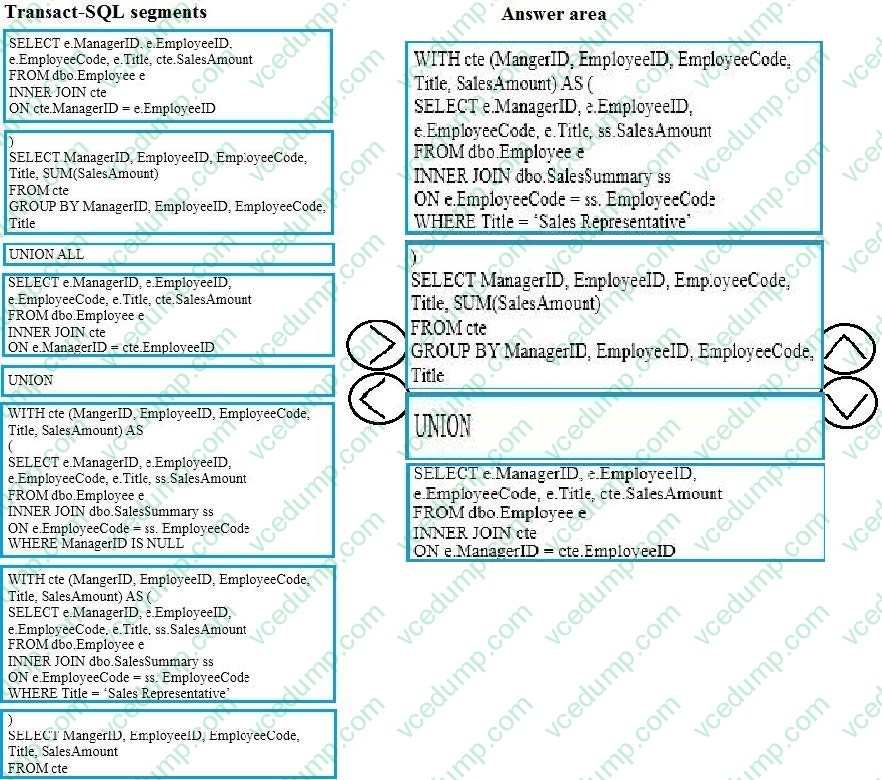
You need to create the query for the Sales Managers report.
Which four Transact-SQL segments should you use to develop the solution? To answer, move the appropriate Transact-SQL segments from the list of Transact-SQL segments to the answer area and arrange them in the correct order.
Select and Place:
-
Question 224:
SIMULATION
You create a table named Sales.Orders by running the following Transact-SQL statement:
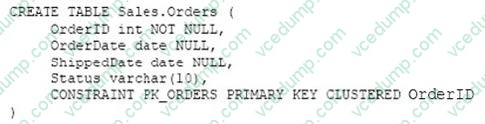
You need to write a query that removes orders from the table that have a Status of Canceled.
Construct the query using the following guidelines:
use one-part column names and two-part table names
use single quotes around literal values
do not use functions
do not surround object names with square brackets
do not use variables
do not use aliases for column names and table names
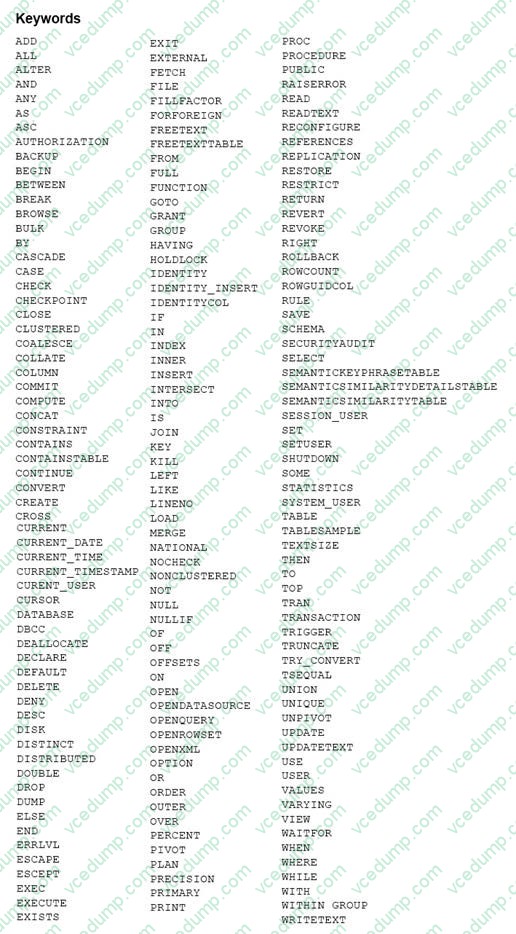
Part of the correct Transact-SQL has been provided in the answer area below. Enter the code in the answer area that resolves the problem and meets the stated goals or requirements. You can add code within the code that has been provided as well as below it.

Use the Check Syntax button to verify your work. Any syntax or spelling errors will be reported by line and character position.
Correct Answer. explanation -
Question 225:
Note: This question is part of a series of questions that use the same or similar answer choices. An answer choice may be correct for more than one question in the series. Each question is independent of the other questions in this series. Information and details provided in a question apply only to that question.
You create a table by running the following Transact-SQL statement:
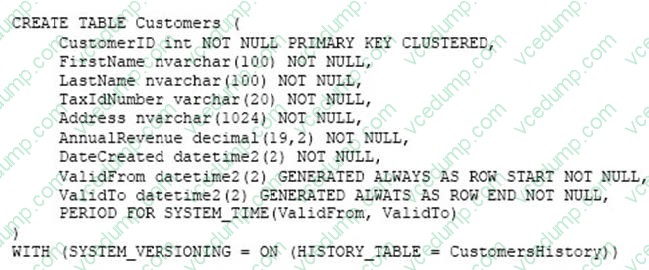
You are developing a report that aggregates customer data only for the year 2014. The report requires that the data be denormalized.
You need to return the data for the report.
Which Transact-SQL statement should you run?
A. Option A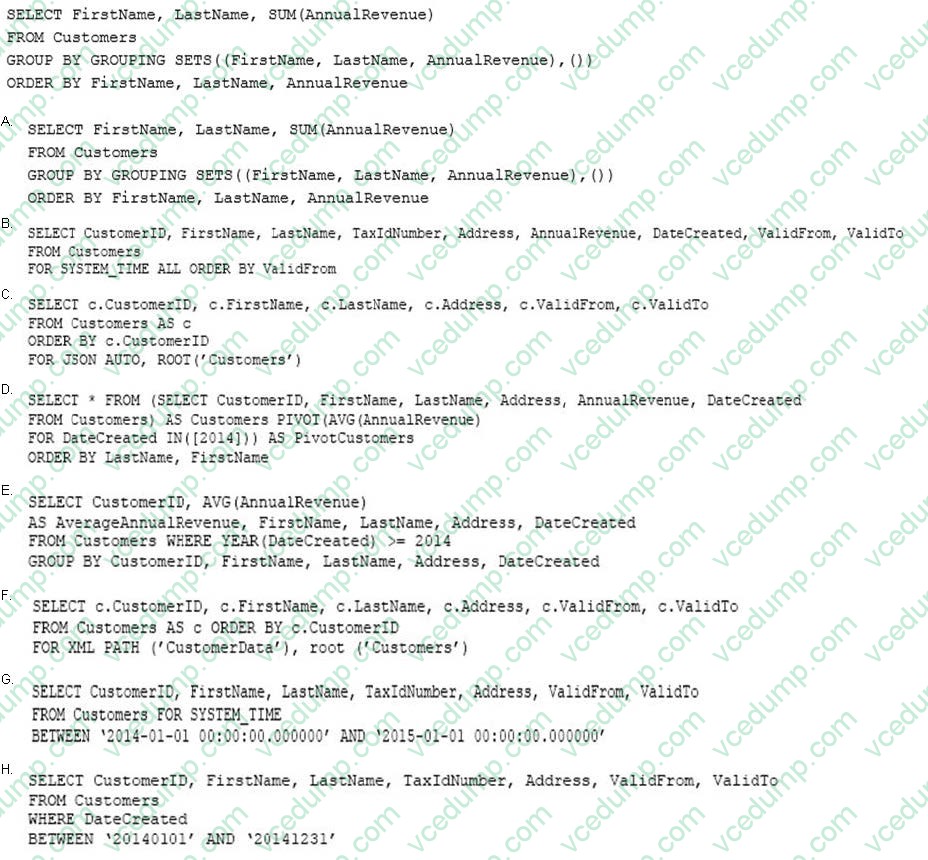
B. Option B
C. Option C
D. Option D
E. Option E
F. Option F
G. Option G
H. Option H -
Question 226:
You run the following Transact-SQL statements:
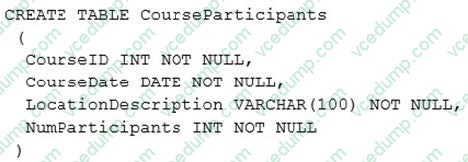
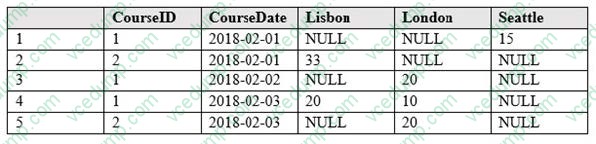
You need to create a query that returns the total number of attendees for each combination of CourseID, CourseDate, and the following locations: Lisbon, London, and Seattle. The result set should resemble the following:
Which Transact-SQL code segment should you run?
A. SELECT * FROM CourseParticipants PIVOT(SUM(NumParticipants) FOR LocationDescription IN (Lisbon, London, Seattle))
B. SELECT * FROM CourseParticipants PIVOT(SUM(NumParticipants) FOR LocationDescription IN (Lisbon, London, Seattle)) as PVTTable
C. SELECT * FROM CourseParticipants UNPIVOT(SUM(NumParticipants) FOR LocationDescription IN (Lisbon, London, Seattle)
D. SELECT * FROM CourseParticipants UNPIVOT(SUM(NumParticipants) FOR LocationDescription IN (Lisbon, London, Seattle) AS PVTTable -
Question 227:
You have a database that stores information about server and application errors. The database contains the following table: Servers

Errors
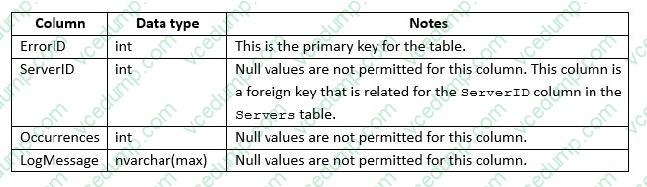
You need to return all unique error log messages and the server where the error occurs most often. Which Transact-SQL statement should you run?
A. Option A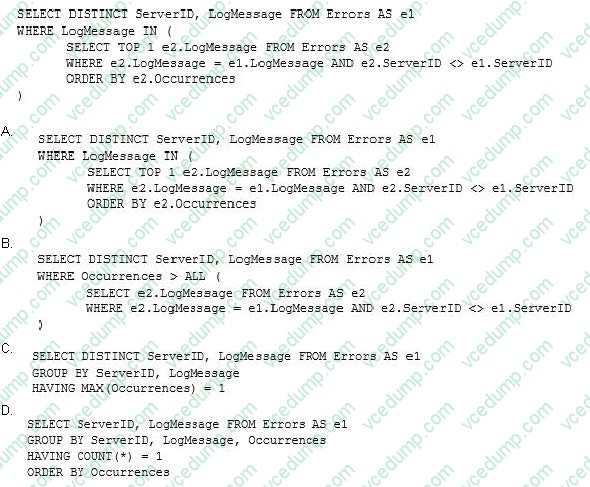
B. Option B
C. Option C
D. Option D -
Question 228:
SIMULATION
You have a table named Cities that has the following two columns: CityID and CityName. The CityID column uses the int data type, and CityName uses nvarchar(max).
You have a table named RawSurvey. Each row includes an identifier for a question and the number of persons that responded to that question from each of four cities. The table contains the following representative data:
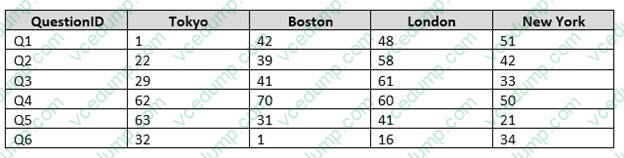
A reporting table named SurveyReport has the following columns: CityID, QuestionID, and RawCount, where RawCount is the value from the RawSurvey table.
You need to write a Transact-SQL query to meet the following requirements:

Retrieve data from the RawSurvey table in the format of the SurveyReport table.
The CityID must contain the CityID of the city that was surveyed.
The order of cities in all SELECT queries must match the order in the RawSurvey table.
The order of cities in all IN statements must match the order in the RawSurvey table.
Construct the query using the following guidelines:
Use one-part names to reference tables and columns, except where not possible.
ALL SELECT statements must specify columns.
Do not use column or table aliases, except those provided.
Do not surround object names with square brackets.
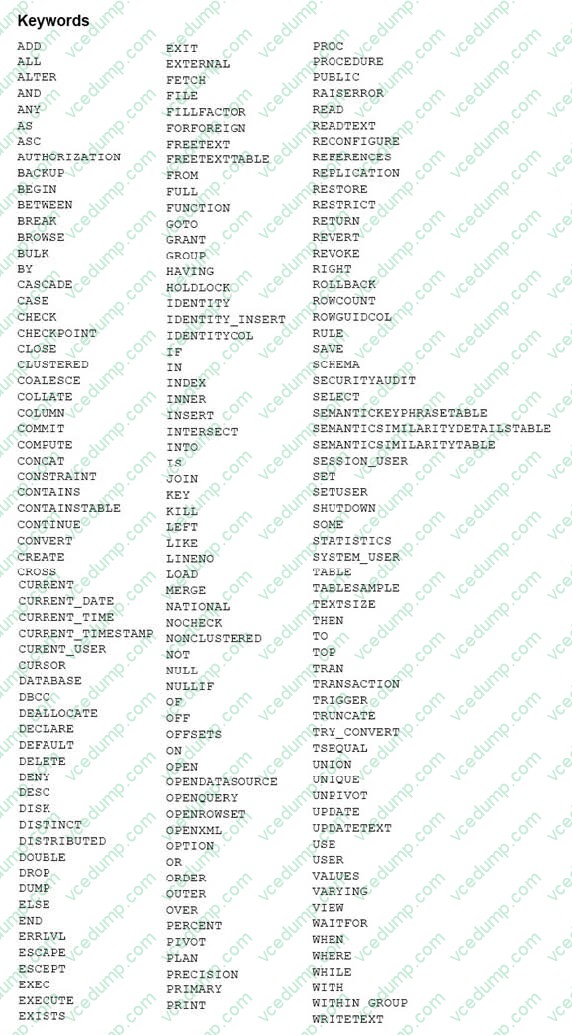
Part of the correct Transact-SQL has been provided in the answer area below. Enter the code in the answer area that resolves the problem and meets the stated goals or requirements. You can add code within the code that has been provided as well as below it.

Use the Check Syntax button to verify your work. Any syntax or spelling errors will be reported by line and character position.
A. Check the answer below
Related Exams:
-
62-193
Technology Literacy for Educators -
70-243
Administering and Deploying System Center 2012 Configuration Manager -
70-355
Universal Windows Platform – App Data, Services, and Coding Patterns -
77-420
Excel 2013 -
77-427
Excel 2013 Expert Part One -
77-725
Word 2016 Core Document Creation, Collaboration and Communication -
77-726
Word 2016 Expert Creating Documents for Effective Communication -
77-727
Excel 2016 Core Data Analysis, Manipulation, and Presentation -
77-728
Excel 2016 Expert: Interpreting Data for Insights -
77-731
Outlook 2016 Core Communication, Collaboration and Email Skills
Tips on How to Prepare for the Exams
Nowadays, the certification exams become more and more important and required by more and more enterprises when applying for a job. But how to prepare for the exam effectively? How to prepare for the exam in a short time with less efforts? How to get a ideal result and how to find the most reliable resources? Here on Vcedump.com, you will find all the answers. Vcedump.com provide not only Microsoft exam questions, answers and explanations but also complete assistance on your exam preparation and certification application. If you are confused on your 70-761 exam preparations and Microsoft certification application, do not hesitate to visit our Vcedump.com to find your solutions here.