70-761 Exam Details
-
Exam Code
:70-761 -
Exam Name
:Querying Data with Transact-SQL -
Certification
:Microsoft Certifications -
Vendor
:Microsoft -
Total Questions
:228 Q&As -
Last Updated
:Jan 21, 2022
Microsoft 70-761 Online Questions & Answers
-
Question 211:
DRAG DROP
You have a table named HR.Employees as shown in the exhibit. (Click the exhibit button.)
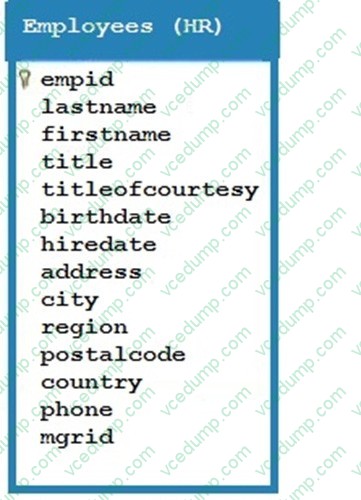
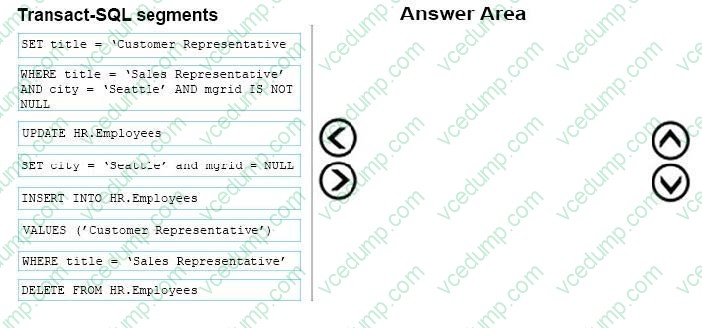
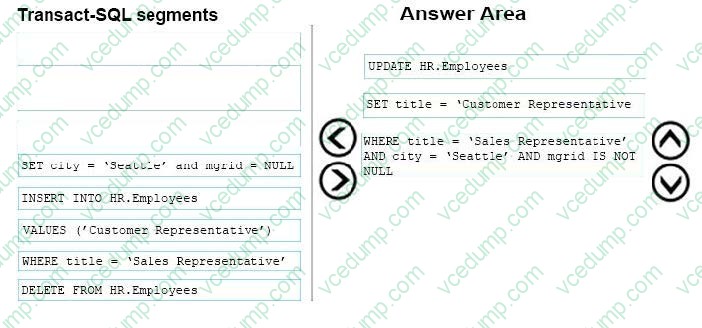
You need to write a query that will change the value of the job title column to Customer Representative for any employee who lives in Seattle and has a job title of Sales Representative. If the employee does not have a manager defined, you must not change the title.
Which three Transact-SQL segments should you use to develop the solution? To answer, move the appropriate Transact-SQL segments from the list of Transact-SQL segments to the answer area and arrange them in the correct order.
Select and Place:
-
Question 212:
HOTSPOT
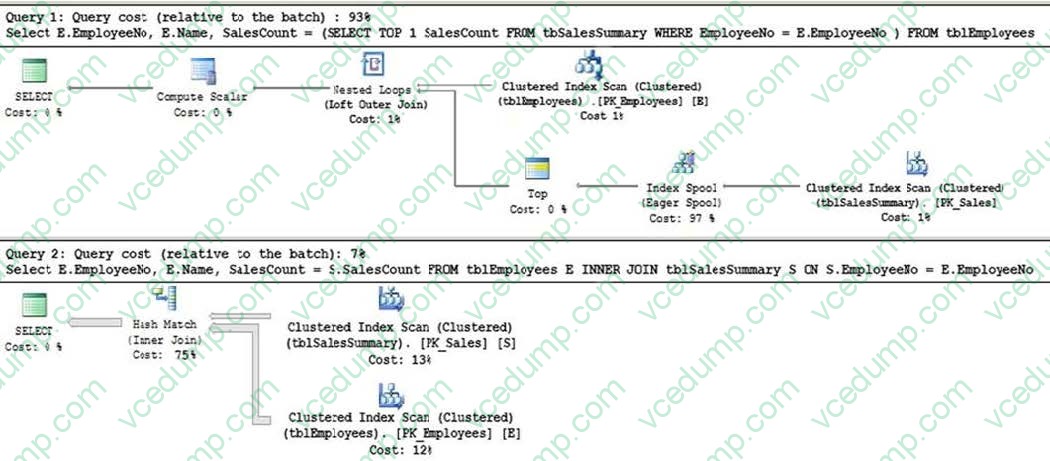
You have a database that contains the following tables: tblEmployees and tblSalesSummary. Each record contains approximately one million records.
You use Microsoft SQL Server Management Studio (SSMS) to run two queries. The Include Actual Execution Plan option is enabled.
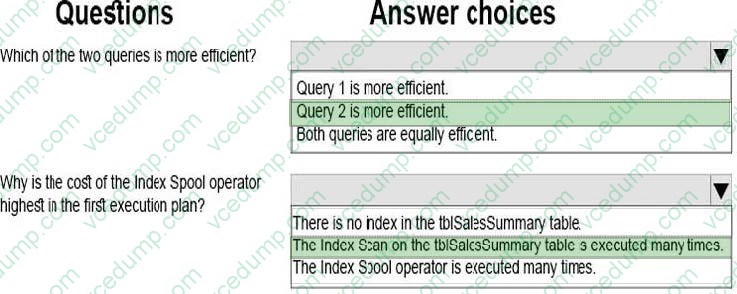
Both queries return the same results. SSMS generates the execution plans shown in the exhibit. (Click the Exhibit button.)
You need to troubleshoot the queries.
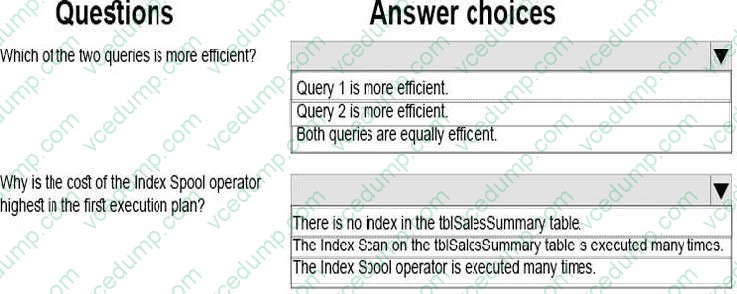
How should you interpret the execution plans? To answer, select the appropriate options in the answer area.
NOTE: Each correct selection is worth one point.
Hot Area:
-
Question 213:
Note: This question is part of a series of questions that use the same scenario. For your convenience, the scenario is repeated in each question. Each question presents a different goal and answer choices, but the text of the scenario is exactly the same in each question in this series.
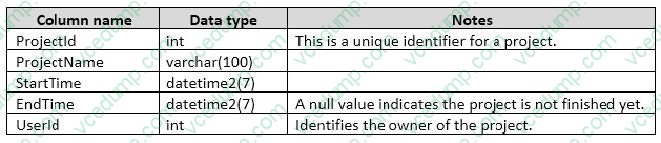
You query a database that includes two tables: Project and Task. The Project table includes the following columns:
The Task table includes the following columns:
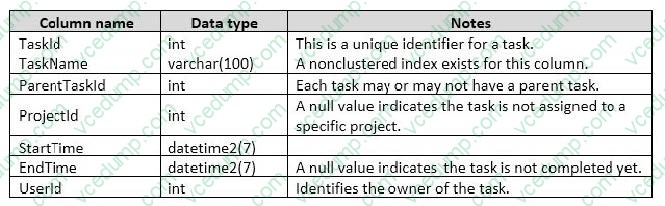
You plan to run the following query to update tasks that are not yet started:
UPDATE Task SET StartTime = GETDATE() WHERE StartTime IS NULL
You need to return the total count of tasks that are impacted by this UPDATE operation, but are not associated with a project.
What set of Transact-SQL statements should you run?
A. Option A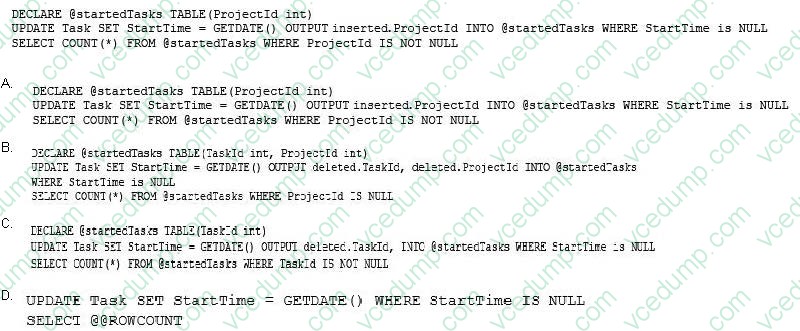
B. Option B
C. Option C
D. Option D -
Question 214:
Note: This question is part of a series of questions that present the same scenario. Each question in the series contains a unique solution that might meet the stated goals. Some question sets might have more than one correct solution, while
others might not have a correct solution.
After you answer a question in this section. You will NOT be able to return to it. As a result, these questions will not appear in the review screen.
You have a database that includes the tables shown in the exhibit (Click the Exhibit button.)
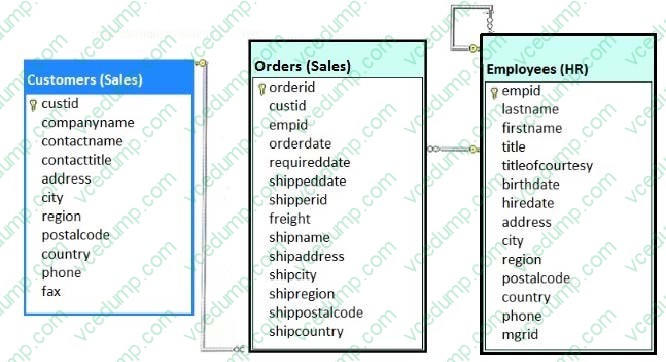
You need to create a Transact-SQL query that returns the following information:

the customer number
the customer contact name
the date the order was placed, with a name of DateofOrder
a column named Salesperson, formatted with the employee first name, a space, and the employee last name
orders for customers where the employee identifier equals 4
The output must be sorted by order date, with the newest orders first.
The solution must return only the most recent order for each customer.
Solution: You run the following Transact-SQL statement:
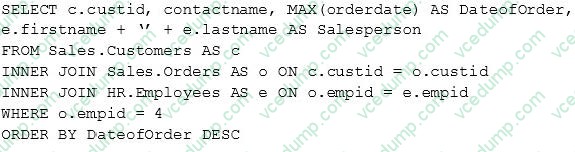
Does the solution meet the goal?
A. Yes
B. No -
Question 215:
You have a database named MyDb. You run the following Transact-SQL statements:
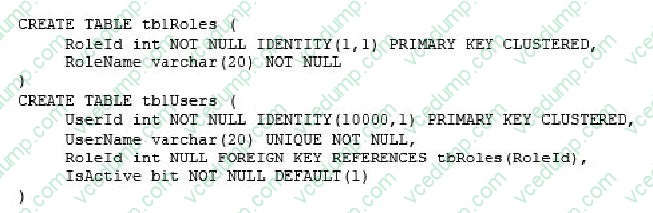
A value of 1 in the IsActive column indicates that a user is active.
You need to create a count for active users in each role. If a role has no active users. You must display a zero as the active users count.
Which Transact-SQL statement should you run?
A. Option A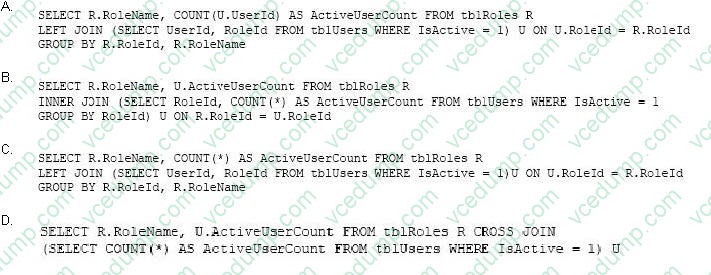
B. Option B
C. Option C
D. Option D -
Question 216:
You need to create a database object that meets the following requirements:
accepts a product identifies as input
calculates the total quantity of a specific product, including quantity on hand and quantity on order
caches and reuses execution plan
returns a value
can be called from within a SELECT statement
can be used in a JOIN clause
What should you create?
A. a temporary table that has a columnstore index
B. a user-defined table-valued function
C. a memory-optimized table that has updated statistics
D. a natively-complied stored procedure that has an OUTPUT parameter -
Question 217:
Note: This question is part of a series of questions that use the same or similar answer choices. An answer choice may be correct for more than one question in the series. Each question is independent of the other questions in this series.
Information and details provided in a question apply only to that question.
You have a database that is denormalized. Users make frequent changes to data in a primary table.
You need to ensure that users cannot change the tables directly, and that changes made to the primary table also update any related tables.
What should you implement?
A. the COALESCE function
B. a view
C. a table-valued function
D. the TRY_PARSE function
E. a stored procedure
F. the ISNULL function
G. a scalar function
H. the TRY_CONVERT function -
Question 218:
DRAG DROP
Note: This question is part of a series of questions that use the same scenario. For your convenience, the scenario is repeated in each question. Each question presents a different goal and answer choices, but the text of the scenario is
exactly the same in each question on this series.
You have a database that tracks orders and deliveries for customers in North America. System versioning is enabled for all tables. The database contains the Sales.Customers, Application.Cities, and Sales.CustomerCategories tables.
Details for the Sales.Customers table are shown in the following table:
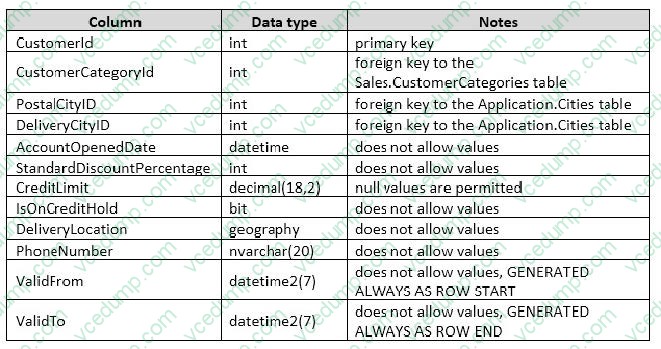
Details for the Application.Cities table are shown in the following table:

Details for the Sales.CustomerCategories table are shown in the following table:

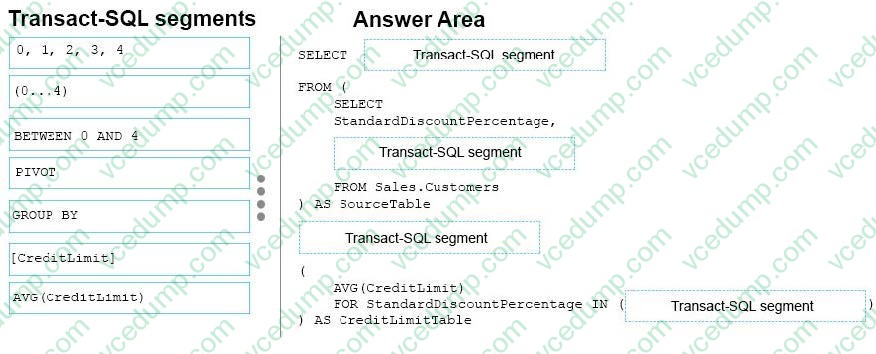
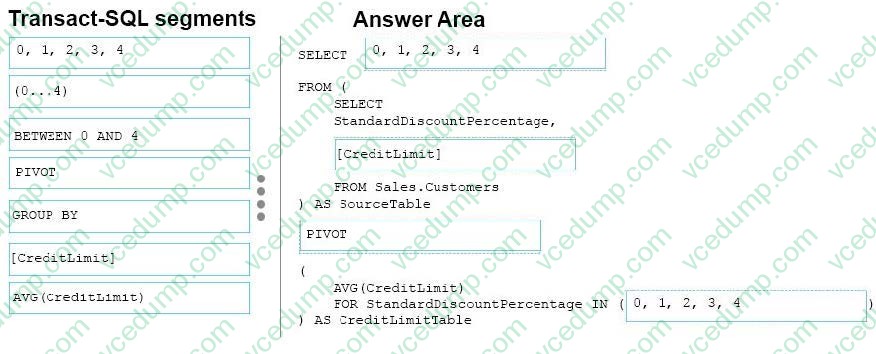
The marketing department is performing an analysis of how discount affect credit limits. They need to know the average credit limit per standard discount percentage for customers whose standard discount percentage is between zero and four.
You need to create a query that returns the data for the analysis.
How should you complete the Transact-SQL statement? To answer, drag the appropriate Transact-SQL segments to the correct locations. Each Transact-SQL segments may be used once, more than once, or not at all. You may need to drag the split bar between panes or scroll to view content.
Select and Place:
-
Question 219:
Note: This question is part of a series of questions that use the same or similar answer choices. An answer choice may be correct for more than one question in the series. Each question is independent of the other questions in this series.
Information and details provided in a question apply only to that question.
You have a database that contains several connected tables. The tables contain sales data for customers in the United States only.
You have the following partial query for the database. (Line numbers are included for reference only.)

You need to complete the query to generate the output shown in the following table.
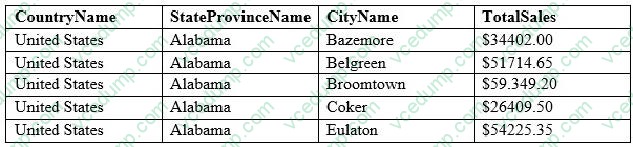
Which statement clause should you add at line 3?
A. GROUP BY
B. MERGE
C. GROUP BY ROLLUP
D. LEFT JOIN
E. GROUP BY CUBE
F. CROSS JOIN
G. PIVOT
H. UNPIVOT -
Question 220:
DRAG DROP
Note: This question is part of a series of questions that use the same scenario. For your convenience, the scenario is repeated in each question. Each question presents a different goal and answer choices, but the text of the scenario is
exactly the same in each question in this series.
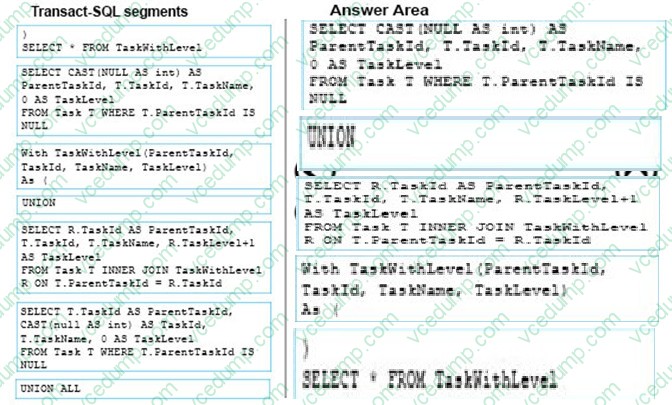
You query a database that includes two tables: Project and Task. The Project table includes the following columns:
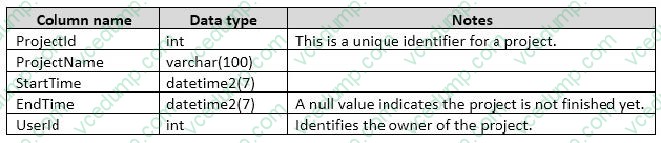
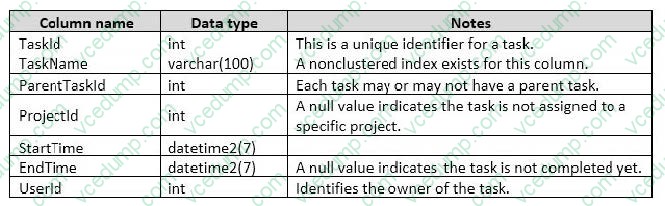
Task level is defined using the following rules:

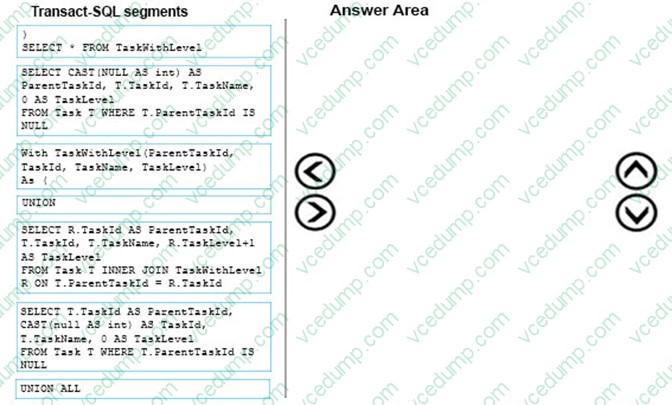
You need to determine the task level for each task in the hierarchy.
Which five Transact-SQL segments should you use to develop the solution? To answer, move the appropriate Transact-SQL segments from the list of Transact-SQL segments to the answer area and arrange them in the correct order.
Select and Place:
Related Exams:
-
62-193
Technology Literacy for Educators -
70-243
Administering and Deploying System Center 2012 Configuration Manager -
70-355
Universal Windows Platform – App Data, Services, and Coding Patterns -
77-420
Excel 2013 -
77-427
Excel 2013 Expert Part One -
77-725
Word 2016 Core Document Creation, Collaboration and Communication -
77-726
Word 2016 Expert Creating Documents for Effective Communication -
77-727
Excel 2016 Core Data Analysis, Manipulation, and Presentation -
77-728
Excel 2016 Expert: Interpreting Data for Insights -
77-731
Outlook 2016 Core Communication, Collaboration and Email Skills
Tips on How to Prepare for the Exams
Nowadays, the certification exams become more and more important and required by more and more enterprises when applying for a job. But how to prepare for the exam effectively? How to prepare for the exam in a short time with less efforts? How to get a ideal result and how to find the most reliable resources? Here on Vcedump.com, you will find all the answers. Vcedump.com provide not only Microsoft exam questions, answers and explanations but also complete assistance on your exam preparation and certification application. If you are confused on your 70-761 exam preparations and Microsoft certification application, do not hesitate to visit our Vcedump.com to find your solutions here.