70-662 Exam Details
-
Exam Code
:70-662 -
Exam Name
:TS: Microsoft Exchange Server -
Certification
:Microsoft Certifications -
Vendor
:Microsoft -
Total Questions
:498 Q&As -
Last Updated
:Apr 12, 2020
Microsoft 70-662 Online Questions & Answers
-
Question 161:
You have an Exchange organization. All servers in the organization have Exchange Server 2010 Service Pack 1 (SP1) installed.
The network contains an internal root certification authority (CA). Users on the network use Outlook Anywhere. A Client Access server uses a wildcard certificate issued by a trusted third-party root CA. You need to ensure that users can send
and receive encrypted e-mail messages by using S/MIME.
What should you do?
A. Instruct all users to import the internal root CA certificate.
B. Import the internal root CA certificate to the Client Access server.
C. Instruct all users to import the third-party root CA certificate.
D. Issue a certificate to each user from the internal root CA. -
Question 162:
You have an Exchange organization. All servers in the organization have Exchange Server 2010 SP1 installed.
You need to ensure that an administrator can recover hard-deleted email messages from a user's mailbox until the deleted item retention period has elapsed. All expired email messages must be deleted when the retention period has
elapsed.
What should you do?
A. From the Exchange Management Shell, run Set-MailboxDatabase -DumpsterStatisics $true.
B. From the properties of the mailbox database, select the This database can be overwritten by a restore check box.
C. From the Exchange Management Shell, run the New-MailboxSearch cmdlet.
D. From the Exchange Management Shell, run the New-MailboxExportRequest cmdlet.
E. From the properties of the mailbox database, modify the Deletion Settings.
F. From the Exchange Management Shell, enable single item recovery.
G. Create a managed custom folder and managed content setting.
H. From the properties of a Mailbox server, modify the System Settings.
I. From the Exchange Management Shell, run the Export-Mailbox cmdlet.
J. From the properties of the mailbox, enable retention hold. -
Question 163:
Your network contains an internal network and a perimeter network. You have an Exchange Server 2003 organization on the internal network.
You install Windows Server 2008 R2 on a new server in the perimeter network.
You need to ensure that you can install the Edge Transport server role on the new server.
What should you do?
A. Install Active Directory Lightweight Directory Services (AD LDS) on the new server.
B. Open TCP port 25 and TCP port 636 on the firewall between the perimeter network and the internal network.
C. Open TCP port 587 and TCP port 3268 on the firewall between the perimeter network and the internal network.
D. Install Active Directory Application Mode (ADAM) on the new server. -
Question 164:
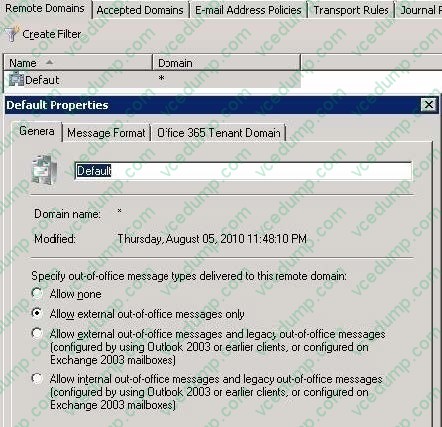
You have an Exchange Server 2010 organization named contoso.com. All users configure internal and external Out Of Office messages.
You need to ensure that internal Out Of Office messages are sent to senders from the fabrikam.com domain.
What should you create and configure?
A. a new accepted domain
B. a new Receive connector
C. a new remote domain
D. a new Send connector -
Question 165:
You need to perform an automated installation of an Exchange Server 2010 server.
Which Command should you include in your script?
A. setup.exe
B. setup.com
C. msiexec.exe
D. lpsetupui.exe -
Question 166:
You work as the Enterprise Exchange Administrator at ABC.com. The ABC.com network consists of a domain named ABC.com.
The ABC.com network has a mail server named ABC-EX02 that has Microsoft Server 2008 with Service Pack 2 installed. You receive instruction from ABC.com to deploy Exchange Server 2010 on ABC-EX02 to support the Hub Transport,
Client Access, and Mailbox server roles.
What action must you take? (Choose all that apply).
A. You should deploy Microsoft .NET Framework 3.5 Service Pack 1.
B. You should deploy the Active Directory Connector (ADC).
C. You should deploy Windows Management Framework.
D. You should delete all Recipient Update Service (RUS) objects.
E. You should run ServerManagerCmd.exe -IP Exchange-Typical.xml.
F. You should run ServerManagerCmd.exe -IP Exchange-CADB.xml. -
Question 167:
You work as the Enterprise Exchange Administrator at ABC.com. ABC.com is using Microsoft Exchange Server 2010 as their messaging solution. What actions must you take to allow a user named Mia Hamm to access the resource mailbox? (Choose all that apply).
A. You must change the resource mailbox's properties.
B. You must use log transactions.
C. You must use Outlook protection rules.
D. You must use the Set-Mailbox Mia Hamm -LitigationHoldEnabled $true cmdlet. -
Question 168:
You have an Exchange Server 2007 organization. All users on your network run Microsoft Office Outlook 2007 to access their mailboxes. Outlook 2007 is configured to connect by using RPC over HTTP and Auto discover. You perform a Typical installation of Exchange Server 2010 on a new server, and then move mailboxes to the new server. Users now report that they cannot access their mailboxes. You need to ensure that all users can access their mailboxes.
What should you do from the new server?
A. Select the Switchover Server option.
B. Enable and configure Outlook Anywhere.
C. Create and configure a Client Access array.
D. Rename the OWA virtual directory to Exchange. -
Question 169:
An organization has Exchange Server 2010 Mailbox Server named Server 1 failed. A new server with Windows 2008 named Server 2. Exchange Server 2010 recovery installation. What should you do before you perform recovery installation?
A. Rename Server1 computer account to Server2. Join Server2 to domain.
B. Rename Server2 as Server1. Reset the Server1 computer account. Join Server1 to domain.
C. Delete computer account for Server1. Join Server2 to domain. Rename Server2 as Server1.
D. Delete computer account for Server1. Rename Server2 as Server1. Create a New Computer account for Server1. Join Server1 to domain. -
Question 170:
You have an Exchange Server 2010 organization. You need to install the Hub Transport server role on a new server.
You install all the prerequisites for the Hub Transport role on the server.
What should you do next?
A. From Windows PowerShell, run the Add-WindowsFeature cmdlet.
B. From Windows PowerShell, run the Install-TransportAgent.ps1 script.
C. At the command prompt, run Setup.com /M:Install /R:HT.
D. At the command prompt, run ServerManagerCmd.exe -IP Exchange-HUB.xml.
Related Exams:
-
62-193
Technology Literacy for Educators -
70-243
Administering and Deploying System Center 2012 Configuration Manager -
70-355
Universal Windows Platform – App Data, Services, and Coding Patterns -
77-420
Excel 2013 -
77-427
Excel 2013 Expert Part One -
77-725
Word 2016 Core Document Creation, Collaboration and Communication -
77-726
Word 2016 Expert Creating Documents for Effective Communication -
77-727
Excel 2016 Core Data Analysis, Manipulation, and Presentation -
77-728
Excel 2016 Expert: Interpreting Data for Insights -
77-731
Outlook 2016 Core Communication, Collaboration and Email Skills
Tips on How to Prepare for the Exams
Nowadays, the certification exams become more and more important and required by more and more enterprises when applying for a job. But how to prepare for the exam effectively? How to prepare for the exam in a short time with less efforts? How to get a ideal result and how to find the most reliable resources? Here on Vcedump.com, you will find all the answers. Vcedump.com provide not only Microsoft exam questions, answers and explanations but also complete assistance on your exam preparation and certification application. If you are confused on your 70-662 exam preparations and Microsoft certification application, do not hesitate to visit our Vcedump.com to find your solutions here.