70-649 Exam Details
-
Exam Code
:70-649 -
Exam Name
:TS: Upgrading Your MCSE on Windows Server 2003 to Windows Server 2008, Technology Specialist -
Certification
:Microsoft Certifications -
Vendor
:Microsoft -
Total Questions
:303 Q&As -
Last Updated
:Dec 16, 2021
Microsoft 70-649 Online Questions & Answers
-
Question 151:
Your network contains a server named Server1 that runs Windows Server 2008 R2.
Server1 has theHyper-V server role installed.
Server1 hosts a virtual machine (VM) named VM1.
You take a snapshot of VM1 at 05:00 and at 19:00.
You use Hyper-V Manager to delete the snapshot taken at 05:00.
You need to ensure that the files created by the 05:00 snapshot are deleted from the hard disk on Server1.
What should you do?
A. At the command prompt, run the rmdir.exe command.
B. From Windows Power Shell, run the Remove-Item cmdlet.
C. From the Hyper-V Manager console, shut down VM1.
D. From the Hyper-V Manager console, right-click VM1 and click Revert. -
Question 152:
Your company has a network that has 100 servers. You install a new server that runs Windows Server 2008 R2. The server has the Web Server (IIS) server role installed.
After a week, you discover that the Reliability Monitor has no data, and that the Systems Stability chart has never been updated.
You need to configure the server to collect the Reliability Monitor data.
What should you do?
A. Run the perfmon.exe /sys command on the server.
B. Configure the Secondary Logon service to start automatically.
C. Configure the Remote Registry service to start automatically.
D. Configure the Task Scheduler service to start automatically. -
Question 153:
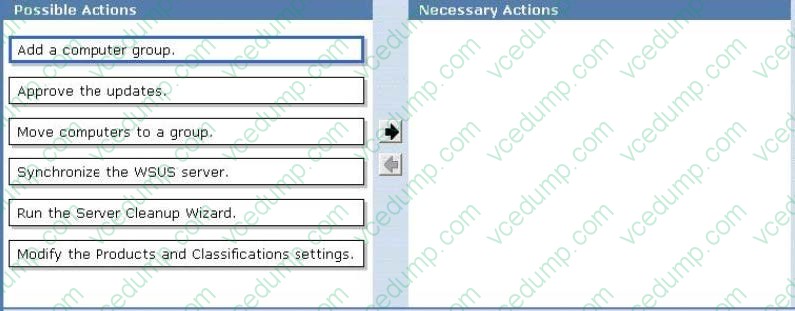
Your network contains a Windows Server Update Services (WSUS) server named Server1.
All client computers are configured to download updates from Server1. Server1 is configured only to synchronize manually to Microsoft Update.
Your company deploys a new Microsoft application.
You discover that the new application is not listed on the Products and Classifications list.
You synchronize the WSUS server.
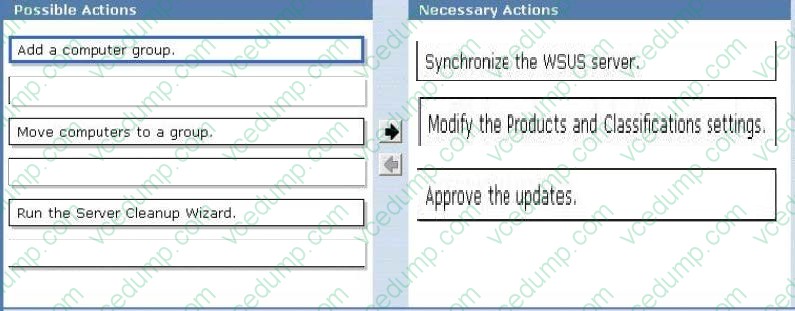
You need to ensure that updates for the new application are available to all of the client computers.
What should you do?
To answer, move the appropriate actions from the Possible Actions list to the Necessary Actions area and arrange them in the correct order.
Select and Place:
-
Question 154:
Your network contains a Network Policy Server (NPS) named Server1. You need to configure a network policy for a VLAN. Which RADIUS attributes should you add?
A. 稬ogin-LAT-Service稬ogin-LAT-Node稬ogin-LAT-Group種AS-Identifier
B. 稵unnel-Assignment-ID稵unnel-Preference稵unnel-Client-Auth-ID種AS-Port-Id
C. 稵unnel-Client-Endpt稵unnel-Server-Endpt種AS-Port-Type稵unnel-Password
D. 稵unnel-Medium-Type稵unnel-Pvt-Group-ID稵unnel-Type稵unnel-Tag -
Question 155:
Your company has a server named DC1 that runs Windows Server 2008 R2. Server1 has the DHCP Server server role installed.
You find that a desktop computer named Computer1 is unable to obtain an IP configuration from the DHCP server.
You install the Microsoft Network Monitor 3.0 application on Server1. You enable P-mode in the Network Monitor application configuration. You plan to capture only the DHCP server-related traffic between Server1 and Computer1. The
network interface configuration for the two computers is shown in the following table.

You need to build a filter in the Network Monitor application to capture the DHCP traffic between Server1 and Computer1. Which filter should you use?
A. IPv4.Address == 169.254.15.84 andand DHCP
B. IPv4.Address == 192.168.2.1 andand DHCP
C. Ethernet.Address == 0x000A5ElC7F67 andand DHCP
D. Ethernet.Address == 0x001731D55EFF andand. DHCP -
Question 156:
Your company has an Active Directory Rights Management Services (AD RMS) server. Users have Windows Vista computers. An Active Directory domain is configured at the Windows Server 2003 functional level.
You need to configure AD RMS so that users are able to protect their documents.
What should you do?
A. Install the AD RMS client 2.0 on each client computer.
B. Add the RMS service account to the local administrators group on the AD RMS server.
C. Establish an e-mail account in Active Directory Domain Services (AD DS) for each RMS user.
D. Upgrade the Active Directory domain to the functional level of Windows Server 2008. -
Question 157:
Your network contains a computer named Computer1 that runs Windows 7.
You need to verify if Computer1 has active DirectAccess connections to the network.
What should you do?
A. From Network Connections, right-click the active network connection, and then click Status.
B. From Network Connections, select the active network connection, and then click Diagnose this connection.
C. From Windows Firewall with Advanced Security, click Monitoring, and then click Connection Security Rules.
D. From Windows Firewall with Advanced Security, click Monitoring, click Security Associations, and then click Main Mode. -
Question 158:
Your company has Active Directory Certificate Services (AD CS) and Network Access Protection (NAP) deployed on the network. You need to ensure that NAP policies are enforced on portable computers that use a wireless connection to access the network. What should you do? (Choose all that apply.)
A. Use the Group Policy Management Console to access the wireless Group Policy settings, and disable the Prevent connections to infrastructure networks option.
B. Configure all access points to use 802.1X authentication.
C. Configure all portable computers to use MS-CHAP v2 authentication.
D. Use the Group Policy Management Console to access the wireless Group Policy settings, and enable the Prevent connections to ad-hoc networks option. -
Question 159:
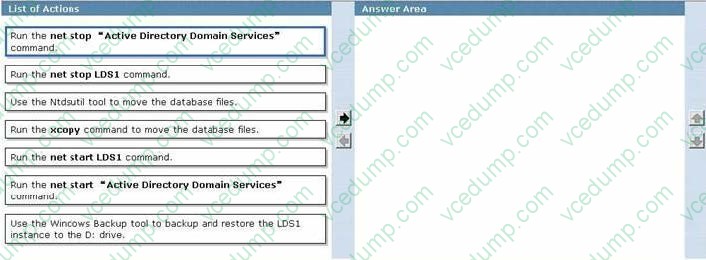
A server named DC1 has the Active Directory Domain Services (AD DS) role and the Active Directory Lightweight Directory Services (AD LDS) role installed.
An AD LDS instance named LDS1 stores its data on the C: drive.
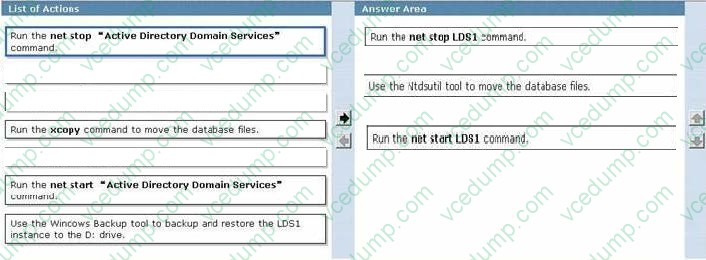
You need to relocate the LDS1 instance to the D: drive.
Which three actions should you perform in sequence? (To answer, move the three appropriate actions from the list of actions to the answer area and arrange them in the correct order.)
Select and Place:
-
Question 160:
Your network contains a server named Server1 that runs Windows Server 2008 R2.
Server1 has the following Remote Desktop Services (RDS) role services installed: * Remote Desktop Session Host (RD Session Host) * Remote Desktop Web Access (RD Web Access)
You publish 10 RemoteApp programs on Server1 by using RD Web Access.
You need to ensure that when users log on to the RD Web Access page, they see only the RemoteApp programs assigned to them.
What should you modify from RemoteApp Manager?
A. the properties of each RemoteApp program
B. the RD Gateway Settings
C. the RDP Settings
D. The RD Session Host Server Settings
Related Exams:
-
62-193
Technology Literacy for Educators -
70-243
Administering and Deploying System Center 2012 Configuration Manager -
70-355
Universal Windows Platform – App Data, Services, and Coding Patterns -
77-420
Excel 2013 -
77-427
Excel 2013 Expert Part One -
77-725
Word 2016 Core Document Creation, Collaboration and Communication -
77-726
Word 2016 Expert Creating Documents for Effective Communication -
77-727
Excel 2016 Core Data Analysis, Manipulation, and Presentation -
77-728
Excel 2016 Expert: Interpreting Data for Insights -
77-731
Outlook 2016 Core Communication, Collaboration and Email Skills
Tips on How to Prepare for the Exams
Nowadays, the certification exams become more and more important and required by more and more enterprises when applying for a job. But how to prepare for the exam effectively? How to prepare for the exam in a short time with less efforts? How to get a ideal result and how to find the most reliable resources? Here on Vcedump.com, you will find all the answers. Vcedump.com provide not only Microsoft exam questions, answers and explanations but also complete assistance on your exam preparation and certification application. If you are confused on your 70-649 exam preparations and Microsoft certification application, do not hesitate to visit our Vcedump.com to find your solutions here.