70-649 Exam Details
-
Exam Code
:70-649 -
Exam Name
:TS: Upgrading Your MCSE on Windows Server 2003 to Windows Server 2008, Technology Specialist -
Certification
:Microsoft Certifications -
Vendor
:Microsoft -
Total Questions
:303 Q&As -
Last Updated
:Dec 16, 2021
Microsoft 70-649 Online Questions & Answers
-
Question 291:
Your network contains a server named Server1 that runs Windows Server 2008 R2.
On Server1, you create an Active Directory Lightweight Directory Services (AD LDS) instance named Instance1.
You connect to Instance1 by using ADSI Edit.
You run the Create Object wizard and you discover that there is no User object class.
You need to ensure that you can create user objects in Instance1.
What should you do?
A. Run the AD LDS Setup Wizard.
B. Modify the schema of Instance1.
C. Modify the properties of the Instance1 service.
D. Install the Remote Server Administration Tools (RSAT). -
Question 292:
Your network contains a server that runs Windows Server 2008 R2.
You plan to create a custom script.
You need to ensure that each time the script runs, an entry is added to the Application event log.
Which tool should you use?
A. Eventcreate
B. Eventvwr
C. Wecutil
D. Wevtutil -
Question 293:
Your network contains a server that has the Hyper-V server role installed. The server hosts a virtual machine (VM) named VM1. VM1 runs Windows Server 2008 R2 and has the file server role installed.
You need to add more disk space to VM1. The solution must minimize the amount of downtime for VM1.
What should you do first on VM1?
A. Add a virtual disk to IDE controller 0.
B. Add a virtual disk to IDE controller 1.
C. Add a virtual disk to the SCSI controller.
D. Add a pass-through disk to IDE controller 0. -
Question 294:
Your network contains a server named Server1 that runs Windows Server 2008 R2.
You need to identify which processes perform the most disk writes and disk reads per second.
Which tool should you use?
A. Reliability Monitor
B. Disk Management
C. Resource Monitor
D. Storage Explorer -
Question 295:
Your network contains a server named Server1 that runs a Server Core installation of Windows Server 2008 R2. The network contains a client computer named Computer1 that runs Windows 7.
You need to ensure that you can collect events from Server1 on Computer1.
What should you run on Server1?
A. net config server
B. eventcreate /so
C. wecutilcs
D. winrmquickconfig -
Question 296:
Your company has 10 servers that run Windows Server 2008 R2. The servers have Remote Desktop Protocol (RDP) enabled for server administration. RDP is configured to use default security settings. All administrators' computers run Windows 7.
You need to ensure the RDP connections are as secure as possible.
Which two actions should you perform? (Each correct answer presents part of the solution. Choose two.)
A. Set the security layer for each server to the RDP Security Layer.
B. Configure the firewall on each server to block port 3389.
C. Acquire user certificates from the internal certification authority.
D. Configure each server to allow connections only to Remote Desktop client computers that use Network Level Authentication. -
Question 297:
Your network contains two servers named Server1 and Server2 that run Windows Server 2008 R2.
Network Access Protection (NAP) is deployed on Server1. Server2 has the Routing and Remote Access service (RRAS) role service installed. You need to configure Server2 to use NAP VPN enforcement.
Which authentication method should you enable on Server2?
A. Encrypted authentication (CHAP)
B. Allow machine certificate authentication for IKEv2
C. Extensible authentication protocol (EAP)
D. Microsoft encrypted authentication version 2 (MS-CHAP v2) -
Question 298:
Your network contains two servers that run Windows Server 2008 R2. The servers are configured as shown in the following table.

The network contains 100 client computers that connect to Remote Desktop Services (RDS) on Server2. Server1 has 100 Remote Desktop Services Per Device client access licenses (RDS Per Device CALs) installed.
You exchange 10 client computers for 10 new client computers.
You need to ensure that the RDS Per Device CALs allocated to the old client computers can be immediately reallocated to the new client computers.
What should you do?
A. From the Remote Desktop Session Host Configuration console on Server2, modify the Licensing settings.
B. From the Remote Desktop Licensing Manager tool on Server1, run the Manage RDS CALs wizard and click the Migrate action.
C. From the Remote Desktop Licensing Manager tool on Server1, navigate to the Windows Server 2008 R2 - Installed RDS Per Device CALs node and run the Install Licenses wizard.
D. From the Remote Desktop Licensing Manager tool on Server1, navigate to the Windows Server 2008 R2 - Installed RDS Per Device CALs node and click the Revoke RDS CAL action. -
Question 299:
Your network contains a server named Server1 that runs Windows Server 2008 R2. Server 1 has the Remote Desktop Session Host (RD Session Host) role service installed. On server1, you install and configure the Windows System Resource Manager (WSRM) feature as shown in the exhibit. (Click the Exhibit button.)
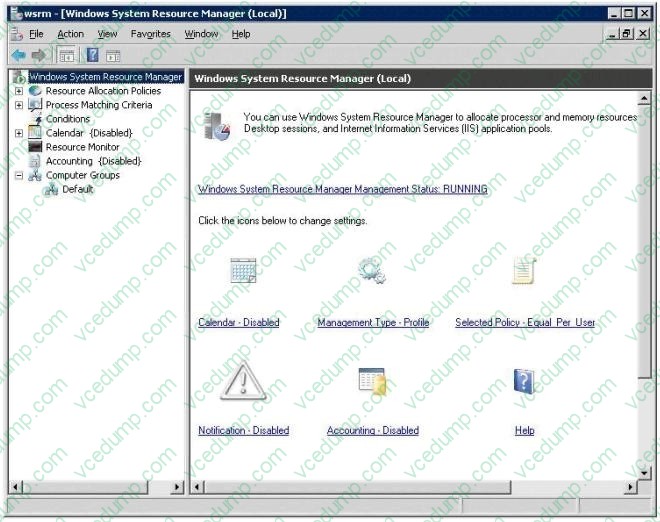
You need to ensure that WSRM enforces the allocation of CPU capacity between users. What should you do?
A. Enable Accounting.
B. Change the Management type to Manage.
C. Add Server1 to the Default computer group.
D. Change the resource allocation policy to Equal_per_process. -
Question 300:
Your network contains an Active Directory domain named fabrikam.com. The domain contains a Web server named Web1 that runs Windows Server 2008 R2.
You create four Web sites named Site1, Site2, Site3, and Site4.
You associate each Web site to a different application pool.
You need to view the amount of memory that each application pool is currently using.
Which feature should you use?
A. HTTP Response Headers
B. Worker Processes
C. Management Service
D. Request Filtering
Related Exams:
-
62-193
Technology Literacy for Educators -
70-243
Administering and Deploying System Center 2012 Configuration Manager -
70-355
Universal Windows Platform – App Data, Services, and Coding Patterns -
77-420
Excel 2013 -
77-427
Excel 2013 Expert Part One -
77-725
Word 2016 Core Document Creation, Collaboration and Communication -
77-726
Word 2016 Expert Creating Documents for Effective Communication -
77-727
Excel 2016 Core Data Analysis, Manipulation, and Presentation -
77-728
Excel 2016 Expert: Interpreting Data for Insights -
77-731
Outlook 2016 Core Communication, Collaboration and Email Skills
Tips on How to Prepare for the Exams
Nowadays, the certification exams become more and more important and required by more and more enterprises when applying for a job. But how to prepare for the exam effectively? How to prepare for the exam in a short time with less efforts? How to get a ideal result and how to find the most reliable resources? Here on Vcedump.com, you will find all the answers. Vcedump.com provide not only Microsoft exam questions, answers and explanations but also complete assistance on your exam preparation and certification application. If you are confused on your 70-649 exam preparations and Microsoft certification application, do not hesitate to visit our Vcedump.com to find your solutions here.