70-642 Exam Details
-
Exam Code
:70-642 -
Exam Name
:TS: Windows Server 2008 Network Infrastructure -
Certification
:Microsoft Certifications -
Vendor
:Microsoft -
Total Questions
:405 Q&As -
Last Updated
:Dec 08, 2021
Microsoft 70-642 Online Questions & Answers
-
Question 241:
Your company has a single Active Directory forest that has a domain in North America named na.contoso.com and a domain in South America named sa.contoso.com. The client computers run Windows 7.
You need to configure the client computers in the North America office to improve the name resolution response time for resources in the South America office. What should you do?
A. Configure a new Group Policy object (GPO) that disables the Local-Link Multicast Name Resolution feature. Apply the policy to all the client computers in the North America office.
B. Configure a new Group Policy object (GPO) that enables the Local-Link Multicast Name Resolution feature. Apply the policy to all the client computers in the North America office.
C. Configure a new Group Policy object (GPO) that configures the DNS Suffix Search List option to sa.contoso.com, na.contoso.com. Apply the policy to all the client computers in the North America office.
D. Configure the priority value for the Service Location (SRV) records on each of the North America domain controllers to 5. -
Question 242:
Your network contains a DNS zone for contoso.com. All servers register their host names in DNS by using dynamic updates.
The network contains a server named Server1.contoso.com. From a computer named Computer1 that runs Windows 7, you successfully resolve Server1.contoso.com to an IP address.
You change the IP address of Server1.contoso.com. From Computer1, you discover that server1.contoso.com still resolves to the old IP address. You successfully connect to server1.contoso.com by using the new IP address.
You need to ensure that you can immediately resolve Server1.contoso.com to the new IP address.
What should you do on Computer1?
A. Run ipconfig.exe and specify the /flushdns parameter.
B. Run netsh.exe and specify the dnsclient context.
C. Restart the Peer Name Resolution Protocol (PNRP) service.
D. Run dnscacheugc.exe. -
Question 243:
You have a DHCP server that runs Windows Server 2008 R2. You need to reduce the size of the DHCP database.
What should you do?
A. From the DHCP snap-in, reconcile the database.
B. From the folder that contains the DHCP database, run jetpack.exe dhcp.mdb temp.mdb.
C. From the properties of the dhcp.mdb file, enable the File is ready for archiving attribute.
D. From the properties of the dhcp.mdb file, enable the Compress contents to save disk space attribute. -
Question 244:
Your corporate network has a member server named RAS1 that runs Windows Server 2008 R2. You configure RAS1 to use the Routing and Remote Access Services (RRAS).
The company's remote access policy allows members of the Domain Users group to dial in to RAS1. The company issues smart cards to all employees.
You need to ensure that smart card users are able to connect to RAS1 by using a dial-up connection. What should you do?
A. Install the Network Policy Server (NPS) server role on RAS1.
B. Create a remote access policy that requires users to authenticate by using SPAP.
C. Create a remote access policy that requires users to authenticate by using EAP-TLS.
D. Create a remote access policy that requires users to authenticate by using MS-CHAP v2. -
Question 245:
Your company has deployed Network Access Protection (NAP) enforcement for VPNs. You need to ensure that the health of all clients can be monitored and reported.
What should you do?
A. Create a Group Policy object (GPO) that enables Security Center and link the policy to the domain.
B. Create a Group Policy object (GPO) that enables Security Center and link the policy to the Domain Controllers organizational unit (OU).
C. Create a Group Policy object (GPO) and set the Require trusted path for credential entry option to Enabled. Link the policy to the domain.
D. Create a Group Policy object (GPO) and set the Require trusted path for credential entry option to Enabled. Link the policy to the Domain Controllers organizational unit (OU). -
Question 246:
Your network contains a Network Policy Server (NPS) named NPS1 and a network access server named NAS1. NAS1 is configured to use NPS1 for authentication and accounting. A firewall separates NPS1 and NAS1.
You need to ensure that NAS1 can successfully send authentication and accounting messages to NPS1. Which ports should you allow through the firewall?
A. TCP ports 80, 443, 389 and 1645 B. TCP ports 88, 135, 139 and 1813
C. UDP ports 53, 67, 68 and 69
D. UDP ports 1812, 1813, 1645 and 1646 -
Question 247:
Your network contains two servers named Server1 and Server2 that run Windows Server 2008 R2. From Server1, you create a collector-initiated subscription that uses Server2 as a source computer. You verify the event subscription and discover the error message shown in the exhibit. (Click the Exhibit button.)
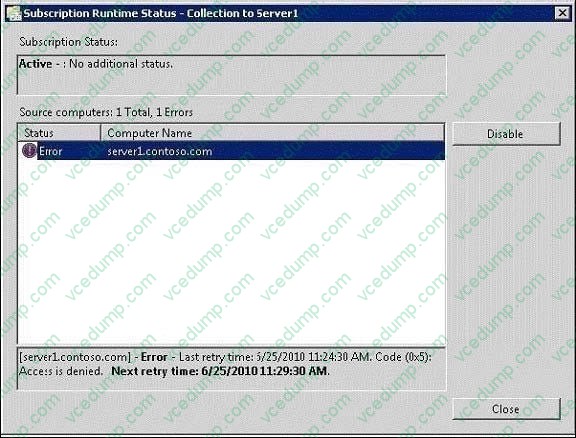
You need to ensure that the subscription collection runs successfully. What should you do?
A. On Server1, run winrm quickconfig.
B. On Server2, run winrm quickconfig.
C. From the properties of the subscription, modify the User Account options.
D. From the properties of the subscription, modify the Protocol and Port options. -
Question 248:
Your company is designing its network. The network will use an IPv6 prefix of 2001:DB8:BBCC:0000::/53.
You need to identify an IPv6 addressing scheme that will support 2000 subnets.
Which network mask should you use?
A. /61
B. /62
C. /63
D. /64 -
Question 249:
Your network contains a DHCP server named DHCP1. You have a DHCP reservation for a computer named Computer1.
You add a DNS server option to the reservation.
You need to ensure that Computer1 immediately receives the new option.
What should you do?
A. Run ipconfig.exe /renew.
B. Run ipconfig.exe /registerdns.
C. On DHCP1, recreate the reservation.
D. On DHCP1, delete the active lease for the reservation. -
Question 250:
Your network contains a single Active Directory domain. All servers run Windows Server 2008 R2. A DHCP server is deployed on the network and configured to provide IPv6 prefixes. You need to ensure that when you monitor network traffic, you see the interface identifiers derived from the Extended Unique Identifier (EUI)-64 address.
Which command should you run?
A. netsh.exe interface ipv6 set global addressmaskreply=disabled
B. netsh.exe interface ipv6 set global dhcpmediasense=enabled
C. netsh.exe interface ipv6 set global randomizeidentifiers=disabled
D. netsh.exe interface ipv6 set privacy state=enabled
Related Exams:
-
62-193
Technology Literacy for Educators -
70-243
Administering and Deploying System Center 2012 Configuration Manager -
70-355
Universal Windows Platform – App Data, Services, and Coding Patterns -
77-420
Excel 2013 -
77-427
Excel 2013 Expert Part One -
77-725
Word 2016 Core Document Creation, Collaboration and Communication -
77-726
Word 2016 Expert Creating Documents for Effective Communication -
77-727
Excel 2016 Core Data Analysis, Manipulation, and Presentation -
77-728
Excel 2016 Expert: Interpreting Data for Insights -
77-731
Outlook 2016 Core Communication, Collaboration and Email Skills
Tips on How to Prepare for the Exams
Nowadays, the certification exams become more and more important and required by more and more enterprises when applying for a job. But how to prepare for the exam effectively? How to prepare for the exam in a short time with less efforts? How to get a ideal result and how to find the most reliable resources? Here on Vcedump.com, you will find all the answers. Vcedump.com provide not only Microsoft exam questions, answers and explanations but also complete assistance on your exam preparation and certification application. If you are confused on your 70-642 exam preparations and Microsoft certification application, do not hesitate to visit our Vcedump.com to find your solutions here.