70-537 Exam Details
-
Exam Code
:70-537 -
Exam Name
:Configuring and Operating a Hybrid Cloud with Microsoft Azure Stack Hub -
Certification
:Microsoft Certifications -
Vendor
:Microsoft -
Total Questions
:99 Q&As -
Last Updated
:Nov 26, 2021
Microsoft 70-537 Online Questions & Answers
-
Question 11:
DRAG DROP
Note: This question is part of a series of questions that use the same scenario. For your convenience, the scenario is repeated in each question. Each question presents a different goal and answer choices, but the text of the scenario is exactly the same in each question in this series.
Start of repeated scenario.
Your company has a network that contains an Active Directory forest named fabrikam.com. The forest is synchronized to a Microsoft Azure Active Directory (Azure AD) tenant and has an Azure subscription.
The company also has an Azure AD tenant named contoso.com. Contoso.com has an Azure subscription. Contoso.com includes foreign principals.
The network contains the computers configured as shown in the following table.
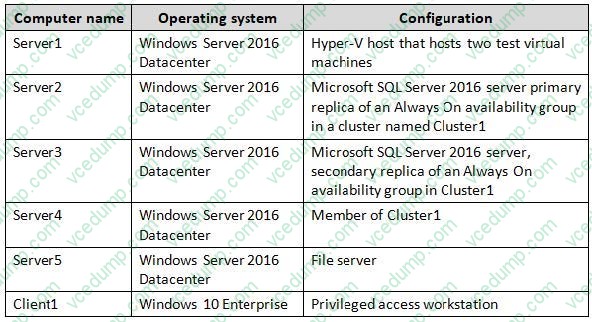
Fabrikam.com contains a user named User1.
For operating system deployment, the company uses a custom operating system image of Windows Server 2016 Datacenter named Image1.
You have an Azure Stack integrated system that is accessed by using the following endpoints:
1. https://portal.fabrikam.com
2. https://adminportal.fabrikam.com
3. https://management.fabrikam.com
4. Privileged endpoint: 192.168.100.100
5. Hardware lifecycle host: 192.168.101.101
6. https://adminmanagement.fabrikam.com
You onboard contoso.com as a guest directory tenant on the Azure Stack integrated system.
You implement in the following Azure Stack providers:
1. SQL Server
2. App Service
End of repeated scenario.
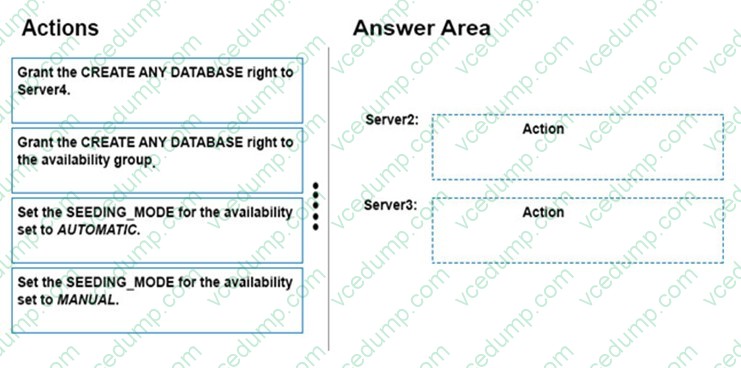
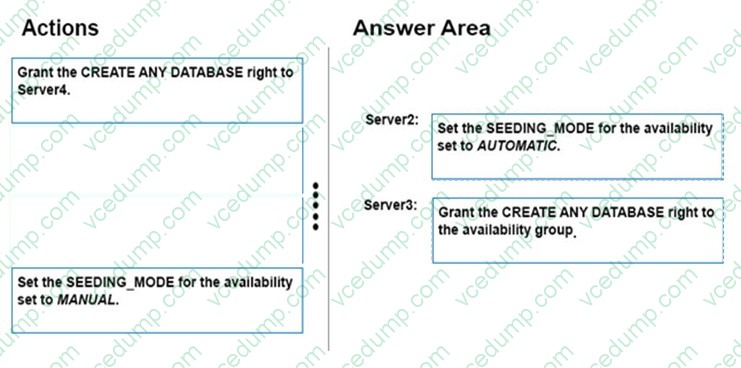
You plan to provide tenants with the ability to create highly available databases in Cluster1.
You need to add Cluster1 as a SQL hosting server on the Azure Stack integrated system.
What should you do on each server? To answer, drag the appropriate actions to the correct servers. Each action may be used once, more than once, or not at all. You may need to drag the split bar between panes or scroll to view content.
NOTE: Each correct selection is worth one point.
Select and Place:
-
Question 12:
Note: This question is part of a series of questions that use the same scenario. For your convenience, the scenario is repeated in each question. Each question presents a different goal and answer choices, but the text of the scenario is
exactly the same in each question in this series.
Start of repeated scenario.
Your company has a main office in New York and a branch office in Toronto. Each office has a dedicated connection to the Internet. Each office has a firewall that uses inbound and outbound rules.
The company has an on-premises network that contains several datacenters. The datacenters contain multiple hypervisor deployments, including Window Server 2016 Hyper-V. The network uses Microsoft System Center for monitoring and
Windows Azure Pack for self-service.
The company has a Microsoft Azure subscription that contains several workloads. You use Azure Resource Manager templates and other automated processes to create and manage the resources in Azure.
You have an Azure Stack integrated system in the New York office. The company has a development team in the Toronto office and a development team in the New York office. The system has an offer named Offer1. Several tenants have
subscriptions based on Offer1.
You have a Hyper-V host named Server1 that runs Windows Server 2012 R2. Server1 is used for testing. The hardware on Server1 can support the deployment of the Azure Stack Development Kit.
You have a Generation 1 virtual machine named VM1 that runs Windows Server 2012 R2. VM1 is deployed to a Hyper-V host that runs Windows Server 2016. VM1 has a fixed size disk named VM1.vhdx that is 200 GB.
End of repeated scenario.
The development team in the Toronto office fails to access the Azure Stack integrated system. The team successfully accesses the Azure subscriptions. The development team in the New York office successfully accesses the Azure Stack
integrated system.
You need to ensure that the Toronto development team can access the system.
What should you do?
A. For the Toronto development team, allow the inbound endpoints of the Azure Stack infrastructure on the New York office firewalls.
B. Create a site-to-site VPN connection from Azure to the New York office.
C. For the Toronto development team, allow ports 4443 and 8080 on the New York firewalls.
D. Configure and enable iDNS. -
Question 13:
You deploy an Azure Stack integrated system that contains several Marketplace packages.
You need to publish an application to the Marketplace.
You create an Azure Marketplace Package (.azpkg) file on your management workstation.
Which two actions should you perform next? Each correct answer presents part of the solution.
NOTE: Each correct selection is worth one point.
A. Create a Manifest.xml file
B. Map the Azure Blob storage URI to the Azure Stack instance
C. Create a public offer
D. Run the Set-AzsOffer cmdlet
E. Run the Add-AzsGalleryItem cmdlet
F. From Microsoft Azure Storage Explorer, copy the file to an Azure Stack storage account -
Question 14:
NOTE: This question is part of a series of questions that present the same scenario. Each question in the series contains a unique solution that might meet the stated goals. Some question sets might have more than one correct solution,
while others might not have a correct solution.
After you answer a question in this section, you will NOT be able to return to it. As a result, these questions will not appear in the review screen.
You have an Azure Stack integrated system that contains four nodes named Node1, Node2, Node3 and Node4.
You plan to replace Node2.
You need to drain the active workloads that run on Node2.
Solution: You connect to the BMC web interface on Node2 and power off the node.
Does this meet the goal?
A. Yes
B. No -
Question 15:
You have an Azure Stack integrated system that has multitenancy enabled.
You successfully onboard several tenants.
Your company has an Active Directory domain named adatum.com that contains an administrative account named [email protected].
An Azure Stack operator attempts to onboard a new tenant for adatum.com.
You attempt to sign in to the new tenant by using [email protected], and you receive the following error message: "Uh oh! Your account is not authorized to access the portal. Did you sign in to the correct directory? Append the target
directory to the portal URL (for example, `https://portal.com/contoso.onmicrosoft.com'), and try again."
You need to ensure that you can sign in to the new tenant by using [email protected].
What should you run?
A. Get-AzureStackToken and New-AzsLocation
B. New-AzsTenantSubscription and Set-AzsSubscription
C. Register-AzsWithMyDirectoryTenant and Regisgter-AzSGuestDirectoryTenant
D. Enable-AdfsEndpoint and Register-AdfsAuthenticationProvider -
Question 16:
You have an Azure Stack integrated system.
A tenant requires assistance managing a subscription.
The tenant needs to create a custom RBAC role definition.
What should you instruct the tenant to do?
A. Establish a PowerShell session to the Azure Resource Manager (user) endpoint. Run the New-AzureRmPolicySetDefinition cmdlet and the New-AzureRoleTemplate cmdlet.
B. Establish a PowerShell session to the Azure Resource Manager (user) endpoint. Create a JSON file that contains the permission definitions. Run the New-AzureRmRoleDefinition cmdlet.
C. Establish a PowerShell session to the Azure Resource Manager (administrator) endpoint. Create an XML file that contains the permission definitions. Run the New-AzureRmRoleDefinition cmdlet
D. Establish a PowerShell session to the Azure Resource Manager (administrator) endpoint. Run the New-AzureRmPolicySetDefinition cmdlet and the New-AzureRoletemplate cmdlet. -
Question 17:
DRAG DROP
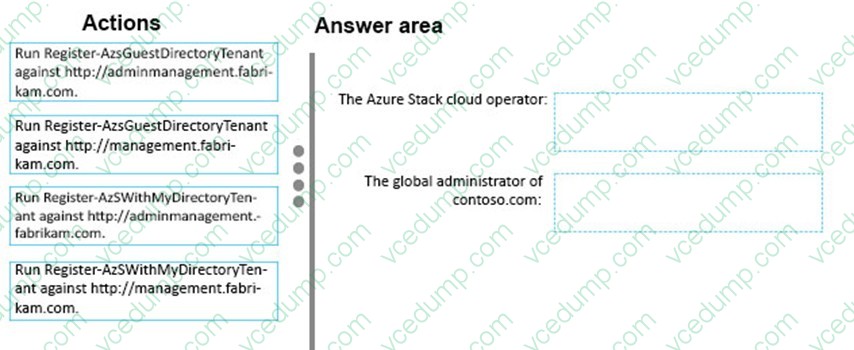
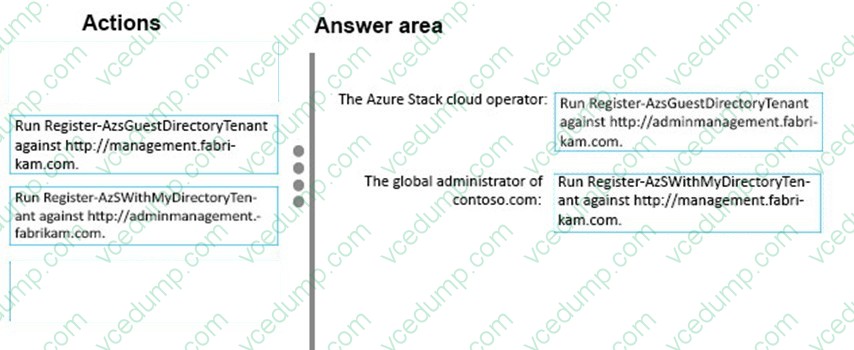
You have an Azure Stack integrated system that uses a Microsoft Azure Active Directory (Azure AD) tenant named fabrikam.com as the identity provider.
You need to onboard contoso.com as a guest directory tenant.
Which action should each role perform? To answer, drag the appropriate actions to the correct roles. Each action may be used once, more than once, or not at all. You may need to drag the split bar between panes or scroll to view content.
NOTE: Each correct selection is worth one point.
Select and Place:
-
Question 18:
Note: This question is part of a series of questions that use the same scenario. For your convenience, the scenario is repeated in each question. Each question presents a different goal and answer choices, but the text of thescenario is exactly the same in each question in this series.
Start of repeated scenario.
Your network contains an Active Directory forest named contoso.com
You deploy an Azure Stack integrated system named Prod to a production environment. You also deploy an Azure Stack integrated system named Dev to a development environment. The developers who access Dev change frequently.
The Azure Stack integrated systems and the contoso.com forest are federated.
The on-premises network contains a Hyper-V host that hosts a Red Hat Enterprise Linux virtual machine named Linux1. Linux1 has the following characteristics:
1.
A 2-TB disk
2.
Generation 1
3.
10 virtual cores
4.
128 GB of RAM
5.
A disk named LinuxVhd.vhdx
You plan to deploy infrastructure as a service (IaaS) to Dev for developer projects. The Marketplace on Dev is configured and ready to publish items. Dev contains one plan named Dev_Plan1 and one offer named Dev_Offer1.
Prod contains two plans and two offers. One of the offers is named Offer1.
All the IaaS and platform as a service (PaaS) tenant data must be backed up to an external location. The solution must ensure that the data can be restored if the datacenter that hosts Prod becomes unavailable.
End of repeated scenario.
You need to recommend a backup strategy for Prod.
Which two technologies should you include in the recommendation? Each correct answer presents part of the solution.
NOTE: Each correct selection is worth one point.
A. Microsoft Azure Backup
B. a blob snapshot
C. AzCopy
D. a virtual machine checkpoint -
Question 19:
HOTSPOT
Note: This question is part of a series of questions that use the same scenario. For your convenience, the scenario is repeated in each question. Each question presents a different goal and answer choices, but the text of thescenario is exactly the same in each question in this series.
Start of repeated scenario.
Your company has a main office in New York and a branch office in Toronto. Each office has a dedicated connection to the Internet. Each office has a firewall that uses inbound and outbound rules.
The company has an on-premises network that contains several datacenters. The datacenters contain multiple hypervisor deployments, including Window Server 2016 Hyper-V. The network uses Microsoft System Center for monitoring and Windows Azure Pack for self-service.
The company has a Microsoft Azure subscription that contains several workloads. You use Azure Resource Manager templates and other automated processes to create and manage the resources in Azure.
You have an Azure Stack integrated system in the New York office. The company has a development team in the Toronto office and a development team in the New York office. The system has an offer named Offer1. Several tenants have subscriptions based on Offer1.
You have a Hyper-V host named Server1 that runs Windows Server 2012 R2. Server1 is used for testing. The hardware on Server1 can support the deployment of the Azure Stack Development Kit.
You have a Generation 1 virtual machine named VM1 that runs Windows Server 2012 R2. VM1 is deployed to a Hyper-V host that runs Windows Server 2016. VM1 has a fixed size disk named VM1.vhdx that is 200 GB.
End of repeated scenario.
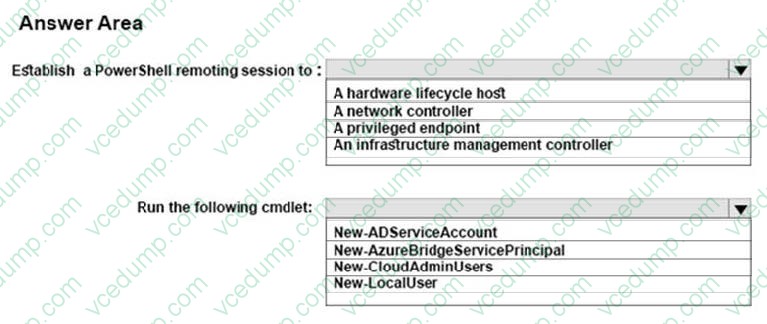
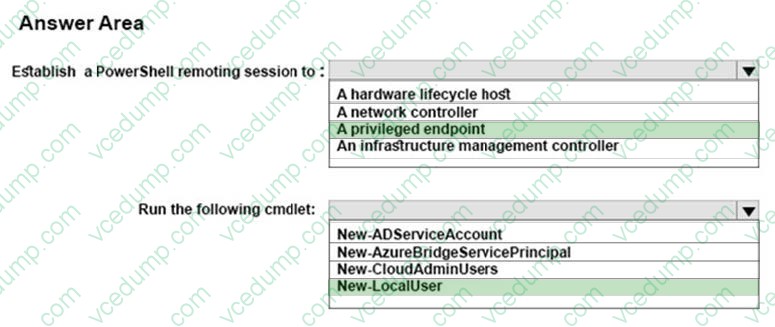
You need to provide a new user with the ability to generate support session tokens when troubleshooting Azure Stack issues with Microsoft Support. What should you do? To answer, select the appropriate options in the answer area. NOTE: Each correct selection is worth one point.
Hot Area:
-
Question 20:
HOTSPOT
Note: This question is part of a series of questions that use the same scenario. For your convenience, the scenario is repeated in each question. Each question presents a different goal and answer choices, but the text of thescenario is exactly the same in each question in this series.
Start of repeated scenario.
Your network contains an Active Directory forest named contoso.com
You deploy an Azure Stack integrated system named Prod to a production environment. You also deploy an Azure Stack integrated system named Dev to a development environment. The developers who access Dev change frequently.
The Azure Stack integrated systems and the contoso.com forest are federated.
The on-premises network contains a Hyper-V host that hosts a Red Hat Enterprise Linux virtual machine named Linux1. Linux1 has the following characteristics:
1. A 2-TB disk
2. Generation 1
3. 10 virtual cores
4. 128 GB of RAM
5. A disk named LinuxVhd.vhdx
You plan to deploy infrastructure as a service (IaaS) to Dev for developer projects. The Marketplace on Dev is configured and ready to publish items. Dev contains one plan named Dev_Plan1 and one offer named Dev_Offer1.
Prod contains two plans and two offers. One of the offers is named Offer1.
All the IaaS and platform as a service (PaaS) tenant data must be backed up to an external location. The solution must ensure that the data can be restored if the datacenter that hosts Prod becomes unavailable.
End of repeated scenario.
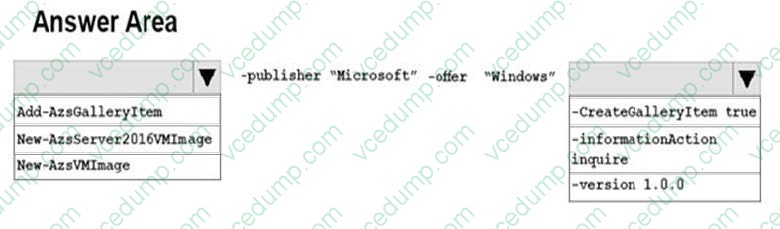
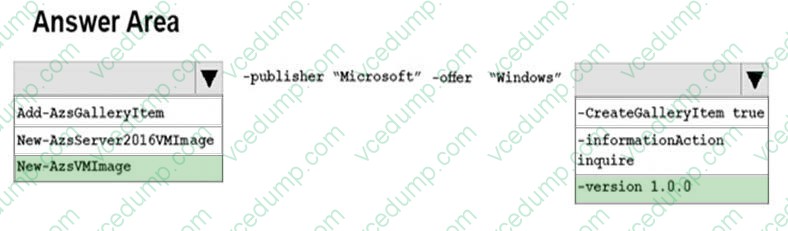
You need to add a custom Windows Server 2016 image to the Marketplace on Dev.
Which command should you run? To answer, select the appropriate options in the answer area.
NOTE: Each correct selection is worth one point.
Hot Area:
Related Exams:
-
62-193
Technology Literacy for Educators -
70-243
Administering and Deploying System Center 2012 Configuration Manager -
70-355
Universal Windows Platform – App Data, Services, and Coding Patterns -
77-420
Excel 2013 -
77-427
Excel 2013 Expert Part One -
77-725
Word 2016 Core Document Creation, Collaboration and Communication -
77-726
Word 2016 Expert Creating Documents for Effective Communication -
77-727
Excel 2016 Core Data Analysis, Manipulation, and Presentation -
77-728
Excel 2016 Expert: Interpreting Data for Insights -
77-731
Outlook 2016 Core Communication, Collaboration and Email Skills
Tips on How to Prepare for the Exams
Nowadays, the certification exams become more and more important and required by more and more enterprises when applying for a job. But how to prepare for the exam effectively? How to prepare for the exam in a short time with less efforts? How to get a ideal result and how to find the most reliable resources? Here on Vcedump.com, you will find all the answers. Vcedump.com provide not only Microsoft exam questions, answers and explanations but also complete assistance on your exam preparation and certification application. If you are confused on your 70-537 exam preparations and Microsoft certification application, do not hesitate to visit our Vcedump.com to find your solutions here.