70-533 Exam Details
-
Exam Code
:70-533 -
Exam Name
:Implementing Microsoft Azure Infrastructure Solutions -
Certification
:Microsoft Certifications -
Vendor
:Microsoft -
Total Questions
:337 Q&As -
Last Updated
:Dec 08, 2021
Microsoft 70-533 Online Questions & Answers
-
Question 111:
A company deploys Microsoft SQL Server on an Azure DS3_V2_ Standard virtual machine (VM).
You need to modify the disk caching policy.
Which Azure PowerShell cmdlet should you run?
A. Set-AzureRmVmOperatingSystem
B. Set-AzureRmVmOSDisk
C. Update-AzureDisk
D. Set-AzureRmVm -
Question 112:
HOTSPOT
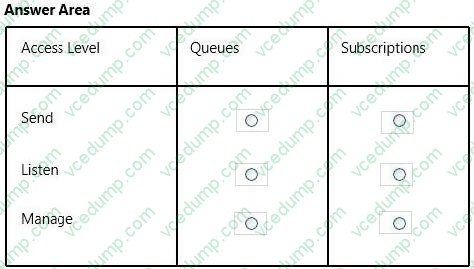
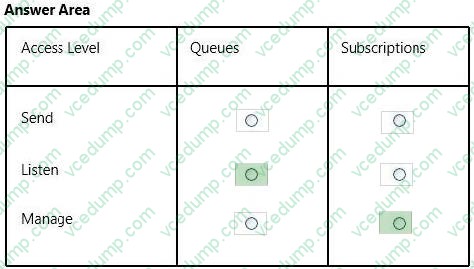
You manage an Azure Service Bus for your company. You plan to enable access to the Azure Service Bus for an application named ContosoLOB.
You need to create a new shared access policy for subscriptions and queues that has the following requirements:
In the table below, identify the permission you need to assign to ensure that ContosoLOB is able to accomplish the above requirements. Make only one selection in each column.
Hot Area:
-
Question 113:
You administer an Azure Web Site named contoso. You create a job named Cleanlogs.cmd that will be executed manually, twice a week.
You need to deploy the job.
To which folder location should you deploy CleanLogs.cmd?
A. ./App_Code/jobs/triggered/cleanLogs/CleanLogs.cmd
B. ./App_Data/jobs/triggered/clean Logs/CleanLogs.cmd
C. ./App_Code/jobs/continuous/cleanLogs/CleanLogs.cmd
D. ./App_Data/jobs/continuous/cleanLogs/CleanLogs.cmd -
Question 114:
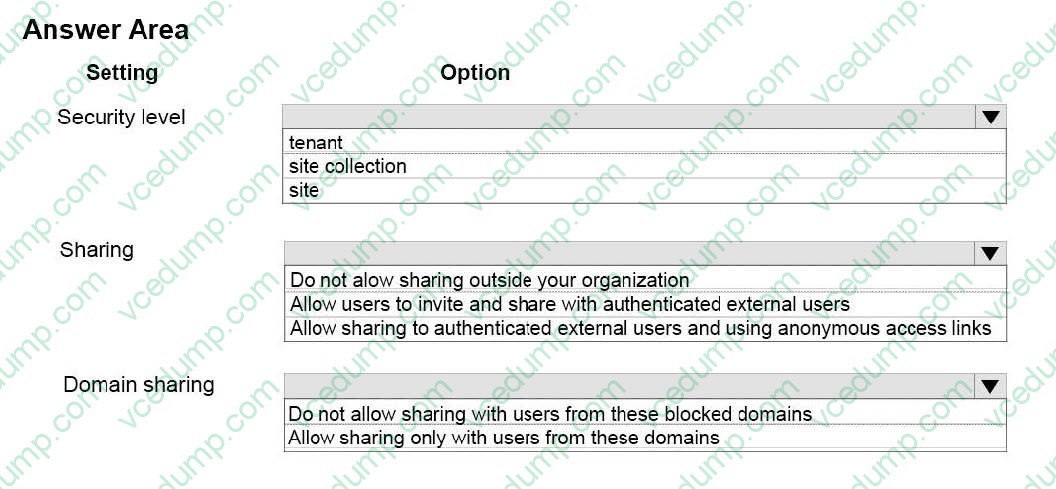
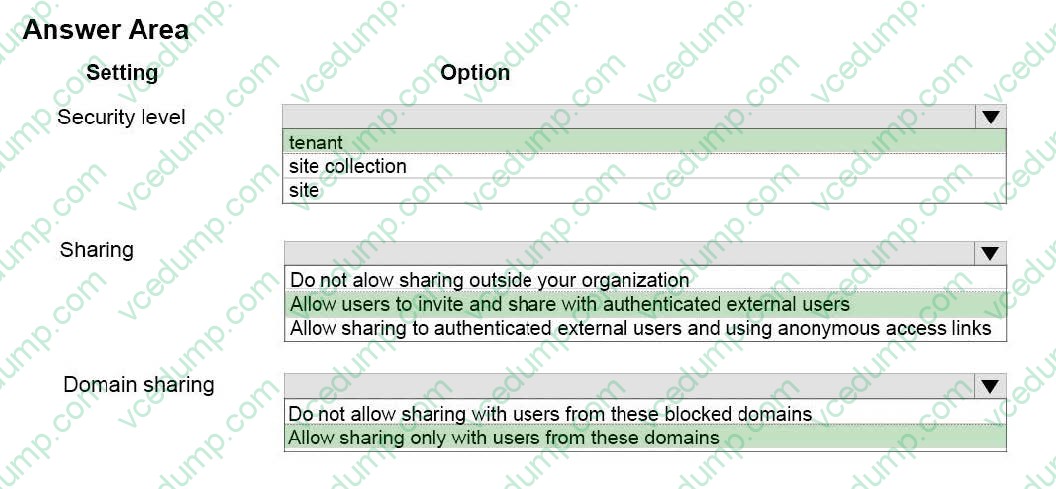
You are the Azure administrator for Contoso Ltd. You plan to use SharePoint Online to facilitate collaboration with a partner company named Fabrikam, Inc.
You have the following collaboration requirements:
You need to configure SharePoint Online.
Which configuration setting should you use? To answer, select the appropriate options in the answer area.
Hot Area:
-
Question 115:
You are the administrator for three Azure subscriptions named Dev, Test, and Prod.
Your Azure PowerShell profile is configured with the Dev subscription as the default.
You need to create a new virtual machine in the Test subscription by using the least administrative effort.
Which PowerShell command should you use?
A. Option A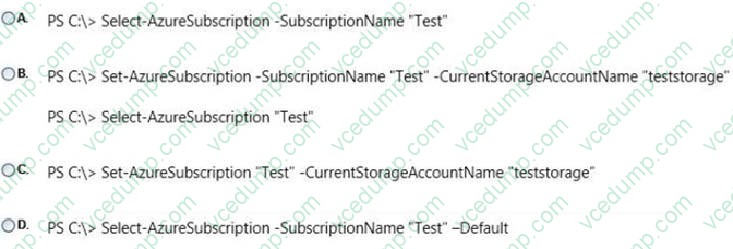
B. Option B
C. Option C
D. Option D -
Question 116:
You manage an Azure Active Directory (AD) tenant
You plan to allow users to log in to a third-party application by using their Azure AD credentials.
To access the application, users will be prompted for their existing third-party user names and passwords.
You need to add the application to Azure AD.
Which type of application should you add?
A. Existing Single Sign-On with identity provisioning
B. Password Single Sign-On with identity provisioning
C. Existing Single Sign-On without identity provisioning
D. Password Single Sign-On without identity provisioning -
Question 117:
You administer an Azure Storage account with a blob container. You enable Storage account logging for read, write and delete requests.
You need to reduce the costs associated with storing the logs.
What should you do?
A. Execute Delete Blob requests over https.
B. Create an export job for your container.
C. Set up a retention policy.
D. Execute Delete Blob requests over http. -
Question 118:
You manage a cloud service that has a web application named WebRole1. WebRole1 writes error messages to the Windows Event Log.
Users report receiving an error page with the following message: "Event 26 has occurred. Contact your system administrator."
You need to access the WebRole1 event log.
Which three actions should you perform? Each correct answer presents part of the solution.
A. Enable verbose monitoring.
B. Update the WebRole1 web.config file.
C. Update the cloud service definition file and the service configuration file.
D. Run the Set-AzureVMDiagnosticsExtensionPowerShell cmdlet.
E. Run the Enable-AzureWebsiteApplicationDiagnostic PowerShell cmdlet.
F. Create a storage account. -
Question 119:
A company has an existing on-premises Active Directory environment that is synchronized using DirSync. They plan to transition the DirSync deployment to Azure Active Directory (Azure AD) Connect.
You need to identify a transition path for the company.
What should you do?
A. Install a new on-premises domain controller.
B. Create a new Azure AD instance.
C. Upgrade the on-premises Active Directory Domain Service (AD DS) forest functional level to Windows Server 2016.
D. Deploy Azure AD Connect in parallel. -
Question 120:
Your company has recently signed up for Azure.
You plan to register a Data Protection Manager (DPM) server with the Azure Backup service.
You need to recommend a method for registering the DPM server with the Azure Backup vault.
What are two possible ways to achieve this goal? Each correct answer presents a complete solution.
A. Import a self-signed certificate created using the makecert tool.
B. Import a self-signed certificate created using the createcert tool.
C. Import an X.509 v3 certificate with valid clientauthentication EKU.
D. Import an X.509 v3 certificate with valid serverauthentication EKU.

Related Exams:
-
62-193
Technology Literacy for Educators -
70-243
Administering and Deploying System Center 2012 Configuration Manager -
70-355
Universal Windows Platform – App Data, Services, and Coding Patterns -
77-420
Excel 2013 -
77-427
Excel 2013 Expert Part One -
77-725
Word 2016 Core Document Creation, Collaboration and Communication -
77-726
Word 2016 Expert Creating Documents for Effective Communication -
77-727
Excel 2016 Core Data Analysis, Manipulation, and Presentation -
77-728
Excel 2016 Expert: Interpreting Data for Insights -
77-731
Outlook 2016 Core Communication, Collaboration and Email Skills
Tips on How to Prepare for the Exams
Nowadays, the certification exams become more and more important and required by more and more enterprises when applying for a job. But how to prepare for the exam effectively? How to prepare for the exam in a short time with less efforts? How to get a ideal result and how to find the most reliable resources? Here on Vcedump.com, you will find all the answers. Vcedump.com provide not only Microsoft exam questions, answers and explanations but also complete assistance on your exam preparation and certification application. If you are confused on your 70-533 exam preparations and Microsoft certification application, do not hesitate to visit our Vcedump.com to find your solutions here.