70-498 Exam Details
-
Exam Code
:70-498 -
Exam Name
:Delivering Continuous Value with Visual Studio Application Lifecycle Management -
Certification
:Microsoft Certifications -
Vendor
:Microsoft -
Total Questions
:95 Q&As -
Last Updated
:Dec 15, 2021
Microsoft 70-498 Online Questions & Answers
-
Question 81:
Your development team uses Scrum as its process framework.
You are attempting to increase efficiency, code quality, and limit scope creep by making some changes to your team's development process.
You need to identify key metrics for measuring the effect of any changes to your process.
Which three key metrics should you use? Each correct answer presents part of the solution.
A. number of story points delivered during the sprint
B. number of manual test cases created
C. number of bugs reported by testers
D. number of tasks added to the sprint after the sprint starts
E. number of classes in the code-base
F. number of items added to the product backlog -
Question 82:
You are using the Microsoft Visual Studio Scrum process template. You recently finished a sprint.
You need to conduct a retrospective meeting prior to planning the next sprint.
What should you do?
A. Analyze items in the product backlog for the next sprint.
B. Analyze the previous sprint to identify what the team is going to do differently during the next sprint
C. Analyze and revise the story points of the work items completed in the previous sprint.
D. Determine which items have been finished on the previous sprint. -
Question 83:
You are the lead software developer for your company. You are using Microsoft Visual Studio 2012 and Test Driven Development to create a new commercial software product.
Management asks you to define unit testing standards that all developers will follow.
You need to design the first unit test for a new class. What should you design the first unit test to do initially?
A. test a range of values
B. test exceptional cases
C. pass the base case
D. fail the base case -
Question 84:
Your Scrum team is planning a release and wants to prioritize user stories based on value and risk. The stories are grouped according to the ratio of value to risk, as shown in the following image. Effort is the same for all user stories.
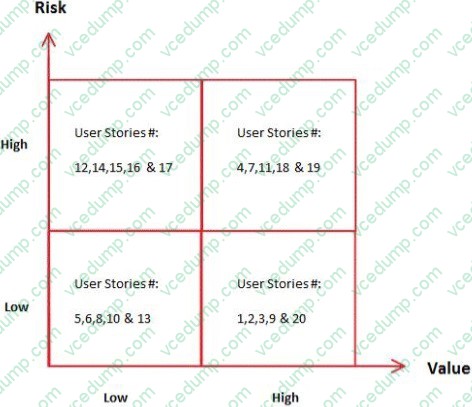
The product owner on your team wants to ensure a higher return on investment based on today's prioritization activity.
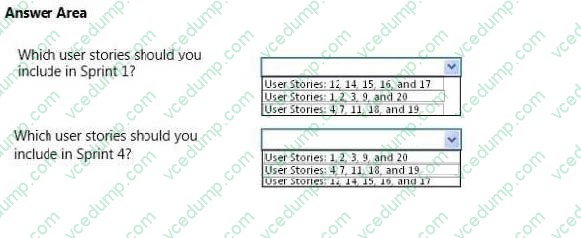
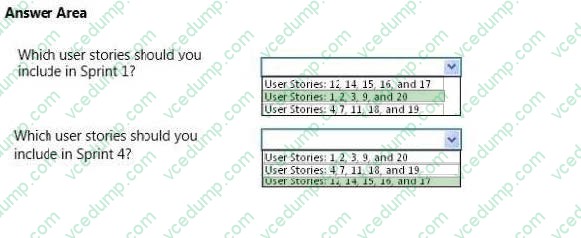
You need to prioritize these user stories into four sprints for this release.
Use the drop-down menus to select the answer choice that answers each question.
Hot Area:
-
Question 85:
Your development team uses Microsoft Visual Studio Team Foundation Server (TFS) 2012 to develop and support an enterprise-wide web application.
The system is too large to perform a manual smoke test.
You need to ensure that the latest release to production has not broken anything.
Which two actions should you perform? (Each correct answer presents part of the solution.
Choose two.)
A. Create a new build definition with your tests configured for the production URI(s). Run the tests and have TFS report success or failure.
B. Create a new virtual machine in Microsoft Test Manager (MTM) that mirrors your production environment. Create a new build that runs your test projects and have TFS report success or failure.
C. Create a series of CodedUI Tests in Microsoft Visual Studio.
D. Create a complete set of unit test projects within Microsoft Visual Studio 2012. -
Question 86:
You develop a solution that is managed in Microsoft Visual Studio Team Foundation Server (TFS) source control using three branches according the following table.
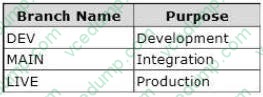
The branch hierarchy is shown in the exhibit. (Click the Exhibit button.)

A new project requires you to divide your team into two separate, and largely independent, teams named Feature Team 1 and Feature Team 2. Each team works on different features.
You need to recommend an effective long-term strategy that:

Allows parallel development,
Allows independent feature releases,
Minimizes conflicts,
Supports integration, and
Allows bug fixes to production code.
What should you do?
A. Instruct both feature teams work off the DEV branch. The teams should only check in when they are ready to integrate.
B. Create two new folders named FB1 and FB2 at the same level as the other branches. Instruct Feature Team 1 to check in to FB1 and Feature Team 2 to check in to FB2. When the teams are ready to integrate, perform baseless merges from FBI to DEV and FB2 to DEV.
C. Instruct Feature Team 1 to check in to the DEV branch and Feature Team 2 to check in to the MAIN branch. When the teams are ready to integration, the DEV branch will be merged into the MAIN branch.
D. Create two branches off DEV named FB1 and FB2. Instruct Feature Team 1 to check-in to FB1 and Feature Team 2 to check-in to FB2. When a team is ready to integrate, FB1 or FB2 will be merged with DEV. -
Question 87:
Your company is considering adopting the family of Microsoft Visual Studio 2012 features.
You need to identify which out-of-the-box features you could use to create an end-to-end application lifecycle management (ALM) solution.
Which three features should you use? (Each correct answer presents part of the solution. Choose three.)
A. Time tracking and budget analysis
B. Manual testing
C. Unit testing and code coverage
D. Requirements management
E. Deployment to production -
Question 88:
Your team uses Microsoft Visual Studio Team Foundation Server (TFS) as their application lifecycle management solution.
The team is developing a mission-critical internal web application. The data service and user interface are on different servers. The web application includes a Windows client The internal IT group uses packaged software to distribute
software to internal clients. File shares are used for staging. The file shares are titled \\deploy\staging\myapp. and they contain the install packages.
The team needs to deploy updates on a quarterly basis. The team also needs to keep copies of the deployed software in the team's environment and to use TFS Release Management.
You need to create a process that deploys the Windows client to the staging area.
What should you do?
A. Create a custom action to deploy your msi file, and use one-click deployment.
B. Create a Release Template, and add the step Copy file or Folder in the Staging tab. Set the Destination to \\deploy\staging\myapp.
C. Create a Release Template, and add the Windows OS task of moving a file. Set the staging area as the place to move the msi file.
D. Create a custom action that connects to the internal third-party deployment api, and add it to the Release Template. -
Question 89:
You are the product owner for a new application. You have the list of product backlog items (PBIs) with assigned business values for the first release of the application. You will be working with an established scrum master and development team. You know the team's capacity and the planned sprint duration. You need to plan the release schedule based on your existing backlog.
A. Ask the development team to decompose the PBIs into individual tasks and estimate hours.
B. Ask the development team to provide high level estimates to complete each PBI.
C. Assign the PBIs to different sprints to define the release.
D. Use the TFS 2012 task board features.
E. Schedule the release using the Iteration Planning workbook.
F. Order the product backlog by business value. -
Question 90:
Your development team uses the Microsoft Visual Studio Scrum 2.0 process template. You are the product owner.
Your product backlog includes a number of items that appear to have equal priority. However, the items have differing business value, complexity, and risk.
You need to order the backlog based on risk, complexity, and business value.
What should you do?
A. Work on items with the highest ratio of business value to effort first.
B. Work on items that have the highest effort first.
C. Work on items that have the lowest effort first.
D. Assign a risk factor to each product backlog item and work on items with the highest risk factor first.
E. Work on items that have the highest business value first.
Related Exams:
-
62-193
Technology Literacy for Educators -
70-243
Administering and Deploying System Center 2012 Configuration Manager -
70-355
Universal Windows Platform – App Data, Services, and Coding Patterns -
77-420
Excel 2013 -
77-427
Excel 2013 Expert Part One -
77-725
Word 2016 Core Document Creation, Collaboration and Communication -
77-726
Word 2016 Expert Creating Documents for Effective Communication -
77-727
Excel 2016 Core Data Analysis, Manipulation, and Presentation -
77-728
Excel 2016 Expert: Interpreting Data for Insights -
77-731
Outlook 2016 Core Communication, Collaboration and Email Skills
Tips on How to Prepare for the Exams
Nowadays, the certification exams become more and more important and required by more and more enterprises when applying for a job. But how to prepare for the exam effectively? How to prepare for the exam in a short time with less efforts? How to get a ideal result and how to find the most reliable resources? Here on Vcedump.com, you will find all the answers. Vcedump.com provide not only Microsoft exam questions, answers and explanations but also complete assistance on your exam preparation and certification application. If you are confused on your 70-498 exam preparations and Microsoft certification application, do not hesitate to visit our Vcedump.com to find your solutions here.