70-498 Exam Details
-
Exam Code
:70-498 -
Exam Name
:Delivering Continuous Value with Visual Studio Application Lifecycle Management -
Certification
:Microsoft Certifications -
Vendor
:Microsoft -
Total Questions
:95 Q&As -
Last Updated
:Dec 15, 2021
Microsoft 70-498 Online Questions & Answers
-
Question 1:
Your company is considering implementing an application lifecycle management (ALM) strategy.
You need to identify the return on investment (ROI) of implementing an ALM strategy.
Which three benefits should you recommend? (Each correct answer presents part of the solution. Choose three.)
A. Bug-free software releases
B. Latest best-of-breed tools specific for each role
C. Improved product quality
D. Shortened development cycles
E. Early user feedback -
Question 2:
As the manager of a mission-critical application development project, you oversee the technical delivery of a software application.
The project has not met any of its milestones, and there are early signs that what requested. Each iteration is taking approximately three weeks longer to finish than available is being produced is not what the stakeholders have was
scheduled. No more resources will be made available.
You need to reduce the cycle time without impacting commitments.
Which two actions should you perform? (Each correct answer presents a complete solution. Choose two.)
A. Reduce (or remove) cycle requirements for quality assurance (QA) and user acceptance testing (UAT). Reorganize the project team to have all hands working on development tasks until the backlog has been caught up to schedule.
B. Analyze the complexity of the work in progress (WIP) and determine if there is any way to simplify the tasks.
C. Work with your technical leads to remove any features from the end product that, on paper, make up the difference in project delays. Then inform the stakeholders what you will patch in later.
D. Create a technical oversight committee that will meet and review all project work and identify areas for improvement for the next cycle.
E. Identify and remove wait times in the development cycle. -
Question 3:
You have an ASP.MVC application running in production.
The application is experiencing intermittent slowdowns and client disconnections on the application tier.
You need to provide detailed execution trace information to the development team.
How should you capture this information?
A. File a bug work item in TFS directly from production.
B. Open the production server event logs in Visual Studio 2012 and create a TFS bug work item from the relevant exception messages.
C. Install and run the IntelliTrace Data Collector on the production application server(s).
D. Install and run the IntelliSense Semantics Collector on the production application server(s). -
Question 4:
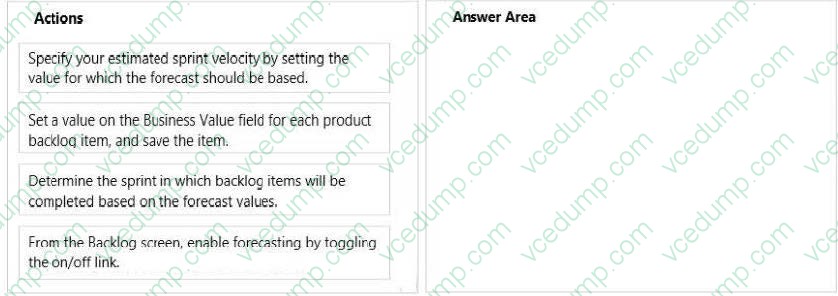
Your team uses Microsoft Visual Studio Team Foundation Server (TFS) to manage the software development process. You are using the Microsoft Visual Studio Scrum process template on your TFS Team Project.
Your product owner adds new product backlog items to your backlog.
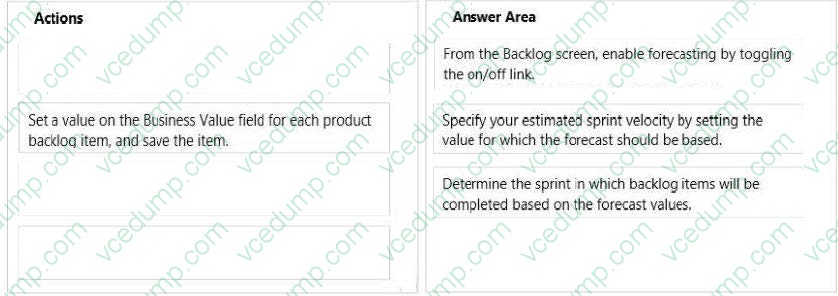
You need to estimate how many sprints are necessary to complete the work in your backlog.
You have set a value for the Effort field for each product backlog item found in your backlog as a first step.
Which three actions should you perform in sequence? To answer, move the appropriate actions from the list of actions to the answer area and arrange them in the correct order.
Select and Place:
-
Question 5:
You manage a development team that has been assigned the task of developing a reporting application. The team holds a kickoff meeting with the stakeholders to document user requirements.
You review the draft requirements list that results from this meeting. You need to indicate which requirements likely will require rework before you can send the requirements list to the development team.
Which three actions should you perform? (Each correct answer presents part of the solution. Choose three.)
A. Identify requirements that are independent of other requirements. These requirements likely will need to be integrated with the other requirements.
B. Identify requirements that cannot be tested easily. These requirements likely will need details to make them more testable.
C. Identify requirements that do not have estimates. These requirements likely will need additional details before they can be approved.
D. Identify requirements that depend on other requirements. These requirements likely will need to be split.
E. Identify requirements that provide little business value. These requirements likely will need to be reconsidered. -
Question 6:
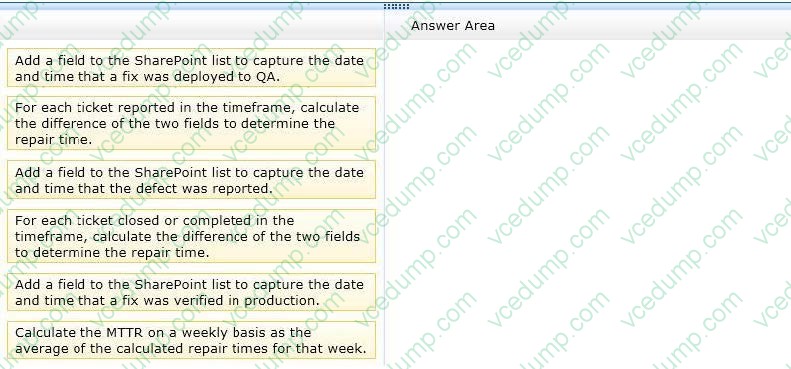
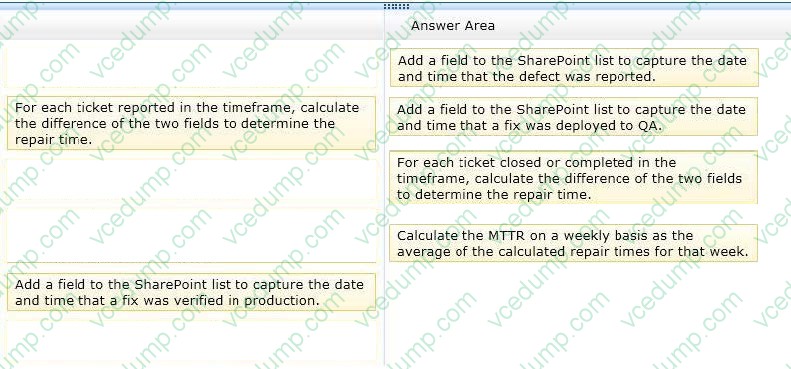
Your IT department uses a custom SharePoint list to capture help desk calls and ticket information. Management asks you to report the mean time to repair (MTTR) on a weekly basis.
You need to modify the list to capture the data necessary to prepare the report.
What should you do? (To answer, move the four appropriate actions from the list of actions to the answer area and arrange them in the correct order.)
Select and Place:
-
Question 7:
Your development team is using the Microsoft Solution Framework (MSF) for Capability Maturity Model Integration (CM MI) Process Improvement 6.0 process template.
You identify the high business value requirements of a project.
You need to prioritize the requirements and ensure that the updates are reflected on the TFS reports.
Which two actions should you perform? (Each correct answer presents part of the solution. Choose two.)
A. Set the Priority to 1 for each of the high-value requirements.
B. Use Microsoft Project.
C. Set the Stack Rank attribute to Top for each of the high-value requirements.
D. Use the Product Backlog feature. -
Question 8:
Your company network includes a Microsoft Visual Studio Team Foundation Server (TFS) 2012 server and Microsoft System Center 2012. Your company launches a new customer sales portal.
It is critical that all issues identified as potential bugs get addressed in a timely manner.
You need to ensure that incident response times are managed across support and development teams.
What should you do?
A. Use Service Manager.
B. Create a new incident within System Center and assign it to a bug work item in TFS.
C. Use SQL Server Reporting Services (SSRS) to query the Operations Manager Data Warehouse and create work items.
D. Use Orchestrator. -
Question 9:
You manage a software development project that includes multiple feature teams. The teams integrate their code into a shared code repository as frequently as possible.
You plan to configure a build definition by using the default build process template (DefaultTemplate.xaml).
You need to know when a check-in from a feature team has broken the build or caused a test to fail, without impacting the feature team.
What should you do?
A. Set the Analyze Test Impact parameter to True in the build process template.
B. Set the build trigger to Continuous Integration and enable automated testing.
C. Add the Builds check-in policy to your team project.
D. Create a shelveset command for pending changes. Queue a build using the latest source with the shelveset parameter. -
Question 10:
You are developing an n-tier application. An architect has provided a layer diagram as shown in the exhibit image. (Click the Exhibit button.)
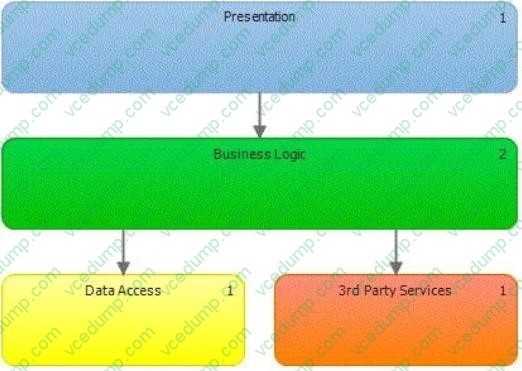
Your code is built as part of an automated team build.
A class in the data access layer is changed to utilize a utility class that resides in the business logic layer.
You need to ensure that the code and layer diagram are valid in a manner that follows good architectural and object oriented practices.
What should you do?
A. Create a new cross-cutting layer and refactor the utility class into the new layer, allowing the new layer to reference both the data access layer and the business logic layer.
B. Leave the layers the same and duplicate the utility class in both the data access layer and the business logic layer.
C. Create a new cross-cutting layer and refactor the utility class into the new layer, allowing the data access layer and business logic layer to have one-way dependencies to the new layer.
D. Change the dependency between the data access layer and the business logic layer to be bi- directional.
Related Exams:
-
62-193
Technology Literacy for Educators -
70-243
Administering and Deploying System Center 2012 Configuration Manager -
70-355
Universal Windows Platform – App Data, Services, and Coding Patterns -
77-420
Excel 2013 -
77-427
Excel 2013 Expert Part One -
77-725
Word 2016 Core Document Creation, Collaboration and Communication -
77-726
Word 2016 Expert Creating Documents for Effective Communication -
77-727
Excel 2016 Core Data Analysis, Manipulation, and Presentation -
77-728
Excel 2016 Expert: Interpreting Data for Insights -
77-731
Outlook 2016 Core Communication, Collaboration and Email Skills
Tips on How to Prepare for the Exams
Nowadays, the certification exams become more and more important and required by more and more enterprises when applying for a job. But how to prepare for the exam effectively? How to prepare for the exam in a short time with less efforts? How to get a ideal result and how to find the most reliable resources? Here on Vcedump.com, you will find all the answers. Vcedump.com provide not only Microsoft exam questions, answers and explanations but also complete assistance on your exam preparation and certification application. If you are confused on your 70-498 exam preparations and Microsoft certification application, do not hesitate to visit our Vcedump.com to find your solutions here.