70-475 Exam Details
-
Exam Code
:70-475 -
Exam Name
:Designing and Implementing Big Data Analytics Solutions -
Certification
:Microsoft Certifications -
Vendor
:Microsoft -
Total Questions
:123 Q&As -
Last Updated
:Dec 09, 2021
Microsoft 70-475 Online Questions & Answers
-
Question 21:
DRAG DROP
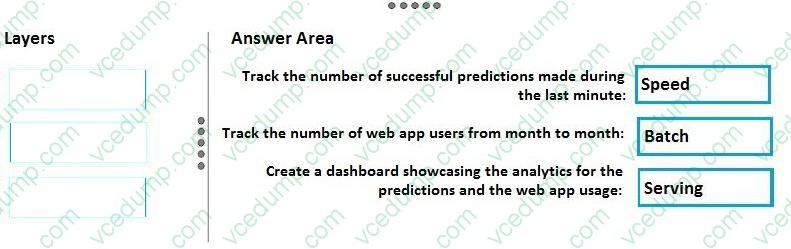
You have a web app that accepts user input, and then uses a Microsoft Azure Machine Learning model to predict a characteristic of the user.
You need to perform the following operations:
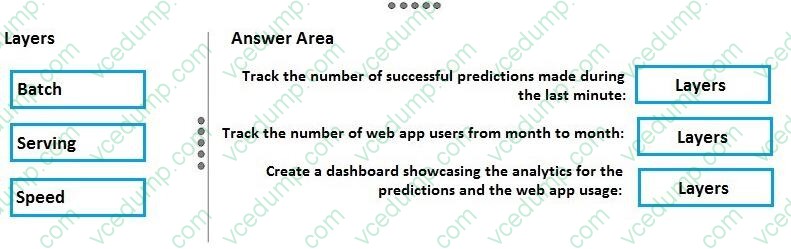
Track the number of web app users from month to month.
Track the number of successful predictions made during the last minute.
Create a dashboard showcasing the analytics for the predictions and the web app usage.
Which lambda layer should you query for each operation? To answer, drag the appropriate layers to the correct operations. Each layer may be used once, more than once, or not at all. You may need to drag the split bar between panes or
scroll to view content.
NOTE: Each correct selection is worth one point.
Select and Place:
-
Question 22:
Note: This question is part of a series of questions that present the same scenario. Each question in the series contains a unique solution that might meet the stated goals. Some question sets might have more than one correct solution, while
the others might not have a correct solution.
After you answer a question in this section, you will NOT be able to return to it. As a result, these questions will not appear in the review screen.
You plan to implement a new data warehouse.
You have the following information regarding the data warehouse:
The first data files for the data warehouse will be available in a few days.
Most queries that will be executed against the data warehouse are ad-hoc.
The schemas of data files that will be loaded to the data warehouse change often.
One month after the planned implementation, the data warehouse will contain 15 TB of data.
You need to recommend a database solution to support the planned implementation.
Solution: You recommend a Microsoft SQL server on a Microsoft Azure virtual machine.
Does this meet the goal?
A. Yes
B. No -
Question 23:
HOTSPOT
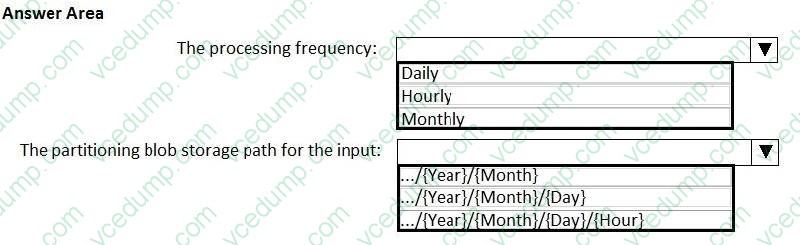
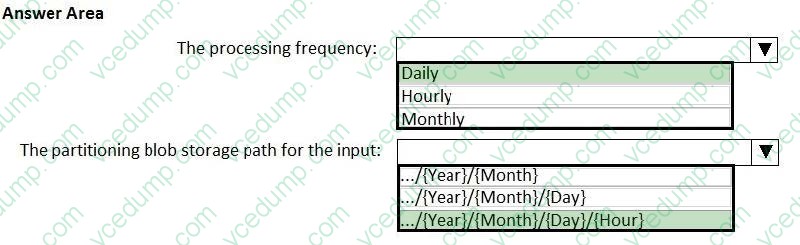
You are planning a solution that will have multiple data files stored in Microsoft Azure Blob storage every hour. Data processing will occur once a day at midnight only.
You create an Azure data factory that has blob storage as the input source and an Azure HDInsight activity that uses the input to create an output Hive table.
You need to identify a data slicing strategy for the data factory.
What should you identify? To answer, select the appropriate options in the answer area.
NOTE: Each correct selection is worth one point.
Hot Area:
-
Question 24:
HOTSPOT
You plan to design a solution to gather data from 5,000 sensors that are deployed to multiple machines. The sensors generate events that contain data on the health status of the machines.
You need to create a new Microsoft Azure event hub to collect the event data.
Which command should you run? To answer, select the appropriate options in the answer area.
NOTE: Each correct selection is worth one point.
Hot Area:

-
Question 25:
HOTSPOT
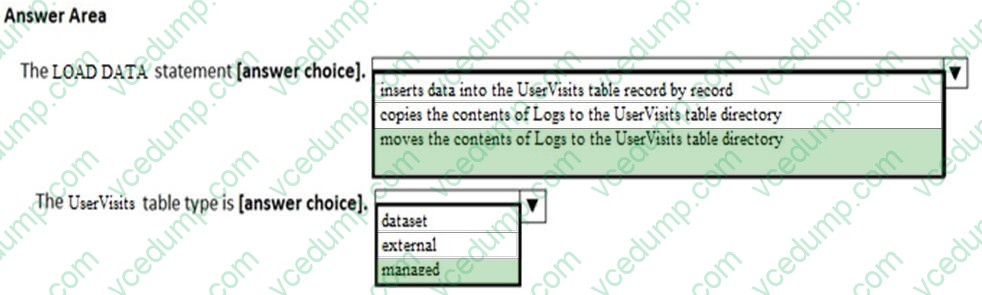
You have the following Hive query.
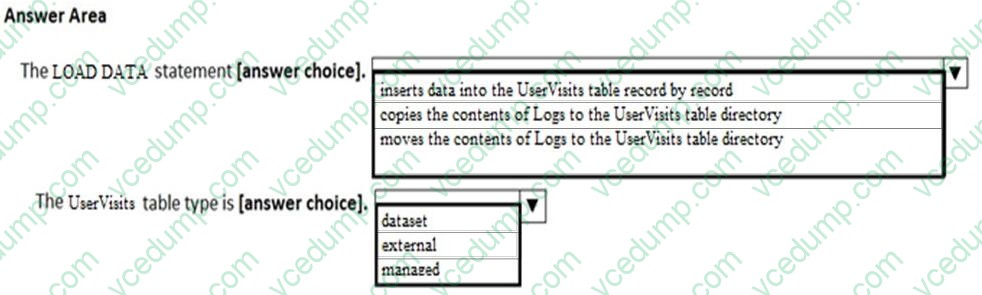
CREATE TABLE UserVisits (username string, urlvisited string, time date);
LOAD DATA INPATH `wasb:///Logs' OVERWRITE INTO TABLE UserVisits;
Use the drop-down menus to select the answer choice that completes each statement based on the information presented in the script.
NOTE: Each correct selection is worth one point.
Hot Area:
-
Question 26:
You need to automate the creation of a new Microsoft Azure data factory.
What are three possible technologies that you can use? Each correct answer presents a complete solution.
NOTE: Each correct selection is worth one point.
A. Azure PowerShell cmdlets
B. the SOAP service
C. T-SQL statements
D. the REST API
E. the Microsoft .NET Framework class library -
Question 27:
Your company builds hardware devices that contains sensors.
You need to recommend a solution to process the sensor data and to write back configuration changes to the devices.
What should you include in the recommendation?
A. Microsoft Azure Event Hubs
B. API apps in Microsoft Azure App Service
C. Microsoft Azure Notification Hubs
D. Microsoft Azure IoT Hub -
Question 28:
DRAG DROP
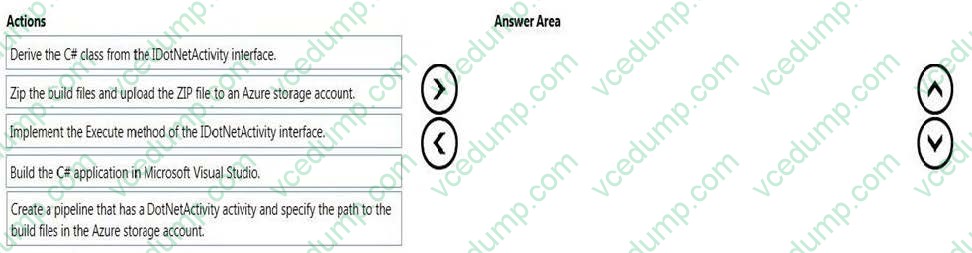
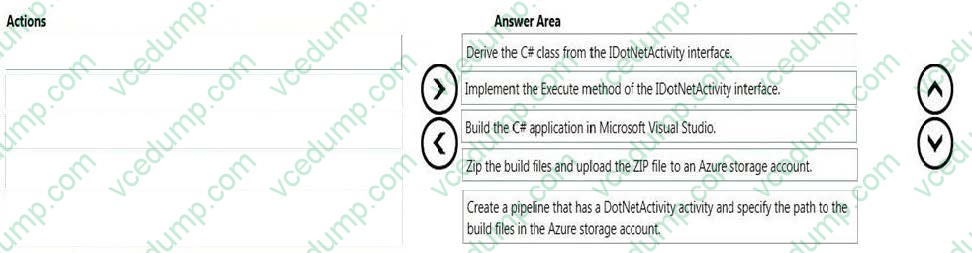
You have a Microsoft Azure HDInsight cluster for analytics workloads. You have a C# application on a local computer. You plan to use Azure Data Factory to run the C# application in Azure.
You need to create a data factory that runs C# application by using HDInsight.
In which order should you perform the actions? To answer, move all actions from the list of actions to the answer area and arrange them in the correct order. NOTE: More than one order of answer choices is correct. You will receive credit for any of the correct orders you select.
Select and Place:
-
Question 29:
HOTSPOT
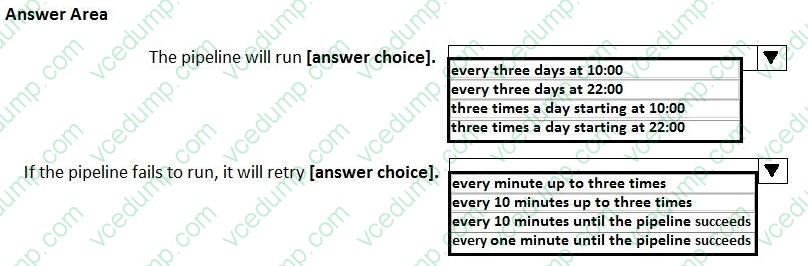
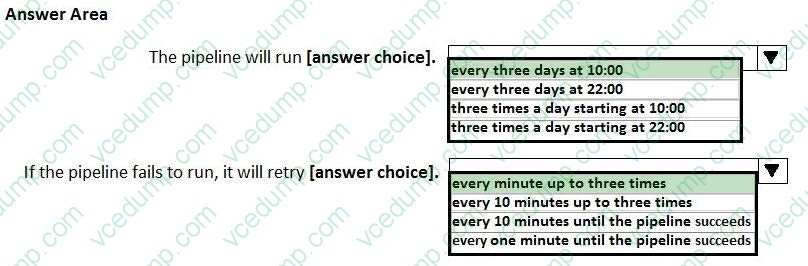
You have a pipeline that contains an input dataset in Microsoft Azure Table Storage and an output dataset in Azure Blob storage. You have the following JSON data.

Use the drop-down menus to select the answer choice that completes each statement based on the information presented in the JSON data. NOTE: Each correct selection is worth one point.
Hot Area:
-
Question 30:
DRAG DROP
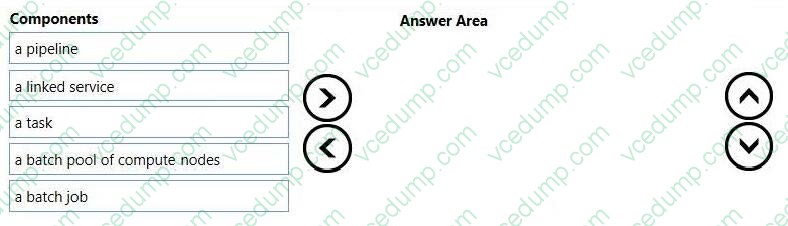
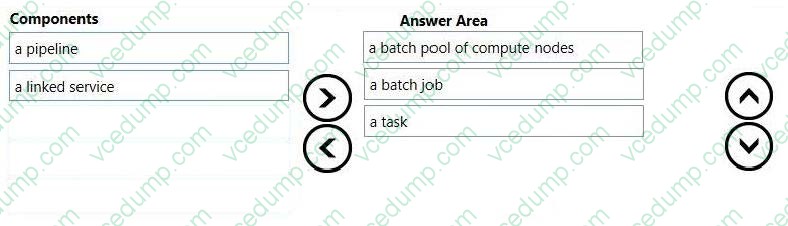
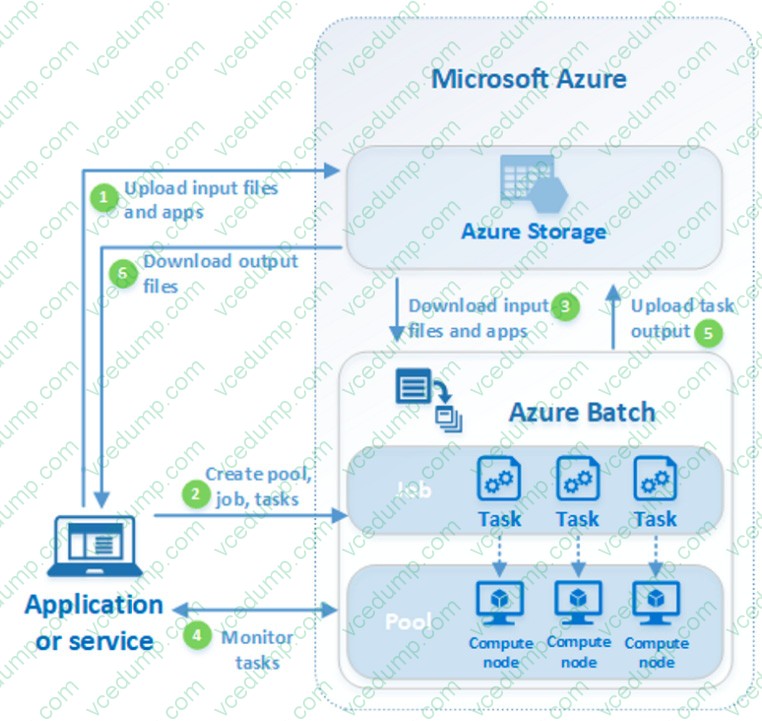
You have a financial model deployed to an application named finance1. The data from the financial model is stored in several data files.
You need to implement a batch processing architecture for the financial model.
You upload the data files and finance1 to a Microsoft Azure Storage account.
Which three components should you create in sequence next? To answer, move the appropriate components from the list of components to the answer area and arrange them in the correct order.
Select and Place:

Related Exams:
-
62-193
Technology Literacy for Educators -
70-243
Administering and Deploying System Center 2012 Configuration Manager -
70-355
Universal Windows Platform – App Data, Services, and Coding Patterns -
77-420
Excel 2013 -
77-427
Excel 2013 Expert Part One -
77-725
Word 2016 Core Document Creation, Collaboration and Communication -
77-726
Word 2016 Expert Creating Documents for Effective Communication -
77-727
Excel 2016 Core Data Analysis, Manipulation, and Presentation -
77-728
Excel 2016 Expert: Interpreting Data for Insights -
77-731
Outlook 2016 Core Communication, Collaboration and Email Skills
Tips on How to Prepare for the Exams
Nowadays, the certification exams become more and more important and required by more and more enterprises when applying for a job. But how to prepare for the exam effectively? How to prepare for the exam in a short time with less efforts? How to get a ideal result and how to find the most reliable resources? Here on Vcedump.com, you will find all the answers. Vcedump.com provide not only Microsoft exam questions, answers and explanations but also complete assistance on your exam preparation and certification application. If you are confused on your 70-475 exam preparations and Microsoft certification application, do not hesitate to visit our Vcedump.com to find your solutions here.