70-475 Exam Details
-
Exam Code
:70-475 -
Exam Name
:Designing and Implementing Big Data Analytics Solutions -
Certification
:Microsoft Certifications -
Vendor
:Microsoft -
Total Questions
:123 Q&As -
Last Updated
:Dec 09, 2021
Microsoft 70-475 Online Questions & Answers
-
Question 111:
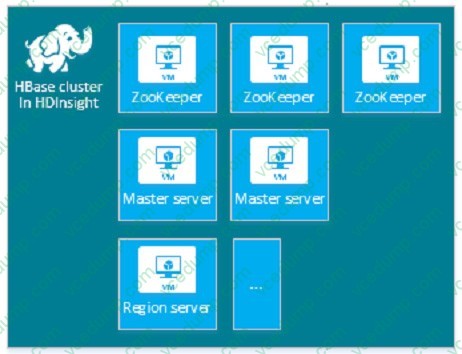
You are designing an Apache HBase cluster on Microsoft Azure HDInsight.
You need to identify which nodes are required for the cluster.
Which three nodes should you identify? Each correct answer presents part of the solution.
NOTE: Each correct selection is worth one point.
A. Nimbus
B. Zookeeper
C. Region
D. Supervisor
E. Falcon
F. Head -
Question 112:
HOTSPOT
Overview:
Litware, Inc. is a company that manufactures personal devices to track physical activity and other health-related data.
Litware has a health tracking application that sends health-related data from a user's personal device to Microsoft Azure.
Litware has three development and commercial offices. The offices are located in the United States, Luxembourg, and India.
Litware products are sold worldwide. Litware has commercial representatives in more than 80 countries.
Existing Environment:
In addition to using desktop computers in all of the offices, Litware recently started using Microsoft Azure resources and services for both development and operations.
Litware has an Azure Machine Learning solution.
Litware recently extended its platform to provide third-party companies with the ability to upload data from devices to Azure. The data can be aggregated across multiple devices to provide users with a comprehensive view of their global health activity.
While the upload from each device is small, potentially more than 100 million devices will upload data daily by using an Azure event hub. Each health activity has a small amount of data, such as activity type, start date/time, and end date/time.
Each activity is limited to a total of 3 KB and includes a customer identification key.
In addition to the Litware health tracking application, the users' activities can be reported to Azure by using an open API.
The developers at Litware perform Machine Learning experiments to recommend an appropriate health activity based on the past three activities of a user.
The Litware developers train a model to recommend the best activity for a user based on the hour of the day.
Requirements:
Litware plans to extend the existing dashboard features so that health activities can be compared between the users based on age, gender, and geographic region.
Minimize the costs associated with transferring data from the event hub to Azure Storage.
Litware identifies the following technical requirements:
Data from the devices must be stored for three years in a format that enables the fast processing of date fields and filtering.
The third-party companies must be able to use the Litware Machine Learning models to generate recommendations to their users by using a third-party application.
Any changes to the health tracking application must ensure that the Litware developers can run the experiments without interrupting or degrading the performance of the production environment.
Activity tracking data must be available to all of the Litware developers for experimentation. The developers must be prevented from accessing the private information of the users.
When the Litware health tracking application asks users how they feel, their responses must be reported to Azure.
The health tracking application uses the features of a live dashboard to provide historical and trending.
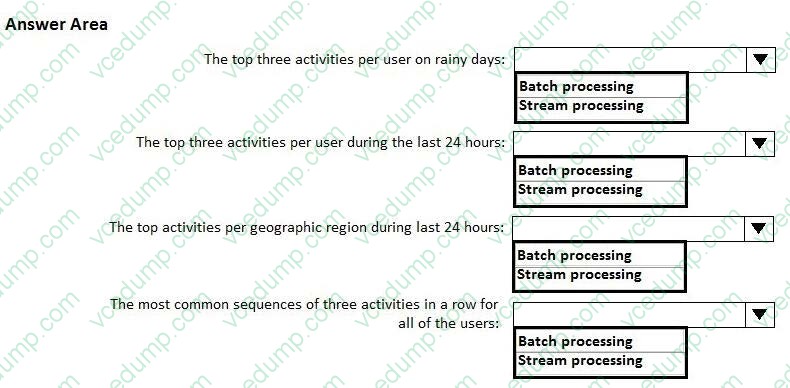
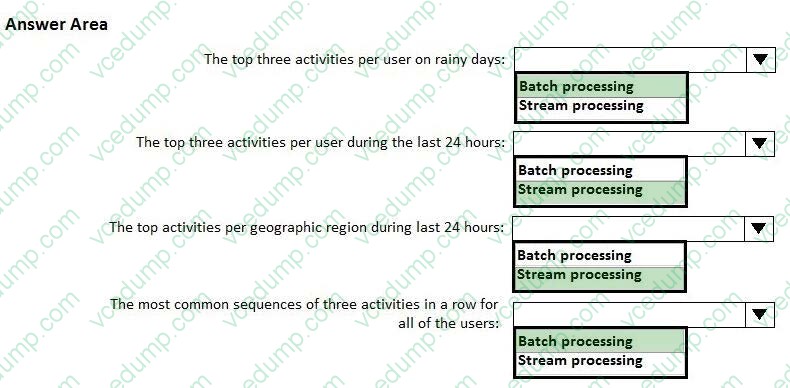
You need to recommend which processing model must be used to process the following types of data:
The top three activities per user on rainy days
The top three activities per user during the last 24 hours
The top activities per geographic region during last 24 hours
The most common sequences of three activities in a row for all of the users
Which processing model should you recommend for each date type? To answer, select the appropriate options in the answer area.
NOTE: Each correct selection is worth one point.
Hot Area:
-
Question 113:
You are developing a solution to ingest data in real-time from manufacturing sensors. The data will be archived. The archived data might be monitored after it is written.
You need to recommend a solution to ingest and archive the sensor data. The solution must allow alerts to be sent to specific users as the data is ingested.
What should you include in the recommendation?
A. a Microsoft Azure notification hub and an Azure function
B. a Microsoft Azure notification hub an Azure logic app
C. a Microsoft Azure Stream Analytics job that outputs data to an Apache Storm cluster in Azure HDInsight
D. a Microsoft Azure Stream Analytics job that outputs data to Azure Cosmos DB -
Question 114:
You plan to use Microsoft Azure IoT Hub to capture data from medical devices that contain sensors.
You need to ensure that each device has its own credentials. The solution must minimize the number of required privileges.
Which policy should you apply to the devices?
A. iothubowner
B. service
C. registryReadWrite
D. device -
Question 115:
You plan to analyze the execution logs of a pipeline to identify failures by using Microsoft power BI.
You need to automate the collection of monitoring data for the planned analysis.
What should you do from Microsoft Azure?
A. Create a Data Factory Set
B. Save a Data Factory Log
C. Add a Log Profile
D. Create an Alert Rule Email -
Question 116:
Note: This question is part of a series of questions that present the same scenario. Each question in the series contains a unique solution that might meet the stated goals. Some question sets might have more than one correct solution, while
the others might not have a correct solution.
After you answer a question in this section, you will NOT be able to return to it. As a result, these questions will not appear in the review screen.
You plan to deploy a Microsoft Azure SQL data warehouse and a web application.
The data warehouse will ingest 5 TB of data from an on-premises Microsoft SQL Server database daily. The web application will query the data warehouse.
You need to design a solution to ingest data into the data warehouse.
Solution: You use the bcp utility to export CSV files from SQL Server and then to import the files to Azure SQL Data Warehouse.
Does this meet the goal?
A. Yes
B. No -
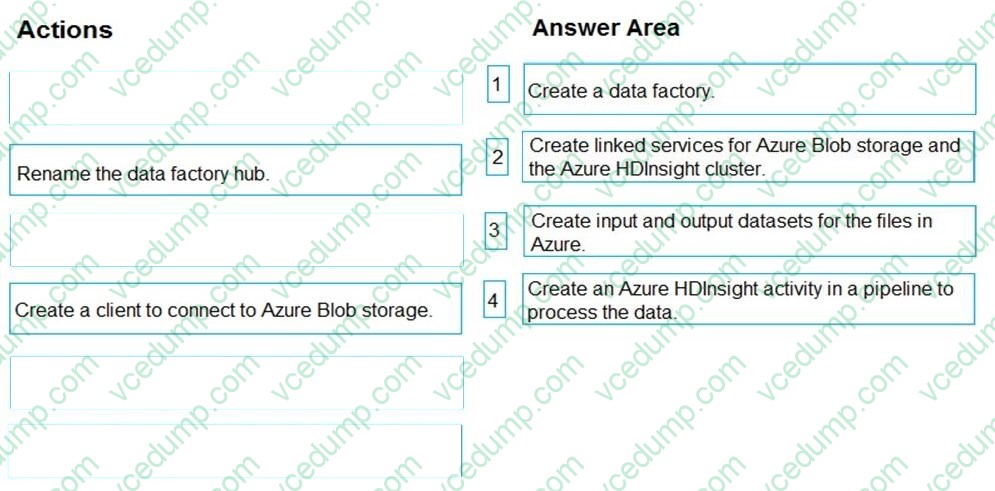
Question 117:
DRAG DROP
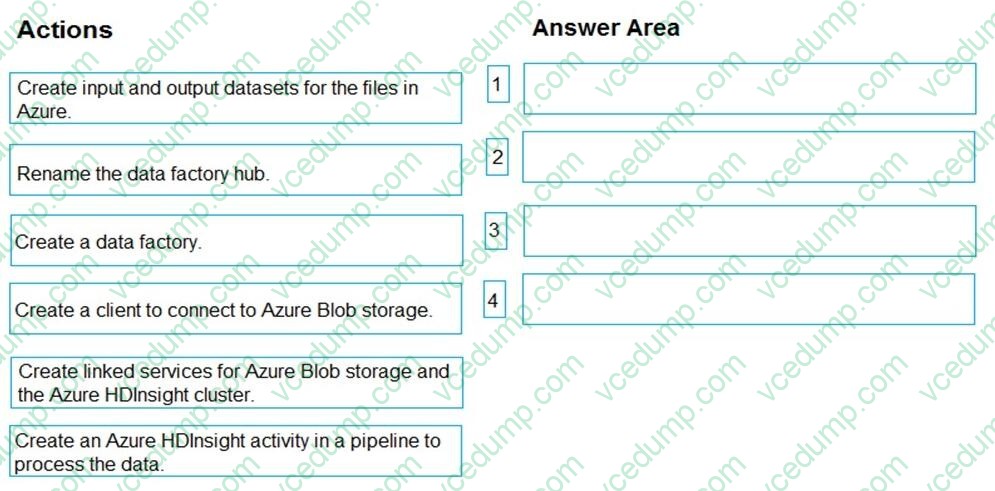
You have an analytics solution in Microsoft Azure that must be operationalized.
You have the relevant data in Azure Blob storage. You use an Azure HDInsight Cluster to process the data.
You plan to process the raw data files by using Azure HDInsight. Azure Data Factory will operationalize the solution.
You need to create a data factory to orchestrate the data movement. Output data must be written back to Azure Blob storage.
Which four actions should you perform in sequence? To answer, move the appropriate actions from the list of actions to the answer area and arrange them in the correct order.
Select and Place:
-
Question 118:
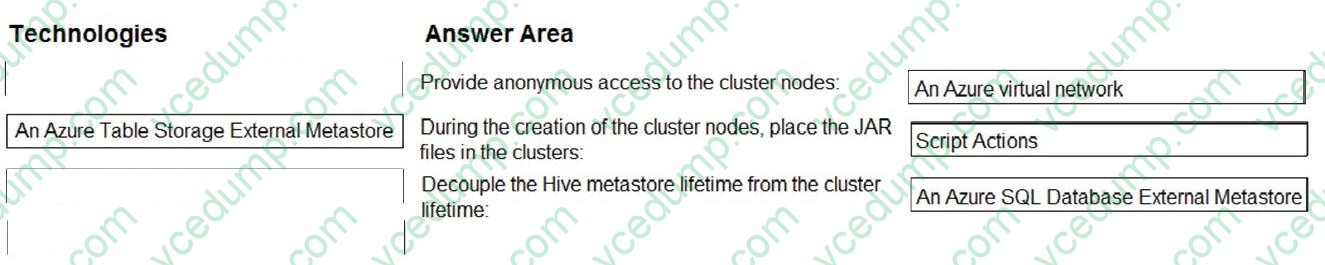
DRAG DROP
You plan to deploy a Hadoop cluster that includes a Hive installation.
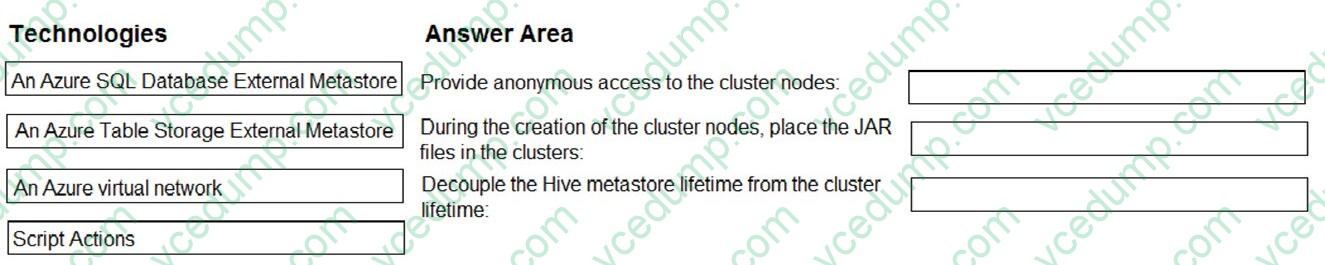
Your company identifies the following requirements for the planned deployment:
During the creation of the cluster nodes, place JAR files in the clusters.
Decouple the Hive metastore lifetime from the cluster lifetime.
Provide anonymous access to the cluster nodes.
You need to identify which technology must be used for each requirement.
Which technology should you identify for each requirement? To answer, drag the appropriate technologies to the correct requirements. Each technology may be used once, more than once, or not at all. You may need to drag the split bar
between panes or scroll to view content.
Select and Place:
-
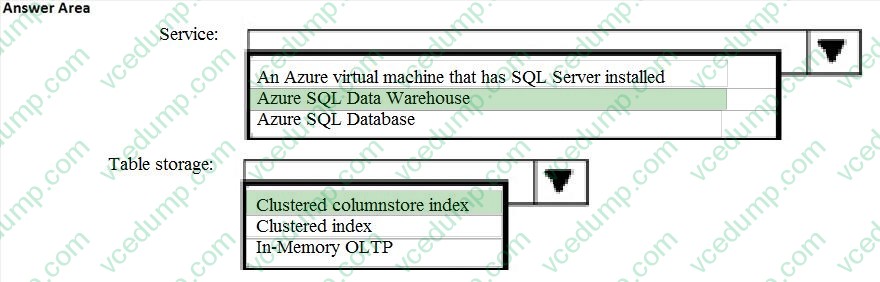
Question 119:
HOTSPOT
Overview:
Relecloud is a social media company that processes hundreds of millions of social media posts per day and sells advertisements to several hundred companies. Relecloud has a Microsoft SQL Server database named DB1 that stores information about the advertisers. DB1 is hosted on a Microsoft Azure virtual machine.
Relecloud has two main offices. The offices are located in San Francisco and New York City.
The offices connect to each other by using a site-to-site VPN. Each office connects directly to the Internet.
Relecloud modifies the pricing of its advertisements based on trending topics. Topics are considered to be trending if they generate many mentions in a specific country during a 15-minute time frame. The highest trending topics generate the highest advertising revenue.
Relecloud wants to deliver reports to the advertisers by using Microsoft Power BI. The reports will provide real-time data on trending topics, current advertising rates, and advertising costs for a given month. Relecloud will analyze the trending topics data, and then store the data in a new data warehouse for ad-hoc analysis. The data warehouse is expected to grow at a rate of 1 GB per hour or 8.7 terabytes (TB) per year. The data will be retained for five years for the purpose of long-term trending.
Requirements:
Management at Relecloud must be able to view which topics are trending to adjust advertising rates in near real-time.
Relecloud plans to implement a new streaming analytics platform that will report on trending topics.
Relecloud plans to implement a data warehouse named DB2.
Relecloud identifies the following technical requirements:
Social media data must be analyzed to identify trending topics in real-time.
The use of Infrastructure as a Service (IaaS) platforms must minimized, whenever possible.
The real-time solution used to analyze the social media data must support scaling up and down without service interruption.
Relecloud identifies the following technical requirements for the advertisers:
The advertisers must be able to see only their own data in the Power BI reports.
The advertisers must authenticate to Power BI by using Azure Active Directory (Azure AD) credentials.
The advertisers must be able to leverage existing Transact-SQL language knowledge when developing the real-time streaming solution.
Members of the internal advertising sales team at Relecloud must be able to see only the sales date of the advertisers to which they are assigned.
The internal Relecloud advertising sales team must be prevented from inserting, updating, and deleting rows for the advertisers to which they are not assigned.
The internal Relecloud advertising sales team must be able to use a text file to update the list of advertisers, and then to upload the file to Azure Blob storage.
Relecloud identifies the following requirements for DB1:
Data generated by the streaming analytics platform must be stored in DB1.
The user names of the advertisers must be mapped to CustomerID in a table named Table2.
The advertisers in DB1 must be stored in a table named Table1 and must be refreshed nightly.
The user names of the employees at Relecloud must be mapped to EmployeeID in a table named Table3.
Relecloud identifies the following requirements for DB2:
DB2 must have minimal storage costs.
DB2 must run load processes in parallel.
DB2 must support massive parallel processing.
DB2 must be able to store more than 40 TB of data.
DB2 must support scaling up and down, as required.
Data from DB1 must be archived in DB2 for long-term storage.
All of the reports that are executed from DB2 must use aggregation.
Users must be able to pause DB2 when the data warehouse is not in use.
Users must be able to view previous versions of the data in DB2 by using aggregates.
Relecloud identifies the following requirements for extract, transformation, and load (ETL):
Data movement between DB1 and DB2 must occur each hour.
An email alert must be generated when a failure of any type occurs during ETL processing.
Sample code and data:
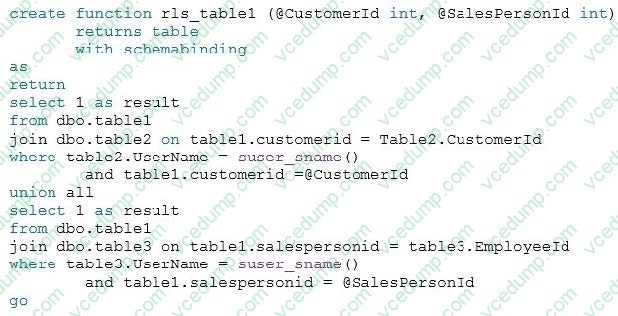
You execute the following code for a table named rls_table1.
You use the following code to create Table1.
create table table1 (customerid int, salespersonid int ... ) Go
The following is a sample of the streaming data.

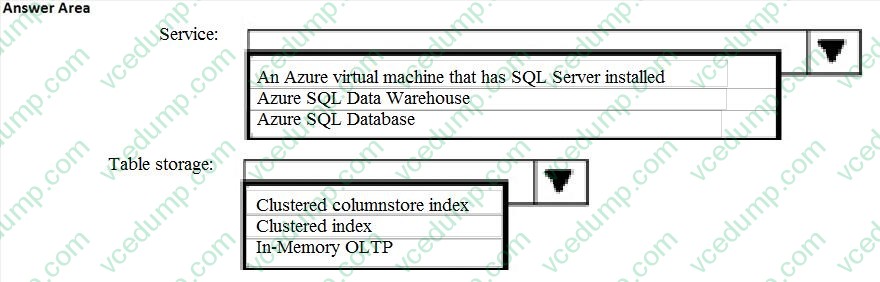
Which service solution and which table storage solution should you recommend for DB2? To answer, select the appropriate options in the answer area. NOTE: Each correct selection is worth one point.
Hot Area:
-
Question 120:
You have an Apache Storm cluster.
The cluster will ingest data from a Microsoft Azure event hub.
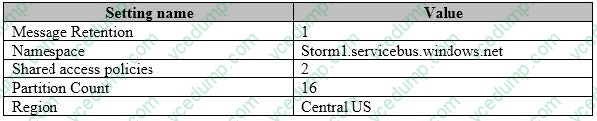
The event hub has the characteristics described in the following table.
You are designing the Storm application topology.
You need to ingest data from all of the partitions. The solution must maximize the throughput of the data ingestion.
Which setting should you use?
A. Partition Count
B. Message Retention
C. Partition Key
D. Shared access policies
Related Exams:
-
62-193
Technology Literacy for Educators -
70-243
Administering and Deploying System Center 2012 Configuration Manager -
70-355
Universal Windows Platform – App Data, Services, and Coding Patterns -
77-420
Excel 2013 -
77-427
Excel 2013 Expert Part One -
77-725
Word 2016 Core Document Creation, Collaboration and Communication -
77-726
Word 2016 Expert Creating Documents for Effective Communication -
77-727
Excel 2016 Core Data Analysis, Manipulation, and Presentation -
77-728
Excel 2016 Expert: Interpreting Data for Insights -
77-731
Outlook 2016 Core Communication, Collaboration and Email Skills
Tips on How to Prepare for the Exams
Nowadays, the certification exams become more and more important and required by more and more enterprises when applying for a job. But how to prepare for the exam effectively? How to prepare for the exam in a short time with less efforts? How to get a ideal result and how to find the most reliable resources? Here on Vcedump.com, you will find all the answers. Vcedump.com provide not only Microsoft exam questions, answers and explanations but also complete assistance on your exam preparation and certification application. If you are confused on your 70-475 exam preparations and Microsoft certification application, do not hesitate to visit our Vcedump.com to find your solutions here.