70-462 Exam Details
-
Exam Code
:70-462 -
Exam Name
:Administering Microsoft SQL Server 2012/2014 Databases -
Certification
:Microsoft Certifications -
Vendor
:Microsoft -
Total Questions
:324 Q&As -
Last Updated
:Feb 06, 2022
Microsoft 70-462 Online Questions & Answers
-
Question 291:
You are designing a data warehouse with two fact tables.
The first table contains sales per month and the second table contains orders per day.
Referential integrity must be enforced declaratively.
You need to design a solution that can join a single time dimension to both fact tables.
What should you do?
A. Join the two fact tables.
B. Merge the fact tables.
C. Create a time dimension that can join to both fact tables at their respective granularity.
D. Create a surrogate key for the time dimension. -
Question 292:
You install Microsoft SQL Server 2012 on a new server.
After setup is complete, you attempt to start the SQL Server service. After being in a starting state for a few moments, the service goes back to a stopped state.
You need to determine the cause of the failure.
Which file should you use?
A. %programfiles%\Microsoft SQL Server\MSSQL11.MSSQLSERVER\MSSQL\Log\Errorlog
B. %programfiles%\Microsoft SQL Server\110\Setup Bootstrap\Log\Summary.txt
C. %programfiles%\Microsoft SQL Server\110\Shared\ErrorDumps\SQLDmpr[XXXX].mdmp
D. %programfiles%\Microsoft SQL Server\MSSQL11.MSSQLSERVER\MSSQL\DATA\mastlog.ldf -
Question 293:
Which of the following file systems is supported for an SQL Server 2012 installation?
A. EXT4
B. NTFS
C. FAT16
D. EXT3 -
Question 294:
Note: This question is part of a series of questions that use the same set of answer choices. An answer choice may be correct for more than one question in the series. You administer a SQL 2012 server that contains a database named
SalesDB. SalesDb contains a schema named Customers that has a table named Regions. A user named UserA is a member of a role named Sales.
UserA is granted the Select permission on the Regions table. The Sales role is granted the Select permission on the Customers schema.
You need to remove the Select permission for UserA on the Regions table. You also need to ensure that UserA can still access all the tables in the Customers schema, including the Regions table, through the Sales role permissions.
Which Transact-SQL statement should you use?
A. DENY SELECT ON Object::Regions FROM UserA
B. DENY SELECT ON Schema::Customers FROM UserA
C. EXEC sp_addrolemember 'Sales', 'UserA'
D. REVOKE SELECT ON Object::Regions FROM UserA
E. REVOKE SELECT ON Object::Regions FROM Sales
F. EXEC sp_droprolemember 'Sales', 'UserA'
G. REVOKE SELECT ON Schema::Customers FROM UserA
H. DENY SELECT ON Object::Regions FROM Sales
I. DENY SELECT ON Schema::Customers FROM Sales
J. REVOKE SELECT ON Schema::Customers FROM Sales -
Question 295:
You administer two instances of Microsoft SQL Server. You deploy an application that uses a database on the named instance.
The application is unable to connect to the database on the named instance.
You need to ensure that the application can connect to the named instance.
What should you do?
A. Start the SQL Server Browser Service.
B. Configure the application as data-tiered.
C. Open port 1433 on the Windows firewall on the server.
D. Configure the named SQL Server instance to use an account that is a member of the Domain Admins group. -
Question 296:
DRAG DROP
You administer a Microsoft SQL Server 2012 instance.
Users report very poor performance. You run the following query and find several wait types with high wait_time_ms_values:
You need to resolve the high wait times to improve the performance.
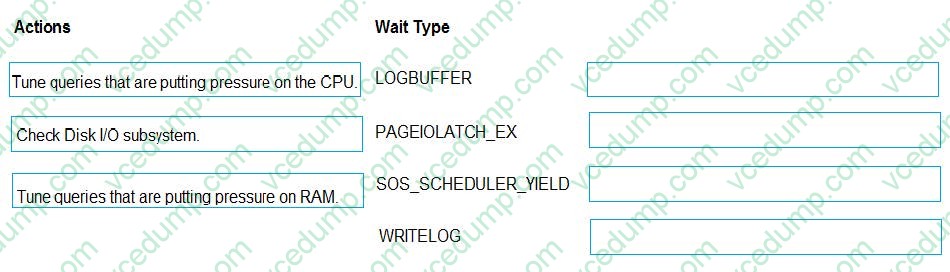
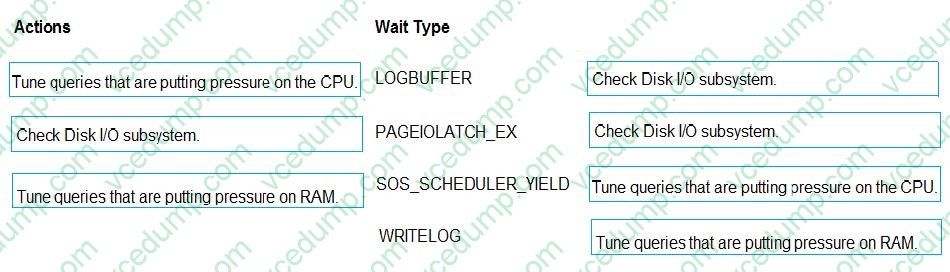
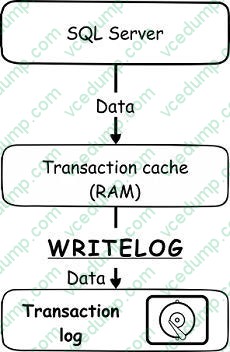
Which actions should you perform to attempt to resolve each wait type? To answer, drag the appropriate actions to the correct wait types. Answer choices may be used once, more than once, or not at all. You may need to drag the split bar
between panes or scroll to view content.
Select and Place:
-
Question 297:
You have a server named SPS1 that has Microsoft SharePoint Server 2013 installed.
You have several Power View reports that are created in Microsoft Excel 2016.
You need to configure SPS1 to display the Power View reports.
Which two SQL Server components should you install on SPS1? Each correct answer presents part of the solution.
A. SQL Server Analysis Services (SSAS) in Multidimensional and Data Mining Mode
B. SQL Server Reporting Services (SSRS) in SharePoint mode
C. the PowerPivot for SharePoint 2013 add-in
D. SQL Server Analysis Services (SSAS) in SharePoint mode
E. SQL Server Analysis Services (SSAS) in Tabular Mode -
Question 298:
You plan to install a Microsoft SQL Server instance.
The instance will support a database that has the following requirements:
Store Excel workbooks on the file system.
Access the workbooks through Transact-SQL.
Include the workbooks in database backups.
During installation, you need to ensure that the requirements will be met.
Which feature should you use?
A. Excel Services
B. FILESTREAM
C. SQL Server Integration Services (SSIS)
D. OpenXML -
Question 299:
DRAG DROP
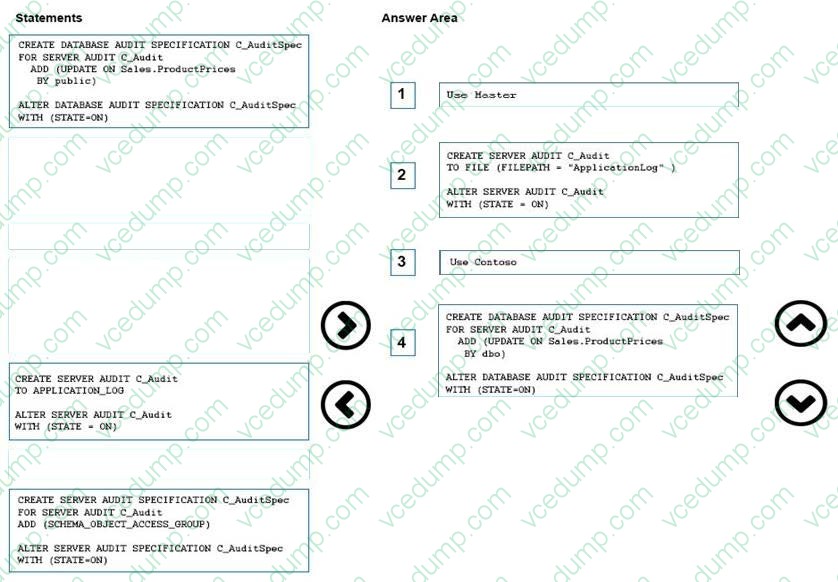
You administer a Microsoft SQL Server database server that has a database named Contoso. The Contoso database has a table named ProductPrices in a schema named Sales.
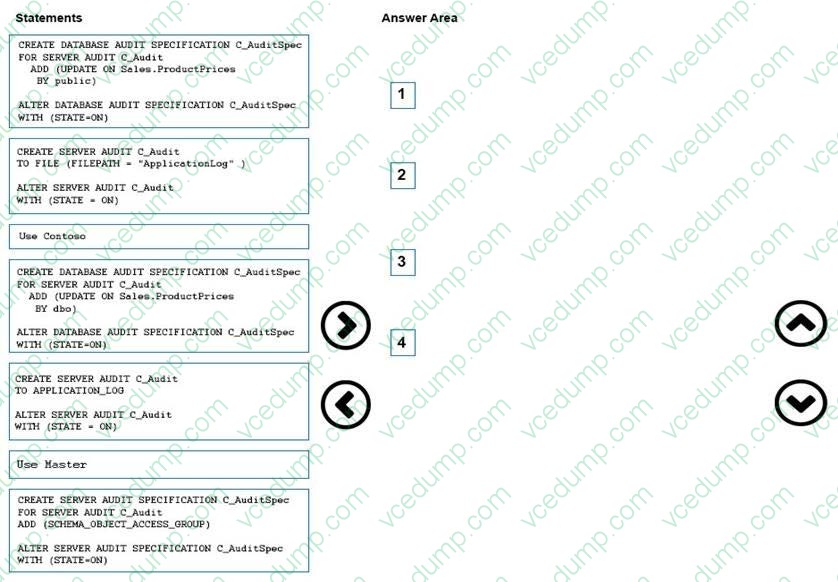
You need to create a script that writes audit events into the application log whenever data in the ProductPrices table is updated.
Which four Transact-SQL statements should you use? (To answer, move the appropriate statements from the list of statements to the answer area and arrange them in the correct order.)
Select and Place:
-
Question 300:
You have been hired as a Database Consultant by ABC.com to design a SQL Server 2012 database solution.
You are tasked with designing a scale-out and high-availability SQL Server 2012 Online
Transaction Processing (OLTP) database solution that will maintain copies of data across two server instances.
Your solution must provide scale-out of read operations by distributing the reads from clients across two SQL Server 2012 nodes. The data in both SQL Server nodes needs to be indexed.
What should you include in your solution?
A. You should include a primary database with scheduled log shipping to the secondary database configured.
B. You should include two servers configured in an Active-Passive SQL Server 2012 Cluster.
C. You should include a primary SQL Server 2012 database that uses transactional replication to replicate data to the secondary database.
D. You should include two servers in an Asynchronous-Commit Availability Mode Availability Group.
E. You should include two servers in a Synchronous-Commit Availability Mode Availability Group.
Related Exams:
-
62-193
Technology Literacy for Educators -
70-243
Administering and Deploying System Center 2012 Configuration Manager -
70-355
Universal Windows Platform – App Data, Services, and Coding Patterns -
77-420
Excel 2013 -
77-427
Excel 2013 Expert Part One -
77-725
Word 2016 Core Document Creation, Collaboration and Communication -
77-726
Word 2016 Expert Creating Documents for Effective Communication -
77-727
Excel 2016 Core Data Analysis, Manipulation, and Presentation -
77-728
Excel 2016 Expert: Interpreting Data for Insights -
77-731
Outlook 2016 Core Communication, Collaboration and Email Skills
Tips on How to Prepare for the Exams
Nowadays, the certification exams become more and more important and required by more and more enterprises when applying for a job. But how to prepare for the exam effectively? How to prepare for the exam in a short time with less efforts? How to get a ideal result and how to find the most reliable resources? Here on Vcedump.com, you will find all the answers. Vcedump.com provide not only Microsoft exam questions, answers and explanations but also complete assistance on your exam preparation and certification application. If you are confused on your 70-462 exam preparations and Microsoft certification application, do not hesitate to visit our Vcedump.com to find your solutions here.