642-885 Exam Details
-
Exam Code
:642-885 -
Exam Name
:Deploying Cisco Service Provider Advanced Routing -
Certification
:Cisco Certifications -
Vendor
:Cisco -
Total Questions
:131 Q&As -
Last Updated
:Jun 15, 2024
Cisco 642-885 Online Questions & Answers
-
Question 81:
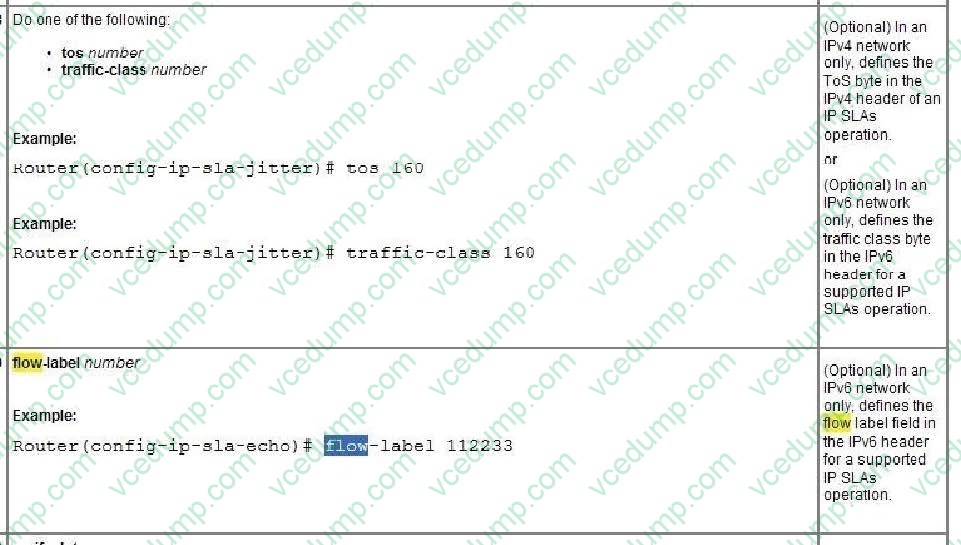
When implementing IP SLA icmp-echo probes on Cisco IOS-XE routers, which two options are available for IPv6? (Choose two.)
A. flow-label
B. hop-limit
C. DSCP
D. traffic-class
E. TOS -
Question 82:
In which four ways does DHCPv6 differ from DHCPv4? (Choose four.)
A. DHCPv6 uses the same message types as DHCPv4.
B. DHCPv4 functions without external protocols.
C. A host discovers a DHCPv6 server by using a DHCP Discover packet.
D. A hosts discovers a DHCPv6 server by using a DHCP Solicit packet.
E. A DHCPv6 server replies with a DHCP Offer packet.
F. A DHCP server replies with a DHCP Advertise message.
G. An IPv6 host can request multiple addresses at the same time from a DHCPv6 server.
H. An IPv6 host can request only one IP address at a time from a DHCPv6 server. -
Question 83:
Which four operations are components of MSDP in interdomain multicast setup? (Choose four.)
A. Multiple domains can have a single statically defined RP.
B. RPs interconnect between domains with UDP connections to pass source active messages.
C. RPs interconnect between domains with TCP connections to pass source active messages.
D. RPs send source active messages for internal sources to MSDP peers.
E. Source active messages are Peer-RPF checked before accepting or forwarding.
F. RPs learn about external sources via source active messages and may trigger (S,G) joins on behalf of local receivers.
G. MSDP connections typically parallel PIM-SM connections. -
Question 84:
Which two options are characteristics of configuration templates used by Cisco IOS XR to optimize BGP peering implementations? (Choose two.)
A. Session groups are used to inherit address family-specific configurations.
B. Cisco IOS XR provides by default a session group operating with all the supported address families.
C. Session groups are used to inherit address family-independent configurations.
D. Session groups can be included within a neighbor group.
E. Session groups can include neighbor groups. -
Question 85:
A junior network engineer has just configured a new IBGP peering between two Cisco ASR9K PE routers in the network using the loopback interface of the router, but the IBGP neighborship is not able to be established. Which two verification steps will be helpful in troubleshooting this problem? (Choose two.)
A. Verify that the network command under router BGP is configured correct on each router for announcing the router's loopback interface in BGP
B. Verify that the ibgp-multihop command under the BGP neighbor is configured correctly on each router
C. Verify that the loopback interfaces are reachable over the IGP
D. Verify that the update-source loopback command under the BGP neighbor is configured correctly on each router
E. Verify that the ttl-security command under the BGP neighbor is configured correctly on each router to enable the router to send the BGP packets using a proper TTL value
F. Verify that the UDP port 179 traffic is not being blocked by an ACL or firewall between the two IBGP peers -
Question 86:
Which types of multicast distribution tree can PIM-SM use?
A. Only shared tree rooted at the source
B. Only shared tree rooted at the RP
C. Only shortest path tree rooted at the RP
D. Shared tree rooted at the source and shortest path tree switchover
E. Shared tree rooted at the RP and shortest path tree switchover
F. Shared tree rooted at the first-hop router and shortest path tree rooted at the RP -
Question 87:
Refer to the exhibit.
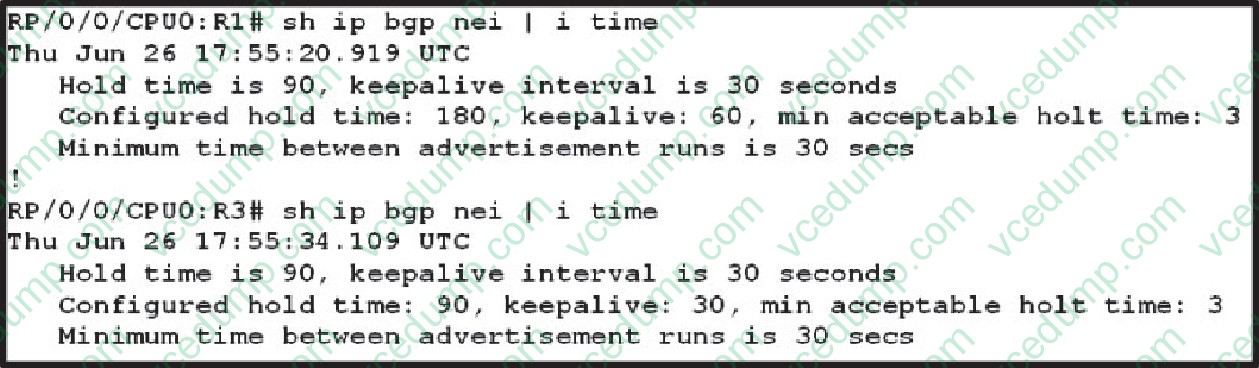
Based on the output of two eBGP adjacent neighbors, which command can be used to set up the default BGP timers?
A. RP/0/0/CPU0:R1(config-bgp)#timers bgp 60 30
B. RP/0/0/CPU0:R2(config-bgp)#timers bgp 30 60
C. RP/0/0/CPU0:R2(config-bgp-nbr)#timers bgp 180 60
D. RP/0/0/CPU0:R2(config-bgp)#timers bgp 60 180
E. RP/0/0/CPU0:R1(config-bgp)#timers bgp 60 180 -
Question 88:
Which statement is correct regarding using the TTL threshold to define the delivery boundaries of multicast traffic?
A. If a packet TTL is less than the specified TTL threshold, the packet is forwarded out of the interface
B. If a packet TTL is greater or equal to the specified TTL threshold, the packet is forwarded out of the interface
C. If a packet TTL is equal to the specified TTL threshold, the packet is dropped
D. When a multicast packet arrives, the TTL threshold value is decremented by 1. If the resulting TTL threshold value is greater than or equal to 0, the packet is dropped -
Question 89:
Which mechanism is used by an IPv6 multicast receiver to join an IPv6 multicast group?
A. IGMP report
B. IGMP join
C. MLD report
D. General query
E. PIM join -
Question 90:
Referring to the topology diagram show in the exhibit,
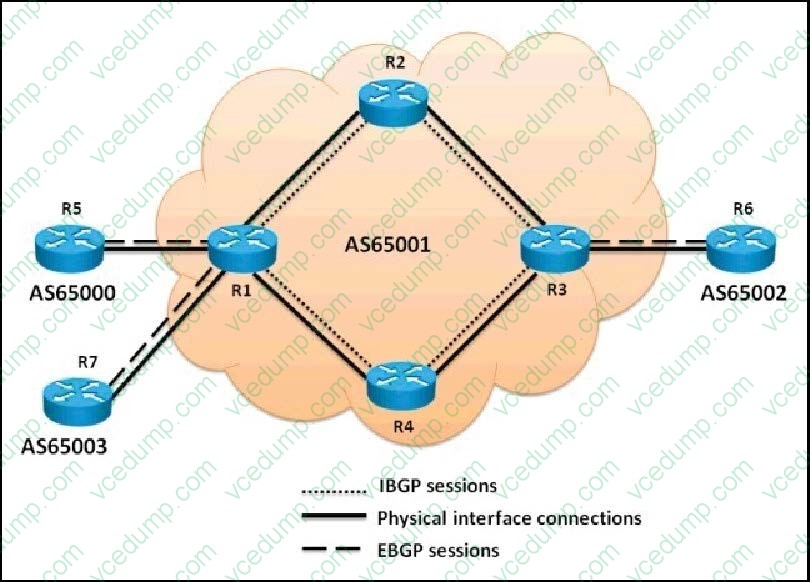
which three statements are correct regarding the BGP routing updates? (Choose three.)
A. The EBGP routing updates received by R1 from R5 will be propagated to the R2, R4, and R7 routers
B. The EBGP routing updates received by R3 from R6 will be propagated to the R2 and R4 routers
C. The EBGP routing updates received by R1 from R5 will be propagated to the R2 and R4 routers
D. The IBGP routing updates received by R3 from R2 will be propagated to the R6 router
E. The IBGP routing updates received by R2 from R1 will be propagated to the R3 router
F. The IBGP routing updates received by R1 from R4 will be propagated to the R5, R7, and R2 routers
Related Exams:
-
300-745
Designing Cisco Security Infrastructure (300-745 SDSI) v1.0 -
350-101
Implementing and Operating Cisco Wireless Core Technologies (350-101 WLCOR)v1.0 -
352-011
Cisco Certified Design Expert Practical -
500-052
Cisco Unified Contact Center Express -
500-173
Designing the FlexPod Solution (FPDESIGN) -
500-201
Deploying Cisco Service Provider Mobile Backhaul Solutions -
500-210
SP Optical Technology Field Engineer Representative -
500-220
Engineering Cisco Meraki Solutions (ECMS) v2.2 -
500-230
Cisco Service Provider Routing Field Engineer -
500-240
Cisco Mobile Backhaul for Field Engineers
Tips on How to Prepare for the Exams
Nowadays, the certification exams become more and more important and required by more and more enterprises when applying for a job. But how to prepare for the exam effectively? How to prepare for the exam in a short time with less efforts? How to get a ideal result and how to find the most reliable resources? Here on Vcedump.com, you will find all the answers. Vcedump.com provide not only Cisco exam questions, answers and explanations but also complete assistance on your exam preparation and certification application. If you are confused on your 642-885 exam preparations and Cisco certification application, do not hesitate to visit our Vcedump.com to find your solutions here.