642-661 Exam Details
-
Exam Code
:642-661 -
Exam Name
:CCIP Configuring BGP on Cisco Routers (BGP) -
Certification
:Cisco Certifications -
Vendor
:Cisco -
Total Questions
:181 Q&As -
Last Updated
:Dec 15, 2021
Cisco 642-661 Online Questions & Answers
-
Question 51:
Which two statements are true about route reflector configurations? (Choose two)
A. Clients must have IBGP sessions to the other clients and to the route reflector.
B. The neighbor ip-address route-reflector-client configuration command is required on the route reflectors.
C. When a cluster contains multiple route reflectors, all the route reflectors in the cluster need to be configured with the same Cluster-ID.
D. When a cluster contains multiple route reflectors, thebgp cluster-id cluster-id configuration command is required on the clients on the route reflectors. -
Question 52:
Which BGP path attribute is only used within the local router and NOT shared between all the BGP routers within the AS?
A. MED
B. Origin
C. Weight
D. Local Preference -
Question 53:
Refer to the exhibit. What effect will the route-map PEER-FILTER have on the route 24.11.62.0/24 with a community of 10:100 injected by the peer router in AS632?
A. local preference will be set to 105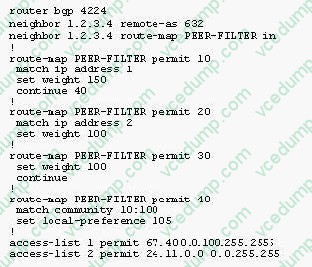
B. weight will be set to 100, local preference will be set to 105
C. weight will be set to 150
D. weight will be set to 100
E. weight will be set to 150, local preference will be set to 105 -
Question 54:
When creating iBGP multipaths which three criteria must be met by multiple paths to the same destination? (Choose three.)
A. The destination AS-number must be different for each destination.
B. Each destination must have a different next-hop address.
C. Router IDs must be the same on all routers.
D. Multi-exit discriminator attributes must be the same on all paths.
E. Interior Gateway Protocol distance must be identical on each path. -
Question 55:
Which of the following errors is the most common when configuring BGP routers within a transit AS?
A. using BGP next-hop-self on the edge routers
B. BGP to IGP redistribution errors
C. IGP to BGP redistribution errors
D. BGP synchronization enabled -
Question 56:
In the diagram, the customer is using static routing to connect to the ISP. Which configuration on the ISP edge routers will enable load balancing and backup of the traffic to the customer?
A. ! R1 ip route 10.1.1.0 255.255.255.128 serial 0 ip route 10.1.1.128 255.255.255.128 serial 0 ! R2 ip route 10.1.1.128 255.255.255.128 serial 0 ip route 10.1.1.0 255.255.255.128 serial 0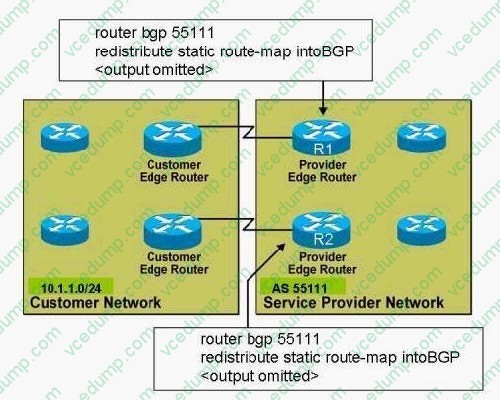
B. ! R1 ip route 10.1.1.0 255.255.255.128 serial 0 ! R2 ip route 10.1.1.128 255.255.255.128 serial
C. ! R1 ip route 10.1.1.0 255.255.255.128 serial 0 ip route 10.1.1.0 255.255.255.0 serial 0 ! R2 ip route 10.1.1.128 255.255.255.128 serial 0 ip route 10.1.1.0 255.255.255.0 serial 0
D. ! R1 ip route 10.1.1.0 255.255.255.0 serial 0 ! R2 ip route 10.1.1.128 255.255.255.0 serial 0 -
Question 57:
What are three characteristics of the local preference BGP attribute? (Choose three.)
A. It is a Cisco-only BGP path attribute.
B. It is used to influence the incoming traffic.
C. Its default local preference is 32768.
D. It can be used to ensure an AS-wide route selection policy.
E. It is stripped in outgoing EBGP updates except with confederation peers.
F. It is used to select routes with equal weight. -
Question 58:
Based on the following show ip bgp neighbor 10.1.1.1 output:R1#show ip bgp neighbor 10.1.1.1BGP neighbor is 10.1.1.1, remote AS 65102, external linkBGP version 4, remote router ID 0.0.0.0BGP state=IdleLast read 00:00:04, hold time is 180, keepalive interval is 60 secondsReceived 0 messages, 0 notifications, 0 in queueSent 0 messages, 0 notifications, 0 in queueRoute refresh request: received 0, sent 0Default minimum time between advertisement runs is 30 secondsFor address family: IPv4 UnicastBGP table version 1, neighbor version 0Index 2, Offset 0, Mask 0x40 accepted prefixes consume 0 bytesPrefix advertised 0, suppressed 0, withdrawn 0Connections established 0; dropped 0Last reset neverExternal BGP neighbor not directly connected.No active TCP connectionWhat is causing the BGP session to the 10.1.1.1 neighbor to remain in the Idle state?
A. The EBGP-multihop value for neighbor 10.1.1.1 is set to the default value.
B. There is an AS number configuration error.
C. The BGP session is using the loopback interface but the update-source is not set to specify the loopback interface.
D. There is an access-list blocking TCP port 179 traffic between the two BGP neighbors. -
Question 59:
Refer to the exhibit. All routers are running BGP. Which of these statements is correct?
A. EBGP is being run betweenRtr-A and Rtr-C and between Rtr-B and Rtr-D. All connections between routers inside AS 200 are IBGP.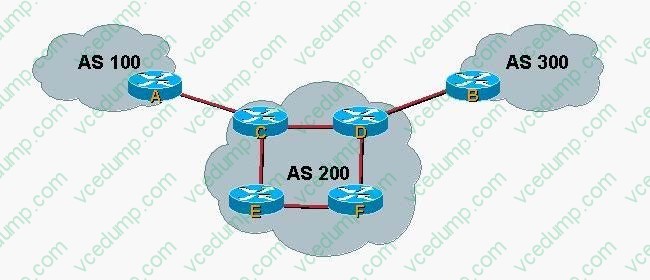
B. All connections between all routers are EBGP.
C. EBGP is being run betweenRtr-A and Rtr-C, between Rtr-B and Rtr-D, and between Rtr-C and Rtr-D. Rtr-C and Rtr-D are route reflectors for Rtr-E and Rtr-F.
D. EBGP is being run betweenRtr-A and Rtr-C, between Rtr-B and Rtr-D, and between Rtr-C and Rtr-D. IBGP is being run between all other routers.
E. All connections between all routers are IBGP. -
Question 60:
Which BGP router configuration command will enable an ISP edge router to advertise a default route to its BGP neighbor even if a default route is not present in its BGP table?
A. router(config-router)#default network 0.0.0.0
B. router(config-router)#neighbor {ip-address} default-originate
C. router(config-router)#network 0.0.0.0 mask 0.0.0.0
D. router(config-router)#network 0.0.0.0
Related Exams:
-
300-745
Designing Cisco Security Infrastructure (300-745 SDSI) v1.0 -
350-101
Implementing and Operating Cisco Wireless Core Technologies (350-101 WLCOR)v1.0 -
352-011
Cisco Certified Design Expert Practical -
500-052
Cisco Unified Contact Center Express -
500-173
Designing the FlexPod Solution (FPDESIGN) -
500-201
Deploying Cisco Service Provider Mobile Backhaul Solutions -
500-210
SP Optical Technology Field Engineer Representative -
500-220
Engineering Cisco Meraki Solutions (ECMS) v2.2 -
500-230
Cisco Service Provider Routing Field Engineer -
500-240
Cisco Mobile Backhaul for Field Engineers
Tips on How to Prepare for the Exams
Nowadays, the certification exams become more and more important and required by more and more enterprises when applying for a job. But how to prepare for the exam effectively? How to prepare for the exam in a short time with less efforts? How to get a ideal result and how to find the most reliable resources? Here on Vcedump.com, you will find all the answers. Vcedump.com provide not only Cisco exam questions, answers and explanations but also complete assistance on your exam preparation and certification application. If you are confused on your 642-661 exam preparations and Cisco certification application, do not hesitate to visit our Vcedump.com to find your solutions here.