642-661 Exam Details
-
Exam Code
:642-661 -
Exam Name
:CCIP Configuring BGP on Cisco Routers (BGP) -
Certification
:Cisco Certifications -
Vendor
:Cisco -
Total Questions
:181 Q&As -
Last Updated
:Dec 15, 2021
Cisco 642-661 Online Questions & Answers
-
Question 21:
What are two purposes of the BGP scan-time command? (Choose two.)
A. to tune the BGP process which walks the BGP table and confirms the reachability of next hops
B. to allow faster detection of downed BGP peers
C. to improve BGP convergence time
D. to tune the BGP update interval
E. to decrease the effects of unstable routes by increasing the route suppression time -
Question 22:
What is the proper configuration to enable route reflector redundancy?
A. To avoid a single point of failure, IBGP full mesh can be used between all the clients in a cluster.
B. To avoid a single point of failure, a route reflector client can have IBGP sessions to more than one route reflector within the cluster.
C. To avoid a single point of failure, a route reflector client can have IBGP sessions to other clients in another cluster.
D. To avoid a single point of failure, a route reflector client have IBGP sessions to other route reflectors in another cluster. -
Question 23:
When using BGP to carry external routes, what is the ideal interaction between BGP and the IGP running within a Transit AS?
A. The IGP should carry the core subnets within the AS. Then a mutual redistribution between BGP and the IGP should be performed.
B. The external routes should be redistributed into a Link-State IGP (like OSPF or IS-IS) with filtering to reduce the size of the Link-State database.
C. The external routes should be redistributed into an IGP.
D. The IGP should carry the routes to reach the BGP next-hops and the core subnets within the AS. -
Question 24:
How should the EBGP session between R1 and R2 be established to enable load balancing? (Choose three.)
A. use static routes on R1 and R2 to reach the other router's loopback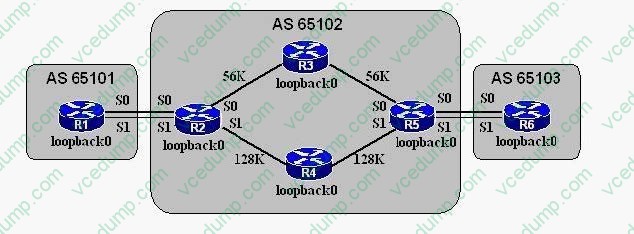
B. establish two EBGP sessions using both the S0 and S1 interface IP address on R1 and R2
C. use the maximum-paths 2 option
D. use theebgp-multihop 2 option
E. establish a single EBGP session using the loopback0 interface IP address on R1 and R2 -
Question 25:
Match proper relationship between the correct description and the appropriate BGP feature.
1.
increase stability by reducing BGP route flaps
2.
reduce IBGP sessions by using special EBGP sessions
3.
can use a hierarchical approach
4.
all routers within the AS must support it
5.
override the BGP synchronization rule
6.
start the BGP routing process using the cluster ID
7.
limit the prefix being received from a BGP peer
8.
modify the BGP split horizon rule
A. I-4,2;II-8,3
B. I-4,1;II-7,3
C. I-4,2;II-5,3
D. I-4,1;II-7,3 -
Question 26:
Refer to the diagram. What should be changed within AS 50001 to improve the route reflector design?
A. Remove the IBGP session between the two redundant RRs (R1 and R2).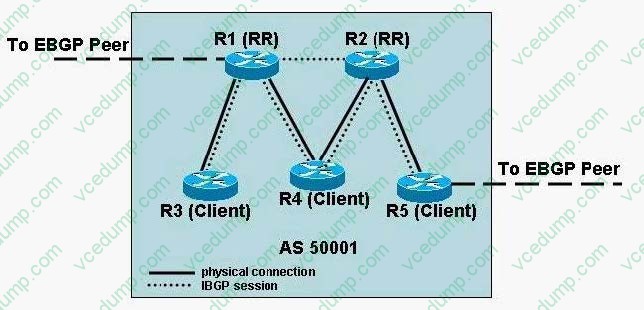
B. Add an IBGP session between each pair of clients (between R3 and R4, R4 and R5).
C. Make R4 the RR and R1 and R2 its clients. R3 and R5 should be a non-RR/non-client.
D. Add a physical link between R1 and R2.
E. Add a physical link between the clients (R3 and R4, and between R4 and R5). -
Question 27:
Which of these situations best describe when to use the AS number translation feature?
A. Allmultihomed customers are using public AS numbers.
B. All single-homed customers are using private AS numbers.
C. Allmultihomed customers are assigned different AS numbers from different ISPs.
D. All single-homed customers are using public AS numbers. -
Question 28:
What type of BGP path attributes are propagated to BGP peers with the partial bit set even if hey are not recognized?
A. Optional Transitive
B. Well Known Mandatory
C. Optional Non-Transitive
D. Well Known Discretionary -
Question 29:
What is the maximum number of parallel routes that can be injected into the routing table when using the iBGP multipath load sharing feature?
A. The number of parallel paths injected into the routing table will depend on the IGP currently in use within theiBGP domain.
B. iBGP multipath can support up to 4 parallel paths.
C. None, multipath is supported oneBGP only when used in conjunction with the update-source command.
D. iBGP multipath can support up to 6 parallel paths.
E. The maximum number of parallel paths injected into the routing table is specified by BGP MED and ranges from 2 to 256 parallel paths. -
Question 30:
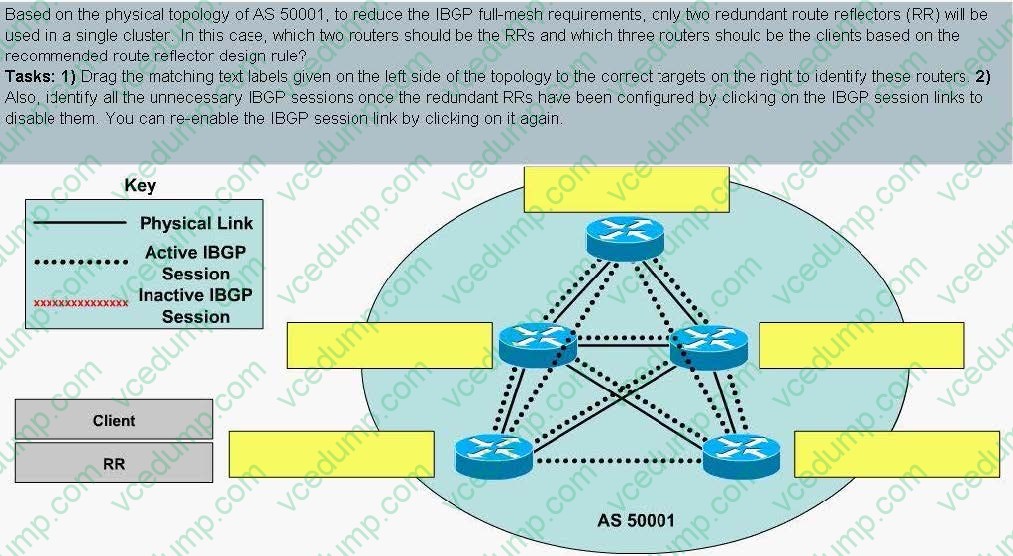
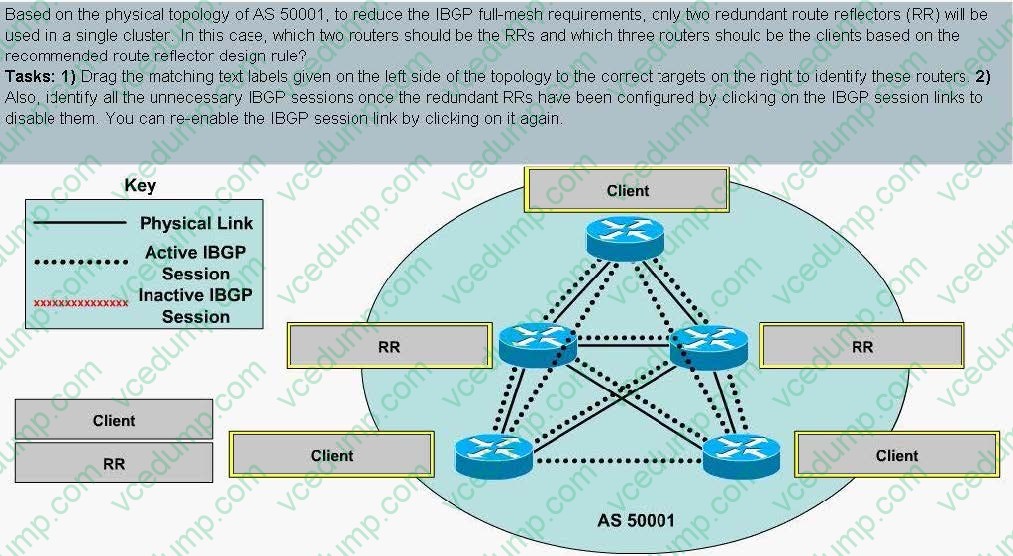
DRAG DROP
Select and Place:
Related Exams:
-
300-745
Designing Cisco Security Infrastructure (300-745 SDSI) v1.0 -
350-101
Implementing and Operating Cisco Wireless Core Technologies (350-101 WLCOR)v1.0 -
352-011
Cisco Certified Design Expert Practical -
500-052
Cisco Unified Contact Center Express -
500-173
Designing the FlexPod Solution (FPDESIGN) -
500-201
Deploying Cisco Service Provider Mobile Backhaul Solutions -
500-210
SP Optical Technology Field Engineer Representative -
500-220
Engineering Cisco Meraki Solutions (ECMS) v2.2 -
500-230
Cisco Service Provider Routing Field Engineer -
500-240
Cisco Mobile Backhaul for Field Engineers
Tips on How to Prepare for the Exams
Nowadays, the certification exams become more and more important and required by more and more enterprises when applying for a job. But how to prepare for the exam effectively? How to prepare for the exam in a short time with less efforts? How to get a ideal result and how to find the most reliable resources? Here on Vcedump.com, you will find all the answers. Vcedump.com provide not only Cisco exam questions, answers and explanations but also complete assistance on your exam preparation and certification application. If you are confused on your 642-661 exam preparations and Cisco certification application, do not hesitate to visit our Vcedump.com to find your solutions here.