Cisco 642-243 Online Practice
Questions and Exam Preparation
642-243 Exam Details
Exam Code
:642-243
Exam Name
:Unified Contact Center Enterprise Support
Certification
:Cisco Certifications
Vendor
:Cisco
Total Questions
:44 Q&As
Last Updated
:Jul 12, 2026
Cisco 642-243 Online Questions &
Answers
Question 1:
In a Cisco Unified Contact Center Enterprise system, a new agent and phone have been added to the system; however, the agent is unable to log in to the system.
The agent is using the same type of phone and and has the same CTI OS desktop setup as other agents who are able to log in without issue.
What are two possible causes for this issue?(Choose two.)
A. The incorrect CTIOS Server IP and Port are configured on the new agent's CTI desktop. B. The new phone used by the agent is not associated with IVRJtapiUser. C. A new Device Target needs to be added for the phone in the Config (for example, /devtype ipphone / DN 12345). D. The phone has call forwarding and call waiting enabled. E. The new phone used by the agent is not associated with PGJtapiUser.
C. A new Device Target needs to be added for the phone in the Config (for example, /devtype ipphone / DN 12345). E. The new phone used by the agent is not associated with PGJtapiUser.
Question 2:
Refer to the exhibit. In a Cisco Unified Contact Center Enterprise system, callers have reported that their calls are dropping intermittently without hearing any greetings or queue music. At times they are able to hear Cisco Unified IP IVR
prompts but are then dropped before connecting to an agent.
The Cisco Unified Communications Manager is configured as follows for this deployment:
All CTI Route Points that make requests to Cisco Unified ICM have names that start with "IPCC."
All CTI Route Points used for Cisco Unified ICM Translation Routing to the Cisco Unified IP IVR are named starting with "Trans."
All CTI Ports used by the Cisco Unified IP IVR are named starting with "CTI."
All Agent Phones are named starting with "SEP."
There is concern about how these devices are associated in the Cisco Unified Communications Manager configuration. The device associations for the PGuser and IVRuser are shown in the exhibit.
Given the problem and the current device associations, what two things might be causing these call failures? (Choose two.)
A. "Enable CTI Application Use" is not checked on the PGuser and IVRuser configurationoptions B. The Peripheral Gateway and Cisco Unified IP IVR do not use the PGuser nor IVRuser Cisco Unified Communications Manager user accounts C. CTI_1300 and TransRtPT3 should not be associated with the PGuser Cisco Unified Communications Manager user account D. All devices should be associated with both the PGuser and IVRuser Cisco Unified Communications Manager user accounts E. The Agent IP Phone 3001 should not be associated with the IVRuser Cisco Unified Communications Manager user account F. The problem is not with the configuration. The Cisco Unified Communications Manager database subscription is broken on subscribers
C. CTI_1300 and TransRtPT3 should not be associated with the PGuser Cisco Unified Communications Manager user account E. The Agent IP Phone 3001 should not be associated with the IVRuser Cisco Unified Communications Manager user account
Question 3:
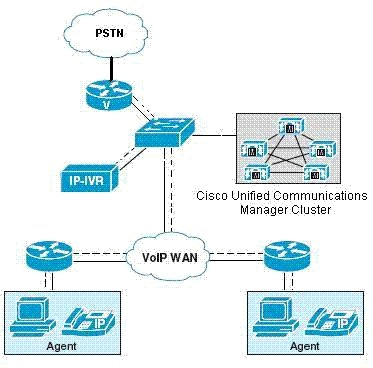
Refer to the exhibit. In a Cisco Unified Contact Center Enterprise deployment with agents deployed as shown in the exhibit, an agent has reported receiving CTI screen pops for calls, but then the call is not sent to the agent. What is a possible cause of this problem?
A. The agent logged in with an extension that does not exist. B. The agent logged in using an extension that is assigned to another agent's phone. C. The agent's phone is not associated with the PG User. D. The agent is still logged into CTIOS on another PC.
B. The agent logged in using an extension that is assigned to another agent's phone.
Question 4:
In a Cisco Unified Contact Center Enterprise system, external callers being queued on the Cisco Unified IP IVR are reporting voice quality issues with the Cisco Unified IP IVR prompts as being "choppy." Which two actions would be helpful in finding the problem? (Choose two.)
A. Check that the codec configuration matches between the voice gateway configuration on the Cisco Unified Communications Manager, and the codec configured on the Cisco Unified IP IVR/CRS server. B. Trace the voice path of a problem call through the network, collecting and analyzing traffic from the voice gateway and Cisco Unified IP IVR/CRS server. C. Enable Performance Monitor counters on the Cisco Unified IP IVR/CRS server to monitor CPU and memory usage. D. Collect JTAPI logs from the Cisco Unified IP IVR to investigate any errors with the call control messages. E. Verify the MTP resources that are available in Cisco Unified Communications Manager for this call flow.
B. Trace the voice path of a problem call through the network, collecting and analyzing traffic from the voice gateway and Cisco Unified IP IVR/CRS server. C. Enable Performance Monitor counters on the Cisco Unified IP IVR/CRS server to monitor CPU and memory usage.
Question 5:
In the Cisco Unified Contact Center Enterprise solution, the Cisco Unified ICM Script Editor Agent-to- Agent Node is used to send calls between agents in the system. Which item is not applicable to the Agent- to-Agent Node usage?
A. When selecting an agent by "Peripheral Number," an expression is required. B. When selecting an agent by "Enterprise Name," an expression is required. C. An agent may be selected by Peripheral Number, Enterprise Name, or Skill Target ID. D. When the "Node fails if agent is unavailable" option is checked, the specified agent must be in a Ready state for the "success" branch of the node to be executed. E. When the "Node fails if agent is unavailable" option is not checked, the "success" branch of the node is executed and the Cisco Unified ICM Call Router sends the call if the Call Router finds a valid label for the agent.
B. When selecting an agent by "Enterprise Name," an expression is required.
Question 6:
In the Cisco Unified Contact Center Enterprise deployment, agents are reporting they are getting two ACD calls from the system at once. Which three of these tools or logs would be useful to help find the cause of this error? (Choose three.)
A. RTRTrace to enable tracing on the Cisco Unified ICM Call Router B. Procmon to enable tracing on the Cisco Unified Communications Manager Peripheral Gateway C. TraceUtil to enable tracing on the Cisco Unified Communications Manager Peripheral Gateway D. EMSTrace to enable tracing for OPC on the Cisco Unified Communications Manager Peripheral Gateway E. OPCTest to turn up tracing for OPC on the Cisco Unified Communications Manager Peripheral Gateway F. OPCTrace to turn up tracing for OPC on the Cisco Unified Communications Manager Peripheral Gateway
A. RTRTrace to enable tracing on the Cisco Unified ICM Call Router B. Procmon to enable tracing on the Cisco Unified Communications Manager Peripheral Gateway E. OPCTest to turn up tracing for OPC on the Cisco Unified Communications Manager Peripheral Gateway
Question 7:
Choose the correct sequence of agent state events from Agent Login to Agent Logout in the Cisco Unified Contact Center Enterprise solution.
A. login, not ready, ready, available, reserved, talking, hold, wrap up, logout B. login, ready, available, reserved, talking, hold, wrap up, not ready, logout C. login, not ready, ready, available, reserved, hold, wrap up, not ready, logout D. login, not ready, ready, available, reserved, talking, hold, wrap up, not ready, logout
C. login, not ready, ready, available, reserved, hold, wrap up, not ready, logout
Question 8:
Refer to the exhibit. In the distributed Cisco Unified Contact Center Enterprise design with multiple Cisco Unified Communications Manager clusters as shown in the exhibit, what is the impact if Agent 2551 transfers a call, routed to that agent by Cisco Unified CCE, directly to Agent 1233 using the agent extension 3311?
A. Agent 1233 could get an ACD call routed by Cisco Unified CCE on extension 3311. B. Cisco Unified CCE would reject the transfer across the intercluster trunk automatically. C. Agent 1233 would get the call, but without any screen pop or CTI data. D. Cisco Unified CCE provides cradle-to-grave reporting on the call once it is sent to Agent 1233. E. The call would only work if both agents were using either CAD or CTI OS desktops.
C. Agent 1233 would get the call, but without any screen pop or CTI data.
Question 9:
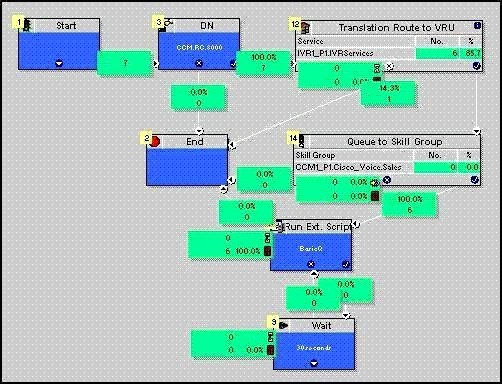
Refer to the exhibit. In a Cisco Unified Contact Center Enterprise deployment, the Cisco Unified ICM Routing Script and related Cisco Unified IP IVR Application shown in the exhibit are causing calls to drop while in queue at the Cisco Unified IP IVR. What is the best option to correct this problem?
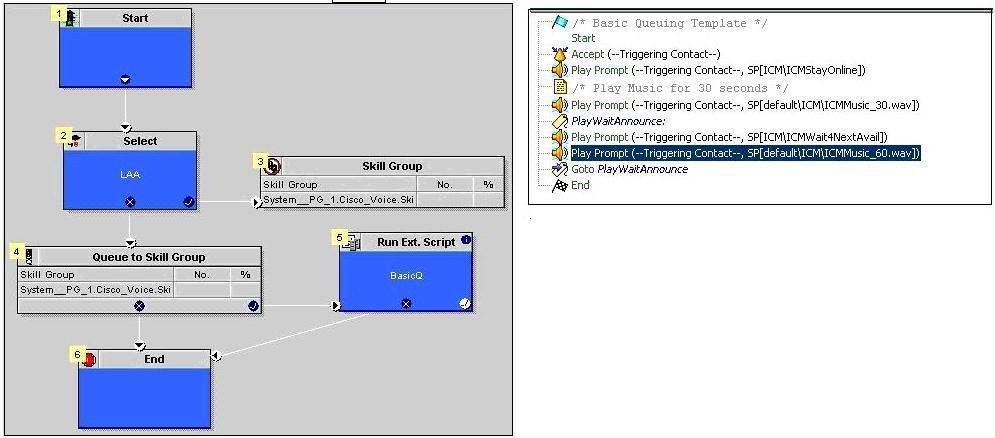
A. Add another "Run External Script" Node and connect the Success Path from Node 5 (five) to this new Node to allow calls to queue for an additional 180 seconds. B. Increase the maximum steps for a Cisco Unified IP IVR Script in the IP-IVR/CRS Server AppAdmin > System Parameters. C. Replace Node 6 (six) with a "Release Call" node which will transfer control of the queued call to the Cisco Unified IP IVR. D. Use a Line Segment to connect the Success Path from Node 5 (five) to the "Queue to Skill Group" Node 4 (four). E. Add additional Prompts in the Cisco Unified IP IVR BasicQ.aef script to play music, which will allow the script to play music for longer than 180 seconds.
D. Use a Line Segment to connect the Success Path from Node 5 (five) to the "Queue to Skill Group" Node 4 (four).
Question 10:
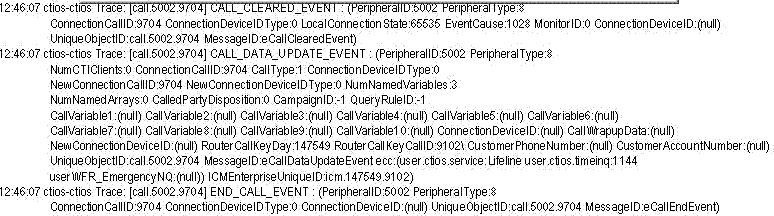
Refer to the exhibit. In a Cisco Unified Contact Center Enterprise system, an agent reports being unable to transfer or conference callers with other agents. The agent is able to accept new inbound calls from the system, but cannot transfer the call. The log files shown in the exhibit were collected from the Cisco Unified Communications Manager PIM logs, the JTAPI Gateway log, and the Cisco Unified Communications Manager Trace log during testing of this failure. Which issue may be the cause of this problem?
A. The wrong Calling Search Space is defined on the Agent IP Phone in Cisco Unified Communications Manager. B. The wrong Partition is defined on Agent Directory Number on the IP Phone in Cisco Unified Communications Manager. C. No Transcoding Resources are defined in the MRGL assigned on the IP Phone in Cisco Unified Communications Manager. D. Cisco Unified Communications Manager only allows one call leg per Directory Number on the IP Phone. The transfer fails due to the second call leg being invoked by the agent.
D. Cisco Unified Communications Manager only allows one call leg per Directory Number on the IP Phone. The transfer fails due to the second call leg being invoked by the agent.
Nowadays, the certification exams become more and more important and required by more and more
enterprises when applying for a job. But how to prepare for the exam effectively? How to prepare
for the exam in a short time with less efforts? How to get a ideal result and how to find the
most reliable resources? Here on Vcedump.com, you will find all the answers.
Vcedump.com provide not only Cisco exam questions,
answers and explanations but also complete assistance on your exam preparation and certification
application. If you are confused on your 642-243 exam preparations
and Cisco certification application, do not hesitate to visit our
Vcedump.com to find your solutions here.