What could cause a vSAN stretched cluster to fail?
Show answer and explanation
Correct answer: D
5V0-21.19 Real Exam Questions
100 questions available · Page 1 of 10
Updated Exam DumpsVerified AnswersPass Guarantee
What could cause a vSAN stretched cluster to fail?
Correct answer: D
End-users are complaining that an application running on an all-flash vSAN datastore is not performing well.
Which performance chart should an administrator view to troubleshoot this issue?
Correct answer: C
References:
https://docs.vmware.com/en/VMware-vSphere/6.7/vsan-673-monitoring-troubleshooting-guide.pdf
When using vSAN Encryption, where does the Key Encryption Key persistently reside?
Correct answer: C
References:
https://blogs.vmware.com/virtualblocks/2018/07/13/understanding-ve-booting-w-vc-unavailable/
A vSAN Witness has connectivity to a vSAN cluster with supported maximum latency of 500 milliseconds
round-trip time (RTT).
Which vSAN cluster type is the vSAN Witness a member of?
Correct answer: B
References:
https://book.akij.net/eBooks/2018/March/5ab76ee97f532/SAnet.cd.EssentialVirtualSAN
(VSAN).pdf (56)
Where would an administrator enable deduplication and compression in a vSAN environment?
Correct answer: B
vSAN Health shows a warning icon next to vSAN Disk Balance health check.
What can be done to fix this issue?
Correct answer: D
Refer to the exhibit.
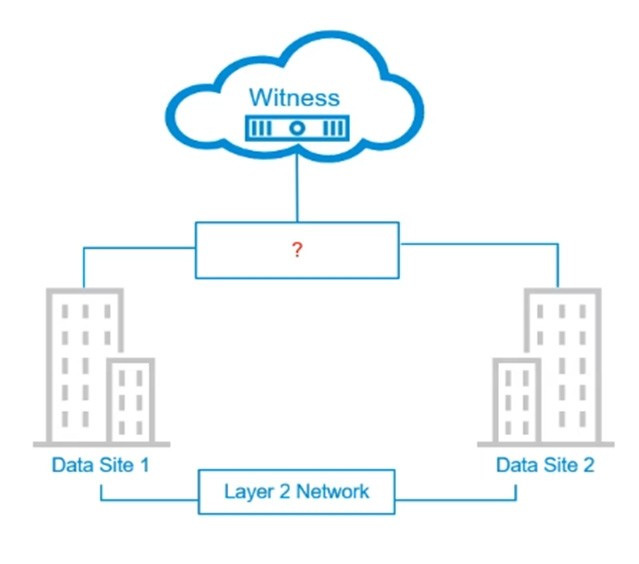
Which networking requirement fulfills the connectivity between the Data Sites and the Witness node?
Correct answer: D
References:
https://storagehub.vmware.com/t/vmware-vsan/vsan-2-node-guide/network-design-considerations-7/
What is the formula for determining the minimum number of vSAN hosts in a cluster necessary to support a Failures To Tolerate (FTT) policy, where FTT=n?
Correct answer: C
To tolerate n failures, you need 2n + 1 ESXi host in the vSAN cluster.
References:
https://searchvmware.techtarget.com/answer/How-can-a-VM-storage-policy-improve-vSAN-cluster-redundancy
An all-flash vSAN cluster contains four nodes.
Which two storage policies can the cluster satisfy? (Choose two.)
Correct answers: C, D
A vSAN all-flash environment with these host specifications has reported high network latency, write latency, and faces degraded performance:
One 1Gbps (vSAN, vMotion Traffic)
One 1Gbps (Management, Fault Tolerance traffic) Based on the specifications of each host, what is recommended to resolve the issue?
Correct answer: B