
350-101 Online Practice Questions

Implementing and Operating Cisco Wireless Core Technologies (350-101 WLCOR)v1.0

137 questions available · Page 1 of 14

Updated Exam DumpsVerified AnswersPass Guarantee

Get Complete Exam Dumps
Question 1 Single choice

How does U-NII-1 operate with regards to the common frequency bands supported in enterprise wireless networks?

  1. A

    It uses a range of higher frequencies and tile enforcement with static power configuration.

  2. B

    It uses a range of lower frequencies with restrictions on transmit power used indoor and outdoor.

  3. C

    It defines subsections with signal handling and is restricted to indoor use helping minimize interference.

  4. D

    It defines class limits for specialty devices and is restricted to outdoor use increasing coverage.

Show answer and explanation

Correct answer: C

Explanation

The condition to solve is How does U-NII-1 operate with regards to the common frequency bands supported in enterprise wireless networks? It defines subsections with signal handling and is restricted to indoor use helping minimize interference. is aligned with that condition rather than with a neighboring workflow.

RF questions should be solved from measurable behavior. Signal level, noise, channel restrictions, interference classification, and propagation effects determine whether a link is stable and compliant. The selected mechanism is tied to that RF behavior, so it explains the observed result without changing unrelated WLAN security or management settings.

It uses a range of higher frequencies and tile enforcement with static power configuration. belongs to a different workflow and would leave the stated condition unresolved. It uses a range of lower frequencies with restrictions on transmit power used indoor and outdoor. may be useful elsewhere, but it does not apply the control that the stem is asking for. It defines class limits for specialty devices and is restricted to outdoor use increasing coverage. changes an adjacent setting instead of the mechanism that produces the required result.

The tested habit is to avoid picking a familiar wireless term unless it changes the exact condition in the question.
Question 2 Single choice

A help desk analyst needs a centralized view of a wireless client's onboarding history, RSSI, SNR, roaming events, and failure reasons across the campus.

Which tool should the analyst use?

  1. A

    AP console session history

  2. B

    Cisco Catalyst Center Assurance Client 360

  3. C

    DHCP option 43 logs only

  4. D

    Local browser cache on the client

Show answer and explanation

Correct answer: B

Explanation

A direct reading of the item leads to Cisco Catalyst Center Assurance Client 360, because the stated requirement is A help desk analyst needs a centralized view of a wireless client's onboarding history, RSSI, SNR, roaming events, and failure reasons across the campus. Which tool should the analyst use?

The scenario is not asking for every related wireless feature; it is asking what satisfies this condition: A help desk analyst needs a centralized view of a wireless client's onboarding history, RSSI, SNR, roaming events, and failure reasons across the campus. Which tool should the analyst use? That points to Cisco Catalyst Center Assurance Client 360. RF questions should be solved from measurable behavior. Signal level, noise, channel restrictions, interference classification, and propagation effects determine whether a link is stable and compliant. That selection is tied to that RF behavior, so it explains the observed result without changing unrelated WLAN security or management settings. AP console session history omits the part of the configuration that actually enforces the requested outcome. DHCP option 43 logs only shifts attention away from the condition that the client, AP, or controller must satisfy. Local browser cache on the client belongs to a different workflow and would leave the stated condition unresolved. The key lesson is that Cisco wireless features are usually scoped tightly, and the scope determines whether a choice is usable.

Question 3 Single choice

An access point transmits at 14 dBm. The engineer increases the transmit power to 17 dBm while the antenna and channel remain unchanged.

What is the RF effect of this change?

  1. A

    The transmit power is doubled.

  2. B

    The transmit power is reduced by half.

  3. C

    The transmit power is increased by ten times.

  4. D

    The received signal becomes independent of distance.

Show answer and explanation

Correct answer: A

Explanation

The useful clue is this requirement: An access point transmits at 14 dBm. The engineer increases the transmit power to 17 dBm while the antenna and channel remain unchanged. What is the RF effect of this change? That clue points to The transmit power is doubled..

RF questions should be solved from measurable behavior. Signal level, noise, channel restrictions, interference classification, and propagation effects determine whether a link is stable and compliant. The selected mechanism is tied to that RF behavior, so it explains the observed result without changing unrelated WLAN security or management settings.

The transmit power is reduced by half. addresses a different failure domain, so it would not close the gap described here. The transmit power is increased by ten times. is too broad or aimed at the wrong layer for this scenario. The received signal becomes independent of distance. does not provide the specific RF, security, forwarding, management, or automation behavior that is required.

The answer should therefore be evaluated by effect, not by how recognizable the command or platform name appears.

Question 4 Single choice

What is the time taken for an RF signal to travel from the transmitter to the receiver known as?

  1. A

    reflection

  2. B

    propagation delay

  3. C

    scattering

  4. D

    link speed

Show answer and explanation

Correct answer: B

Explanation

The stem narrows the problem to What is the time taken for an RF signal to travel from the transmitter to the receiver known as? In that context, propagation delay is the setting or feature that applies.

RF questions should be solved from measurable behavior. Signal level, noise, channel restrictions, interference classification, and propagation effects determine whether a link is stable and compliant. This choice is tied to that RF behavior, so it explains the observed result without changing unrelated WLAN security or management settings. reflection omits the part of the configuration that actually enforces the requested outcome. scattering shifts attention away from the condition that the client, AP, or controller must satisfy. link speed belongs to a different workflow and would leave the stated condition unresolved.

The key lesson is that Cisco wireless features are usually scoped tightly, and the scope determines whether a choice is usable.

A complete review also checks whether the choice would still solve the problem if all other settings stayed the same. That test favors the correct choice because it changes the feature, protocol, or policy named by the question. The distractors may be legitimate Cisco wireless concepts, but they would send the engineer toward a different task and leave the stated requirement unresolved.

Question 5 Single choice

Users report slowness on the network, and it is suspected that certain applications are consuming all the bandwidth. A network engineer must enable the NBAR protocol to improve wireless client traffic visibility and provide advanced, granular, application classification, and analytics.

How should the network engineer configure NBAR on a 9800 WLC?

  1. A

    Enable NBARv2 on the WLAN.

  2. B

    Enable deep packet inspection on the WLAN.

  3. C

    Configure packet inspection on the policy profile.

  4. D

    Configure AVC on the policy profile.

Show answer and explanation

Correct answer: D

Explanation

The requirement can be read as follows: Users report slowness on the network, and it is suspected that certain applications are consuming all the bandwidth. A network engineer must enable the NBAR protocol to improve wireless client traffic visibility and provide advanced, granular, application classification, and analytics. The matching behavior is Configure AVC on the policy profile..

Catalyst 9800 questions often test object ownership. The WLAN profile identifies the SSID, the policy profile carries client policy, and tags bind those objects to APs. The selected mechanism belongs to the object that owns the requested behavior, so it is more precise than a command that changes RF settings, AP join behavior, or an unrelated profile.

Enable NBARv2 on the WLAN. shifts attention away from the condition that the client, AP, or controller must satisfy. Enable deep packet inspection on the WLAN. belongs to a different workflow and would leave the stated condition unresolved. Configure packet inspection on the policy profile. may be useful elsewhere, but it does not apply the control that the stem is asking for.

The same logic applies on real deployments: fix the component that owns the failure domain first, then validate adjacent services.

Question 6 Single choice

Which new attribute does IEEE 802.11ax introduce when used in wireless local area networks?

  1. A

    60 GHz utilization

  2. B

    Wi-Fi multimedia

  3. C

    OFDMA

  4. D

    MIMO

Show answer and explanation

Correct answer: C

Explanation

Here, OFDMA is tied to the actual requirement in the stem: Which new attribute does IEEE 802.11ax introduce when used in wireless local area networks?

Protocol questions depend on the exact 802.11 function involved. Airtime scheduling, frame exchange, channel behavior, and secure roaming each solve a different problem. That configuration maps to the protocol mechanism described by the stem rather than to a controller administration task or a general monitoring feature.

60 GHz utilization addresses a different failure domain, so it would not close the gap described here. Wi-Fi multimedia is too broad or aimed at the wrong layer for this scenario. MIMO does not provide the specific RF, security, forwarding, management, or automation behavior that is required.

The answer should therefore be evaluated by effect, not by how recognizable the command or platform name appears.

A complete review also checks whether the choice would still solve the problem if all other settings stayed the same. That test favors the correct choice because it changes the feature, protocol, or policy named by the question. The distractors may be legitimate Cisco wireless concepts, but they would send the engineer toward a different task and leave the stated requirement unresolved.

Question 7 Single choice

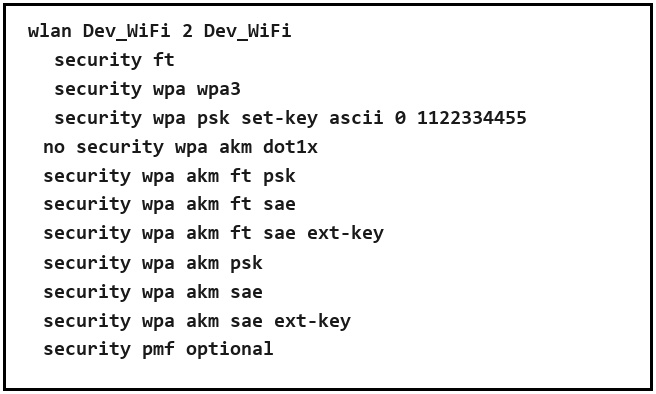
Refer to the exhibit.

A startup company has recently moved to new offices and performed a full network refresh. The application development team requested a high-speed reliable wireless network to use for testing real-time applications. Although, the wireless network is Wi-Fi 7 enabled, the wireless clients are connecting using lower speeds.

Which configuration must be applied on the WLC to increase throughput?

  1. A

    security wpa3 akm sae ext-key

  2. B

    security wpa wpa2 wpa3 aes512

  3. C

    security wpa wpa2 wpa3 tkip512

  4. D

    security wpa wpa2 ciphers gcmp256

Show answer and explanation

Correct answer: D

Explanation

The key is to match the requested effect, A startup company has recently moved to new offices and performed a full network refresh. The application development team requested a high-speed reliable wireless network to use for testing real-time applications. Although, the wireless network is Wi-Fi 7 enabled., with the feature or command that actually produces it; that points to security wpa wpa2 ciphers
gcmp 256.

Security questions should separate authentication, authorization, and policy enforcement. The WLAN security method gets the client on the network, while RADIUS and policy attributes decide what access the client receives. The chosen setting is the piece that enables or applies that security behavior; the other
choices either skip the external method, use the wrong authentication model, or affect a separate policy area.

security wpa3 akm sae ext-key addresses a different failure domain, so it would not close the gap described here. security wpa wpa2 wpa3 aes512 is too broad or aimed at the wrong layer for this scenario. security wpa wpa2 wpa3 tkip512 does not provide the specific RF, security, forwarding, management, or automation behavior that is required.
The answer should therefore be evaluated by effect, not by how recognizable the command or platform name appears.

Question 8 Single choice

Clients on a centrally switched WLAN authenticate successfully, but none of them receive an IP address.
The DHCP server is on a different subnet, and the client VLAN gateway has no helper address.

What should be configured?

  1. A

    A higher AP transmit power level

  2. B

    A different RADIUS shared secret

  3. C

    DHCP relay for the client VLAN

  4. D

    A DFS channel exclusion list

Show answer and explanation

Correct answer: C

Explanation

The answer follows from the requirement itself: Clients on a centrally switched WLAN authenticate successfully, but none of them receive an IP address. The DHCP server is on a different subnet, and the client VLAN gateway has no helper address. What should be configured? DHCP relay for the client VLAN is the response that matches that requirement.

RF questions should be solved from measurable behavior. Signal level, noise, channel restrictions, interference classification, and propagation effects determine whether a link is stable and compliant. The selected mechanism is tied to that RF behavior, so it explains the observed result without changing unrelated WLAN security or management settings.

A higher AP transmit power level may be useful elsewhere, but it does not apply the control that the stem is asking for. A different RADIUS shared secret changes an adjacent setting instead of the mechanism that produces the required result. A DFS channel exclusion list addresses a different failure domain, so it would not close the gap described here.

That is why the correct selection follows the requirement directly instead of merely belonging to the same Cisco wireless product family.

Question 9 Single choice

Which function does FRA use to optimize client experience and network coverage?

  1. A

    Monitoring on the physical interface level in the AP

  2. B

    Enhances roaming by redirecting the client to move to the appropriate AP

  3. C

    Implementation by local data path control

  4. D

    Dynamically adapts the roles of dual-band radios in an AP

Show answer and explanation

Correct answer: B

Explanation

For this scenario, Enhances roaming by redirecting the client to move to the appropriate AP is not just related terminology; it is the part that satisfies.
Which function does FRA use to optimize client experience
and network coverage?
Protocol questions depend on the exact 802.11 function involved. Airtime scheduling, frame exchange, channel behavior, and secure roaming each solve a different problem. That configuration maps to the protocol mechanism described by the stem rather than to a controller administration task or a general monitoring feature.

Monitoring on the physical interface level in the AP may be useful elsewhere, but it does not apply the control that the stem is asking for. Implementation by local data path control changes an adjacent setting instead of the mechanism that produces the required result. Dynamically adapts the roles of dual-band radios in an AP addresses a different failure domain, so it would not close the gap described here.

That is why the correct selection follows the requirement directly instead of merely belonging to the same Cisco wireless product family.

Question 10 Single choice

How does the optimized roaming function operate in a WLC implementation?

  1. A

    It disassociates clients when the RSSI is lower than the set threshold.

  2. B

    It is integrated with external services for client wireless experience.

  3. C

    Device locations are determined through peer-to-peer beacons.

  4. D

    Load balancing is statically defined for all locations.

Show answer and explanation

Correct answer: A

Explanation

This scenario centers on How does the optimized roaming function operate in a WLC implementation? The response It disassociates clients when the RSSI is lower than the set threshold. works at that same control point.

RF questions should be solved from measurable behavior. Signal level, noise, channel restrictions, interference classification, and propagation effects determine whether a link is stable and compliant. That configuration is tied to that RF behavior, so it explains the observed result without changing unrelated WLAN security or management settings.

It is integrated with external services for client wireless experience. shifts attention away from the condition that the client, AP, or controller must satisfy. Device locations are determined through peer-to-peer beacons. belongs to a different workflow and would leave the stated condition unresolved. Load balancing is statically defined for all locations. may be useful elsewhere, but it does not apply the control that the stem is asking for.

The same logic applies on real deployments: fix the component that owns the failure domain first, then validate adjacent services.