312-50 Exam Details
-
Exam Code
:312-50 -
Exam Name
:Certified Ethical Hacker -
Certification
:EC-COUNCIL Certifications -
Vendor
:EC-COUNCIL -
Total Questions
:765 Q&As -
Last Updated
:May 31, 2026
EC-COUNCIL 312-50 Online Questions & Answers
-
Question 401:
A denial of Service (DoS) attack works on the following principle:
A. MS-DOS and PC-DOS operating system utilize a weaknesses that can be compromised and permit them to launch an attack easily.
B. All CLIENT systems have TCP/IP stack implementation weakness that can be compromised and permit them to lunch an attack easily.
C. Overloaded buffer systems can easily address error conditions and respond appropriately.
D. Host systems cannot respond to real traffic, if they have an overwhelming number of incomplete connections (SYN/RCVD State).
E. A server stops accepting connections from certain networks one those network become flooded. -
Question 402:
Attackers target HINFO record types stored on a DNS server to enumerate information. These are information records and potential source for reconnaissance. A network administrator has the option of entering host information specifically the CPU type and operating system when creating a new DNS record. An attacker can extract this type of information easily from a DNS server.
Which of the following commands extracts the HINFO record?
A. Option A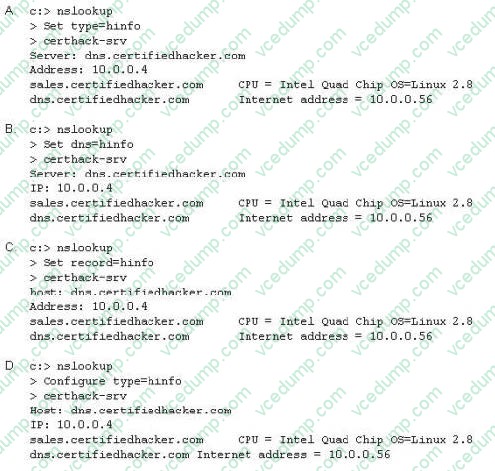
B. Option B
C. Option C
D. Option D -
Question 403:
Jake is a network administrator who needs to get reports from all the computer and network devices on his network. Jake wants to use SNMP but is afraid that won't be secure since passwords and messages are in clear text. How can Jake gather network information in a secure manner?
A. He can use SNMPv3
B. Jake can use SNMPrev5
C. He can use SecWMI
D. Jake can use SecSNMP -
Question 404:
Assuring two systems that are using IPSec to protect traffic over the internet, what type of general attack could compromise the data?
A. Spoof Attack
B. Smurf Attack
C. Man in the Middle Attack
D. Trojan Horse Attack
E. Back Orifice Attack -
Question 405:
Which of the following steganography utilities exploits the nature of white space and allows the user to conceal information in these white spaces?
A. Snow
B. Gif-It-Up
C. NiceText
D. Image Hide -
Question 406:
Exhibit:
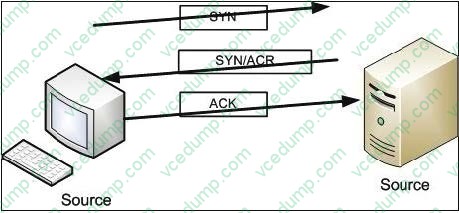
Please study the exhibit carefully.
Which Protocol maintains the communication on that way?
A. UDP
B. IP
C. TCP
D. ARP
E. RARP -
Question 407:
On wireless networks, a SSID is used to identify the network. Why are SSID not considered to be a good security mechanism to protect a wireless network?
A. The SSID is only 32 bits in length
B. The SSID is transmitted in clear text
C. The SSID is to identify a station not a network
D. The SSID is the same as the MAC address for all vendors -
Question 408:
WEP is used on 802.11 networks, what was it designed for?
A. WEP is designed to provide a wireless local area network (WLAN) with a level of security and privacy comparable to what it usually expected of a wired LAN.
B. WEP is designed to provide strong encryption to a wireless local area network (WLAN) with a lever of integrity and privacy adequate for sensible but unclassified information.
C. WEP is designed to provide a wireless local area network (WLAN) with a level of availability and privacy comparable to what is usually expected of a wired LAN.
D. WEOP is designed to provide a wireless local area network (WLAN) with a level of privacy comparable to what it usually expected of a wired LAN. -
Question 409:
While reviewing the result of scanning run against a target network you come across the following:
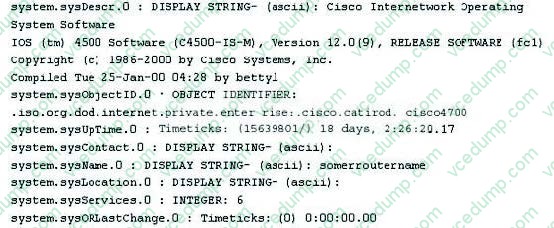
Which among the following can be used to get this output?
A. A Bo2k system query.
B. nmap protocol scan
C. A sniffer
D. An SNMP walk -
Question 410:
How would you permanently wipe the data in the hard disk?
A. wipe -fik /dev/hda1
B. erase -fik /dev/hda1
C. delete -fik /dev/hda1
D. secdel -fik /dev/hda1
Related Exams:
-
112-51
EC-Council Certified Network Defense Essentials (NDE) -
212-055
Sun Certified Programmer for the Java 2 Platform.SE 5.0 -
212-77
EC-Council Certified Linux Security -
212-81
EC-Council Certified Encryption Specialist (ECES) -
212-82
EC-Council Certified Cybersecurity Technician (C|CT) -
212-89
EC Council Certified Incident Handler (ECIH v3) -
312-38
EC-Council Certified Network Defender (CND) -
312-39
EC-Council Certified SOC Analyst (CSA) -
312-40
EC-Council Certified Cloud Security Engineer (CCSE) -
312-49
ECCouncil Computer Hacking Forensic Investigator (V9)
Tips on How to Prepare for the Exams
Nowadays, the certification exams become more and more important and required by more and more enterprises when applying for a job. But how to prepare for the exam effectively? How to prepare for the exam in a short time with less efforts? How to get a ideal result and how to find the most reliable resources? Here on Vcedump.com, you will find all the answers. Vcedump.com provide not only EC-COUNCIL exam questions, answers and explanations but also complete assistance on your exam preparation and certification application. If you are confused on your 312-50 exam preparations and EC-COUNCIL certification application, do not hesitate to visit our Vcedump.com to find your solutions here.