312-50 Exam Details
-
Exam Code
:312-50 -
Exam Name
:Certified Ethical Hacker -
Certification
:EC-COUNCIL Certifications -
Vendor
:EC-COUNCIL -
Total Questions
:765 Q&As -
Last Updated
:May 31, 2026
EC-COUNCIL 312-50 Online Questions & Answers
-
Question 321:
John is the network administrator of XSECURITY systems. His network was recently compromised. He analyzes the logfiles to investigate the attack.
Take a look at the following Linux logfile snippet. The hacker compromised and "owned" a Linux machine. What is the hacker trying to accomplish here?
[root@apollo /]# rm rootkit.c [root@apollo /]# [root@apollo /]# ps -aux | grep inetd ; ps -aux | grep portmap ; rm /sbin/portmap ; rm /tmp/h ; rm /usr/sbin/rpc.portmap ; rm -rf .bash* ; rm - rf /root/ .bash_history ; rm - rf /usr/sbin/namedps -aux | grep inetd ; ps -aux | grep portmap ; rm /sbin/por359 ? 00:00:00 inetd 359 ? 00:00:00 inetd rm: cannot remove `/tmp/h': No such file or directory rm: cannot remove `/usr/sbin/rpc.portmap': No such file or directory [root@apollo /]# ps -aux | grep portmap [root@apollo /]# [root@apollo /]# ps -aux | grep inetd ; ps -aux | grep portmap ; rm /sbin/portmap ; rm /tmp/h ; rm /usr/sbin/rpc.portmap ; rm -rf .bash* ; rm -rf /root/ .bash_history ; rm - rf /usr/sbin/namedps -aux | grep inetd ; ps -aux | grep portmap ; rm /sbin/por359 ? 00:00:00 inetd rm: cannot remove `/sbin/portmap': No such file or directory rm: cannot remove `/tmp/h': No such file or directory >rm: cannot remove `/usr/sbin/rpc.portmap': No such file or directory [root@apollo /]# rm: cannot remove `/sbin/portmap': No such file or directory
A. The hacker is planting a rootkit
B. The hacker is trying to cover his tracks
C. The hacker is running a buffer overflow exploit to lock down the system
D. The hacker is attempting to compromise more machines on the network -
Question 322:
James is an IT security consultant as well as a certified ethical hacker. James has been asked to audit the network security of Yerta Manufacturing, a tool manufacturing company in Phoenix. James performs some initial external tests and then begins testing the security from inside the company's network.
James finds some big problems right away; a number of users that are working on Windows XP computers have saved their usernames and passwords used to connect to servers on the network. This way, those users do not have to type in their credentials every time they want access to a server. James tells the IT manager of Yerta Manufacturing about this, and the manager does not believe this is possible on Windows XP. To prove his point, James has a user logon to a computer and then James types in a command that brings up a window that says "Stored User Names and Passwords".
What command did James type in to get this window to come up?
A. To bring up this stored user names and passwords window, James typed in "rundll32.exe storedpwd.dll, ShowWindow"
B. James had to type in "rundll32.exe keymgr.dll, KRShowKeyMgr" to get the window to pop up
C. James typed in the command "rundll32.exe storedpwd.dll" to get the Stored User Names and Passwords window to come up
D. The command to bring up this window is "KRShowKeyMgr" -
Question 323:
Bob has a good understanding of cryptography, having worked with it for many years. Cryptography is used to secure data from specific threat, but it does not secure the application from coding errors. It can provide data privacy, integrity and enable strong authentication but it cannot mitigate programming errors.
What is a good example of a programming error that Bob can use to illustrate to the management that encryption will not address all of their security concerns?
A. Bob can explain that a random generator can be used to derive cryptographic keys but it uses a weak seed value and it is a form of programming error.
B. Bob can explain that by using passwords to derive cryptographic keys it is a form of a programming error.
C. Bob can explain that a buffer overflow is an example of programming error and it is a common mistake associated with poor programming technique.
D. Bob can explain that by using a weak key management technique it is a form of programming error. -
Question 324:
Exhibit:
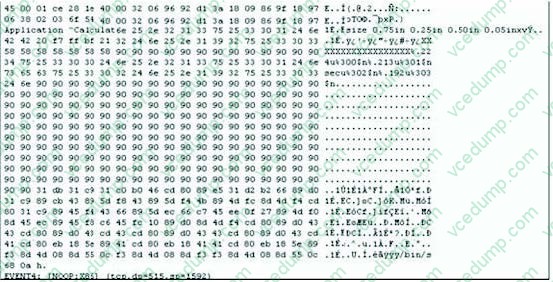
The following is an entry captured by a network IDS. You are assigned the task of analyzing this entry. You notice the value 0x90, which is the most common NOOP instruction for the Intel processor. You figure that the attacker is attempting a
buffer overflow attack. You also notice "/bin/sh" in the ASCII part of the output.
As an analyst what would you conclude about the attack?
A. The buffer overflow attack has been neutralized by the IDS
B. The attacker is creating a directory on the compromised machine
C. The attacker is attempting a buffer overflow attack and has succeeded
D. The attacker is attempting an exploit that launches a command-line shell -
Question 325:
Jim's organization has just completed a major Linux roll out and now all of the organization's systems are running the Linux 2.5 kernel. The roll out expenses has posed constraints on purchasing other essential security equipment and software. The organization requires an option to control network traffic and also perform stateful inspection of traffic going into and out of the DMZ.
Which built-in functionality of Linux can achieve this?
A. IP Tables
B. IP Chains
C. IP Sniffer
D. IP ICMP -
Question 326:
Attacking well-known system defaults is one of the most common hacker attacks. Most software is shipped with a default configuration that makes it easy to install and setup the application. You should change the default settings to secure the system.
Which of the following is NOT an example of default installation?
A. Many systems come with default user accounts with well-known passwords that administrators forget to change
B. Often, the default location of installation files can be exploited which allows a hacker to retrieve a file from the system
C. Many software packages come with "samples" that can be exploited, such as the sample programs on IIS web services
D. Enabling firewall and anti-virus software on the local system -
Question 327:
What are the two basic types of attacks?(Choose two.
A. DoS
B. Passive
C. Sniffing
D. Active
E. Cracking -
Question 328:
Which Steganography technique uses Whitespace to hide secret messages?
A. snow
B. beetle
C. magnet
D. cat -
Question 329:
When writing shellcodes, you must avoid _________________ because these will end the string.
A. Null Bytes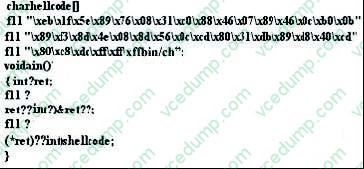
B. Root Bytes
C. Char Bytes
D. Unicode Bytes -
Question 330:
Which of the following is NOT part of CEH Scanning Methodology?
A. Check for Live systems
B. Check for Open Ports
C. Banner Grabbing
D. Prepare Proxies
E. Social Engineering attacks
F. Scan for Vulnerabilities
G. Draw Network Diagrams
Related Exams:
-
112-51
EC-Council Certified Network Defense Essentials (NDE) -
212-055
Sun Certified Programmer for the Java 2 Platform.SE 5.0 -
212-77
EC-Council Certified Linux Security -
212-81
EC-Council Certified Encryption Specialist (ECES) -
212-82
EC-Council Certified Cybersecurity Technician (C|CT) -
212-89
EC Council Certified Incident Handler (ECIH v3) -
312-38
EC-Council Certified Network Defender (CND) -
312-39
EC-Council Certified SOC Analyst (CSA) -
312-40
EC-Council Certified Cloud Security Engineer (CCSE) -
312-49
ECCouncil Computer Hacking Forensic Investigator (V9)
Tips on How to Prepare for the Exams
Nowadays, the certification exams become more and more important and required by more and more enterprises when applying for a job. But how to prepare for the exam effectively? How to prepare for the exam in a short time with less efforts? How to get a ideal result and how to find the most reliable resources? Here on Vcedump.com, you will find all the answers. Vcedump.com provide not only EC-COUNCIL exam questions, answers and explanations but also complete assistance on your exam preparation and certification application. If you are confused on your 312-50 exam preparations and EC-COUNCIL certification application, do not hesitate to visit our Vcedump.com to find your solutions here.