312-50 Exam Details
-
Exam Code
:312-50 -
Exam Name
:Certified Ethical Hacker -
Certification
:EC-COUNCIL Certifications -
Vendor
:EC-COUNCIL -
Total Questions
:765 Q&As -
Last Updated
:May 31, 2026
EC-COUNCIL 312-50 Online Questions & Answers
-
Question 281:
You are attempting to map out the firewall policy for an organization. You discover your target system is one hop beyond the firewall. Using hping2, you send SYN packets with the exact TTL of the target system starting at port 1 and going up to port 1024. What is this process known as?
A. Footprinting
B. Firewalking
C. Enumeration
D. Idle scanning -
Question 282:
An nmap command that includes the host specification of 202.176.56-57.* will scan _______ number of hosts.
A. 2
B. 256
C. 512
D. Over 10,000 -
Question 283:
The follows is an email header. What address is that of the true originator of the message?
Return-Path:
Received: from smtp.com (fw.emumail.com [215.52.220.122]. by raq-221-181.ev1.net (8.10.2/8.10.2. with ESMTP id h78NIn404807 for
network.; 8 Aug 2003 23:25:25 -0000 Received: from ([19.25.19.10].
by smtp.com with SMTP
Received: from unknown (HELO CHRISLAPTOP. (168.150.84.123.
by localhost with SMTP; 8 Aug 2003 23:25:01 -0000
From: "Bill Gates"
To: "mikeg"
Subject: We need your help!
Date: Fri, 8 Aug 2003 19:12:28 -0400
Message-ID: <51.32.123.21@CHRISLAPTOP>
MIME-Version: 1.0
Content-Type: multipart/mixed;
boundary="----=_NextPart_000_0052_01C35DE1.03202950"
X-Priority: 3 (Normal.
X-MSMail-Priority: Normal
X-Mailer: Microsoft Outlook, Build 10.0.2627
X-MimeOLE: Produced By Microsoft MimeOLE V6.00.2800.1165 Importance: Normal
A. 19.25.19.10
B. 51.32.123.21
C. 168.150.84.123
D. 215.52.220.122
E. 8.10.2/8.10.2 -
Question 284:
Bank of Timbukut is a medium-sized, regional financial institution in Timbuktu. The bank has deployed a new Internet-accessible Web Application recently. Customers can access their account balances, transfer money between accounts, pay bills and conduct online financial business using a web browser.
John Stevens is in charge of information security at Bank of Timbukut. After one month in production, several customers have complained about the Internet enabled banking application. Strangely, the account balances of many of the bank's customers had been changed ! However, money hasn't been removed from the bank, instead money was transferred between accounts. Given this attack profile, John Stevens reviewed the Web Application's logs and found the following entries.
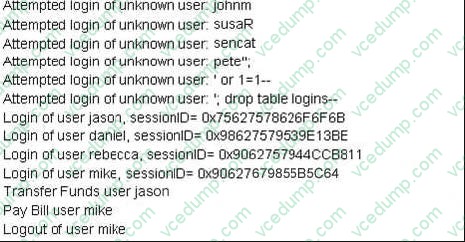
What kind of attack did the Hacker attempt to carry out at the Bank?
A. Brute Force attack in which the Hacker attempted guessing login ID and password from password cracking tools
B. The Hacker used a generator module to pass results to the Web Server and exploited Web Application CGI vulnerability.
C. The Hacker first attempted logins with suspected user names, then used SQL injection to gain access to valid login IDs
D. The Hacker attempted Session Hijacking, in which the hacker opened an account with the bank, then logged in to receive a session ID, guessed the next ID and took over Jason's session. -
Question 285:
How do you defend against ARP Poisoning attack? (Select 2 answers) A. Enable DHCP Snooping Binding Table
B. Restrict ARP Duplicates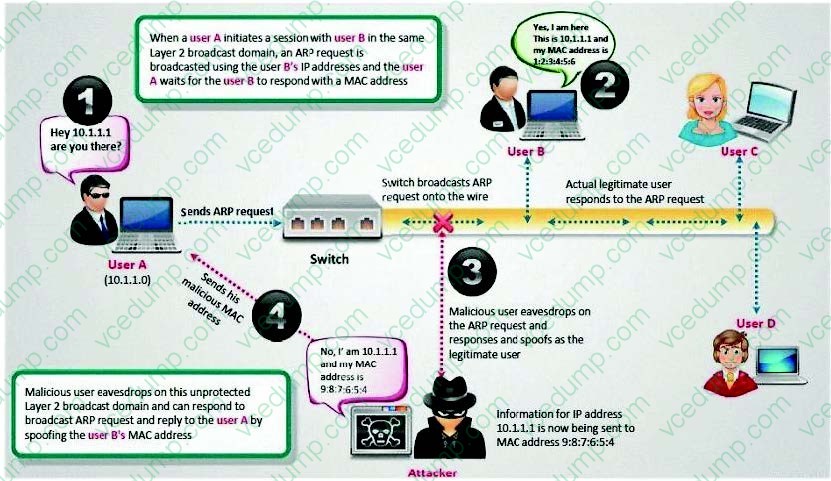
C. Enable Dynamic ARP Inspection
D. Enable MAC snooping Table -
Question 286:
Bob is acknowledged as a hacker of repute and is popular among visitors of "underground" sites. Bob is willing to share his knowledge with those who are willing to learn, and many have expressed their interest in learning from him. However, this knowledge has a risk associated with it, as it can be used for malevolent attacks as well.
In this context, what would be the most affective method to bridge the knowledge gap between the "black" hats or crackers and the "white" hats or computer security professionals? (Choose the test answer)
A. Educate everyone with books, articles and training on risk analysis, vulnerabilities and safeguards.
B. Hire more computer security monitoring personnel to monitor computer systems and networks.
C. Make obtaining either a computer security certification or accreditation easier to achieve so more individuals feel that they are a part of something larger than life.
D. Train more National Guard and reservist in the art of computer security to help out in times of emergency or crises. -
Question 287:
Which of the following algorithms can be used to guarantee the integrity of messages being sent, in transit, or stored? (Choose the best answer)
A. symmetric algorithms
B. asymmetric algorithms
C. hashing algorithms
D. integrity algorithms -
Question 288:
You may be able to identify the IP addresses and machine names for the firewall, and the names of internal mail servers by:
A. Sending a mail message to a valid address on the target network, and examining the header information generated by the IMAP servers
B. Examining the SMTP header information generated by using the mx command parameter of DIG
C. Examining the SMTP header information generated in response to an e-mail message sent to an invalid address
D. Sending a mail message to an invalid address on the target network, and examining the header information generated by the POP servers -
Question 289:
A POP3 client contacts the POP3 server:
A. To send mail
B. To receive mail
C. to send and receive mail
D. to get the address to send mail to
E. initiate a UDP SMTP connection to read mail -
Question 290:
Bob is a Junior Administrator at ABC Company. On One of Linux machine he entered the following firewall rules:
iptables t filter A INPUT -p tcp --dport 23 j DROP
Why he entered the above line?
A. To accept the Telnet connection
B. To deny the Telnet connection
C. The accept all connection except telnet connection
D. None of Above
Related Exams:
-
112-51
EC-Council Certified Network Defense Essentials (NDE) -
212-055
Sun Certified Programmer for the Java 2 Platform.SE 5.0 -
212-77
EC-Council Certified Linux Security -
212-81
EC-Council Certified Encryption Specialist (ECES) -
212-82
EC-Council Certified Cybersecurity Technician (C|CT) -
212-89
EC Council Certified Incident Handler (ECIH v3) -
312-38
EC-Council Certified Network Defender (CND) -
312-39
EC-Council Certified SOC Analyst (CSA) -
312-40
EC-Council Certified Cloud Security Engineer (CCSE) -
312-49
ECCouncil Computer Hacking Forensic Investigator (V9)
Tips on How to Prepare for the Exams
Nowadays, the certification exams become more and more important and required by more and more enterprises when applying for a job. But how to prepare for the exam effectively? How to prepare for the exam in a short time with less efforts? How to get a ideal result and how to find the most reliable resources? Here on Vcedump.com, you will find all the answers. Vcedump.com provide not only EC-COUNCIL exam questions, answers and explanations but also complete assistance on your exam preparation and certification application. If you are confused on your 312-50 exam preparations and EC-COUNCIL certification application, do not hesitate to visit our Vcedump.com to find your solutions here.