303 Exam Details
-
Exam Code
:303 -
Exam Name
:BIG-IP ASM Specialist -
Certification
:F5 Certifications -
Vendor
:F5 -
Total Questions
:524 Q&As -
Last Updated
:Jul 12, 2026
F5 303 Online Questions & Answers
-
Question 201:
An IT support engineer needs to access and modify Virtual Servers in three partitions (Common /Banking and Dev) daily on a BIG-IP device. The company operates a Least Privilege access policy. What level of access does the IT support engineer need to ensure completion of daily roles?
A. Manager in /common/Banking, and /Dev partitions
B. Application Editor in /Common, /Banking, and /Dev partitions
C. Manager in all partitions
D. Application Editor in all partitions -
Question 202:
Refer to the exhibit.
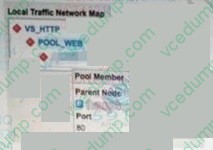
Why is the virtual server responsive to incoming connections?
A. The pool member is disabled
B. The pool member monitor failed
C. The node is disabled.
D. The node monitor failed -
Question 203:
An LTM device has a virtual server mapped to www5f.com with a pool assigned. The objects are defined as follows: Virtual server. Destination 192.168.245.100.443 netmask 255.255.255.0 Persistence: Source address persistence netmask 255.0.0.0 SNAT:AutoMap Profiles: HnP/TCP How should the BIG-IP Administrator modify the persistence profile so that each unique IP address creates a persistence record?
A. netmask 0.0.0.0
B. netmask 255.255.255.255
C. netmask 255.255.0.0
D. netmask 255.256.255.0 -
Question 204:
What should an LTM Specialist configure on an LTM device to send AVR notification emails?
A. Email notification to be sent via iControl from the LTM device
B. Syslog on the LTM device to send to an SMTP server
C. Custom SNMP traps on the LTM device for AVR notifications
D. Email notification to be sent via SMTP from the LTM device -
Question 205:
An LTM Specialist has configured a virtual server for www.example.com, load balancing connections to a pool of application servers that provide a shopping cart application. Cookie persistence is enabled on the virtual server. Users are able
to connect to the application, but the user's shopping cart fails to update. A traffic capture shows the following:
Request:
GET /cart/updatecart.php HTTP/1.1
Host: www.example.com
Connection: keep-alive
Cache-Control: max-age=0
User-Agent: Mozilla/5.0 (Macintosh; Intel Mac OS X 10_7_5) AppleWebKit/537.4 (KHTML, like Gecko) Chrome/22.0.1229.94 Safari/537.4 Accept: text/html,application/xhtml+xml,application/xml;q=0.9,*/*;q=0.8
Accept-EncodinG. gzip,deflate,sdch
Accept-LanguagE. en-US,en;q=0.8
Accept-Charset: ISO-8859-1,utf-8;q=0.7,*;q=0.3
CookiE. BIGipServerwebstore_pool=353636524.20480.0000 Response: HTTP/1.1 200 OK
DatE. Wed, 24 Oct 2012 18:00:13 GMT Server: Apache/2.2.22 (Ubuntu) X-Powered-By: PHP/5.3.10-1ubuntu3.1 Set-CookiE. cartID=647A5EA6657828C69DB8188981CB5; path=/; domain=wb01.example.com Keep-AlivE. timeout=5, max=100 Connection: Keep-Alive Content-TypE. text/html No changes can be made to the application. What should the LTM Specialist do to resolve the problem?
A. Use an iRule to rewrite the cartID cookie domain.
B. Create a universal persistence profile on the cartID cookie.
C. Enable source address persistence as a fallback persistence method.
D. Create a cookie persistence profile with "match across services" enabled. -
Question 206:
What does the following iRule do? when CLIENT_ACCEPTED {
if { [matchclass [IP::client_addr] equals WebClient1-Whitelist1] }{
#log local0. "Valid client IP: [IP::client_addr] - forwarding traffic"
#Pool WebClient1
} else {
log local0. "Invalid client IP: [IP::client_addr] - discarding"
discard
}
}
A. The iRule compares a client IP to a list. If the client IP is on the list, discard and log the discard.
B. The iRule compares a client IP to a list. If the client IP is NOT on the list, discard and log the discard.
C. The iRule compares a client IP to a list. If the client IP is on the list, the client is sent to Pool WebClient1. Otherwise, discard and log the discard.
D. The iRule compares a client IP to a list. If the client IP is NOT on the list, the client is sent to Pool WebClient1. Otherwise, discard and log the discard. -
Question 207:
Refer to the exhibit.
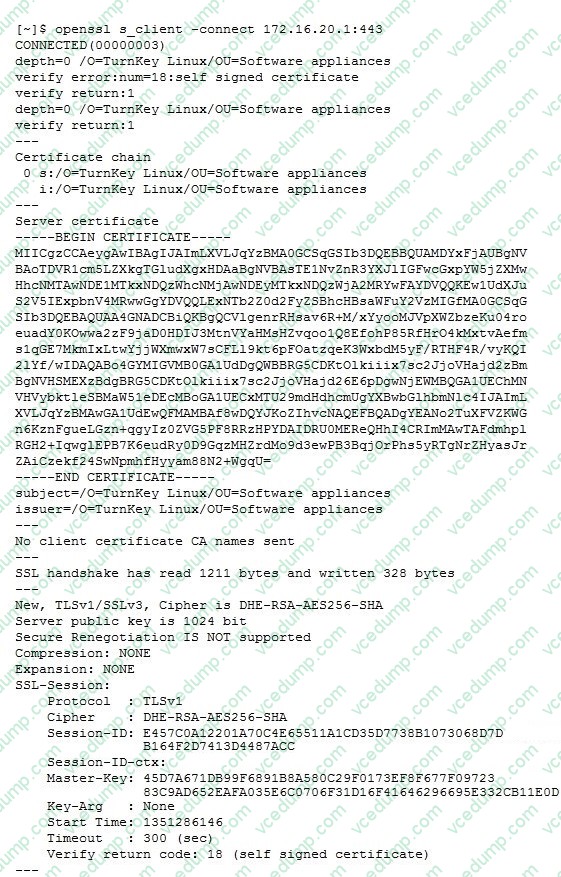
An LTM Specialist is troubleshooting an issue with SSL and is receiving the error shown when connecting to the virtual server. When connecting directly to the pool member, clients do NOT receive this message, and the application functions correctly. The LTM Specialist exports the appropriate certificate and key from the pool member and imports them into the LTM device. The LTM Specialist then creates the Client SSL profile and associates it with the virtual server.
What is the issue?
A. The SSL certificate and key have expired.
B. The SSL certificate and key do NOT match.
C. The client CANNOT verify the certification path.
D. The common name on the SSL certificate does NOT match the hostname of the site. -
Question 208:
Refer to the exhibit.
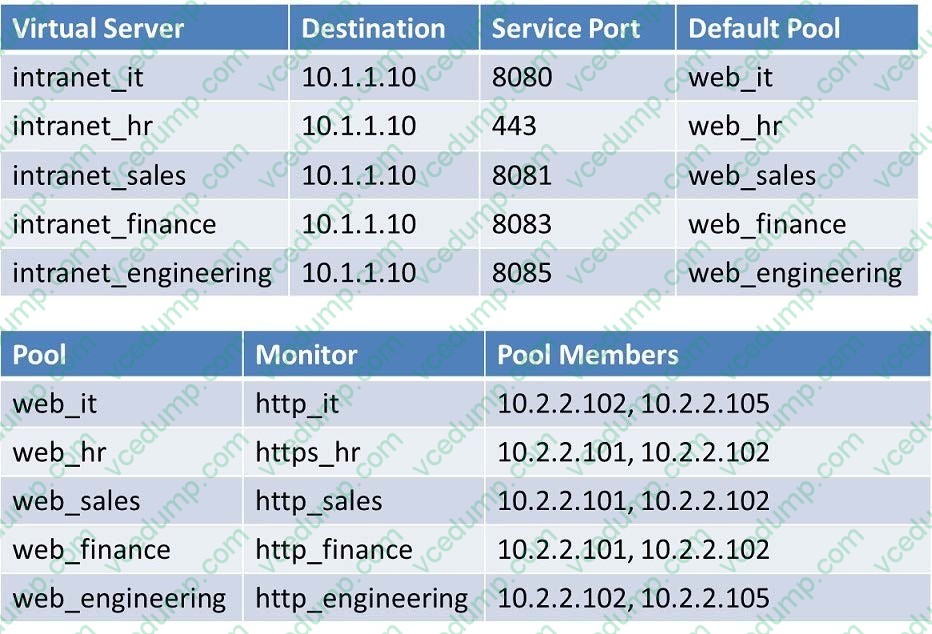
Every monitor has the same Send String, Recv String, and an Alias of *:*. The LTM Specialist simplifies the configuration to minimize the number of monitors. How many unique monitors remain?
B. 2
C. 3
D. 4
E. 5
Correct Answer. B -
Question 209:
Which file should be modified to create custom SNMP alerts?
A. /config/alert.conf
B. /etc/alertd/alert.conf
C. /config/user_alert.conf
D. /etc/alertd/user_alert.conf -
Question 210:
What is a benefit provided by F5 Enterprise Manager?
A. Enterprise Manager allows administrators to analyze traffic flow and create custom application IPS signatures.
B. Enterprise Manager allows administrators to establish baseline application usage and generate an alert if an administratively set threshold for the application is exceeded.
C. Enterprise Manager allows administrators to identify application vulnerabilities. Virtual patches are then automatically generated and applied to remediate the detected application vulnerability.
D. Enterprise Manager allows administrators to monitor all application traffic. Configuration optimization suggestions based on the observed traffic patterns are then generated for the administrator to review and apply.
Related Exams:
-
101
Application Delivery Fundamentals -
201
TMOS Administration -
301A
BIG-IP LTM Specialist: Architect, Set up and Deploy -
301B
BIG-IP Local Traffic Manager (LTM) Specialist: Maintain & Troubleshoot -
302
BIG-IP DNS Specialist -
303
BIG-IP ASM Specialist -
402
F5 Cloud Solutions -
771-101
Application Delivery Fundamentals -
F50-506
F5 FirePass 600 V5 -
F50-531
BIG-IP v10.x LTM Essentials V10.x
Tips on How to Prepare for the Exams
Nowadays, the certification exams become more and more important and required by more and more enterprises when applying for a job. But how to prepare for the exam effectively? How to prepare for the exam in a short time with less efforts? How to get a ideal result and how to find the most reliable resources? Here on Vcedump.com, you will find all the answers. Vcedump.com provide not only F5 exam questions, answers and explanations but also complete assistance on your exam preparation and certification application. If you are confused on your 303 exam preparations and F5 certification application, do not hesitate to visit our Vcedump.com to find your solutions here.