
300-820 Real Exam Questions

Implementing Cisco Collaboration Hybrid and Cloud Technologies (CLHCT) v2.0

305 questions available · Page 1 of 31

Updated Exam DumpsVerified AnswersPass Guarantee

Get Complete Exam Dumps
Question 1 Single choice

An administrator is configuring DNS to allow Mobile and Remote Access logins for the domain cisco.com.

Where must the_collab- edge_tls.cisco.com DNS SRV record be configured?

  1. A

    in the public DNS server

  2. B

    in DNS SRV settings under Cisco Unified OS Administration in Cisco UCM

  3. C

    in DNS settings in the Expressway-E on the interface that faces the Internet

  4. D

    in DNS settings under Cisco Unified OS Administration in Cisco UCM

Show answer and explanation

Correct answer: A

Explanation

Internet-based Mobile and Remote Access clients must discover the edge service before they can contact the organization's internal collaboration systems. The _collab-edge._tls.cisco.com SRV record must therefore be published on the public DNS server, where external clients can resolve it. Cisco UCM DNS settings are not the external discovery point.
Question 2 Single choice

Which role does Call Policy play when preventing toll fraud on Expressways?

  1. A

    It controls which calls are allowed, which calls are rejected, and which calls are redirected to a different destination.

  2. B

    It changes the calling and called number on a call.

  3. C

    It changes the audio protocol used by a call through Expressways.

  4. D

    It changes the audio codec used in a call through Expressways.

Show answer and explanation

Correct answer: A

Explanation

Call Policy evaluates call attributes and determines whether a call is allowed, rejected, or redirected to a different destination. Those disposition controls can block unauthorized routing patterns that would otherwise enable toll fraud. Rewriting calling numbers, changing audio protocols, or selecting codecs does not provide the required permission decision.

Question 3 Single choice

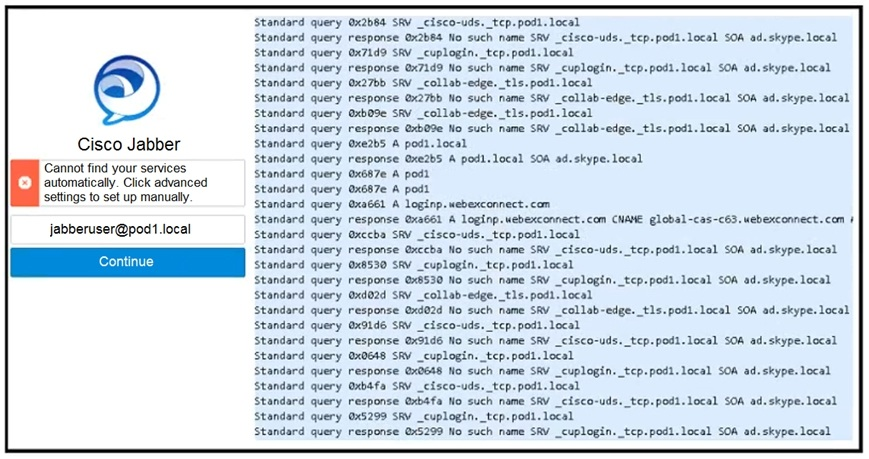
Refer to the exhibit.

The administrator attempted to log in, but Jabber clients cannot log in via mobile and remote access.

How is this issue resolved?

  1. A

    Skype for Business mode must be disabled on the DNS server because it conflicts with Jabber login requirements.

  2. B

    The domain pod1.local must be deprovisioned from the Webex cloud for Jabber logins.

  3. C

    A DNS SRV record must be created for_collab-edge._tls.pod1.local that points to the Expressway-E.

  4. D

    The username [email protected] is invalid. The user should instead sign-in simply as jabberuser.

Show answer and explanation

Correct answer: C

Explanation

The DNS responses report that _collab-edge._tls.pod1.local does not exist, so an external Jabber client cannot discover the Mobile and Remote Access edge service automatically. Creating that SRV record and pointing it to Expressway-E supplies the missing service location. The user can then use the pod1.local domain to discover the external login path.

Question 4 Single choice

An engineer wants to configure a zone on the Expressway-E to receive communications from the Expressway-C in order to allow inbound and outbound calls.

How is the peer address configured on the Expressway-C when Expressway-E has only one NIC enabled and is using static NAT mode?

  1. A

    Expressway-E FQDN

  2. B

    Cisco UCM FQDN

  3. C

    Expressway-E DHCP

  4. D

    Cisco UCM DHCP

Show answer and explanation

Correct answer: A

Explanation

With one Expressway-E interface and static NAT, Expressway-C identifies its traversal peer by the Expressway-E FQDN. The peer is the Expressway-E, not Cisco Unified CM, and DHCP is an address-assignment method rather than a peer identity. Using the FQDN also provides the named identity expected for the server connection.

Question 5 Single choice

Which entry in the public (external) DNS is valid to configure DNS SRV records for a Cisco Mobile and Remote Access solution?

  1. A

    _cisco-uds._tcp.<domain>

  2. B

    _cisco-mra._tls.<domain>

  3. C

    _collab-edge._tls.<domain>

  4. D

    _cisco-expwy._tls.<domain>

Show answer and explanation

Correct answer: C

Explanation

External clients use the public DNS service record named _collab-edge._tls.DOMAIN to discover the Mobile and Remote Access edge service over TLS. This record directs discovery toward the collaboration edge. The _cisco-uds service record serves internal service discovery, so it does not fulfill the public external DNS role described here.

Question 6 Single choice

What is the method for enabling macro provisioning through Control Hub for Webex devices?

  1. A

    It requires accessing the device's local web interface and manually uploading a specific configuration file.

  2. B

    Administrators must navigate to Devices > Settings > Macros in Control Hub and toggle on "Allow Control Hub to manage macros."

  3. C

    It involves sending an API command directly to the device using a third-party scripting tool.

  4. D

    Macro provisioning is automatically enabled by default when a device is registered to Control Hub.

Show answer and explanation

Correct answer: B

Explanation

Macro provisioning must be explicitly allowed from the organization management interface. The administrator navigates to Devices, then Settings and Macros in Control Hub, and enables "Allow Control Hub to manage macros." That toggle grants Control Hub the management path required to provision macros to registered devices.

Question 7 Multiple choice

Which two licenses are required for the Expressway B2B feature to work? (Choose two)

  1. A

    Traversal Server

  2. B

    Advanced Networking

  3. C

    Device Provisioning

  4. D

    Rich Media Sessions

  5. E

    TURN Relays

Show answer and explanation

Correct answers: A, D

Explanation

The Traversal Server license enables the Expressway traversal-server role required for the B2B path, while Rich Media Sessions licenses provide the licensed sessions used by traversed B2B communications. Both capabilities are needed for the feature to operate. Device Provisioning and TURN Relays address other functions, not this two-part B2B licensing requirement.

Question 8 Single choice

A company has an on-premises Cisco collaboration cluster that contains Cisco UCM, IM and Presence, and Cisco Webex in the cloud. The company wants to integrate the on-premises infrastructure with Webex to enable interoperability with the Webex App. An engineer already configured the cluster in Cisco UCM, IM and Presence, and the organization in the Webex Control Hub.

Which action must the engineer take to complete the configuration?

  1. A

    Deploy Directory Connector.

  2. B

    Open the TCP 443 port from IM and Presence to Webex Cloud.

  3. C

    Deploy a Webex Device Connector.

  4. D

    Deploy a Cisco Expressway Message Connector host.

Show answer and explanation

Correct answer: D

Explanation

The on-premises Cisco UCM and IM and Presence cluster and the Webex organization are already configured, so the remaining requirement is the component that links their messaging functions. Deploying a Cisco Expressway Message Connector host supplies that hybrid connection and enables interoperability with the Webex App. Directory and Device Connectors serve different integration purposes.

Question 9 Single choice

An engineer configures the search rules on the Cisco Expressway and must configure routing, which enables call routing to the IP addresses of the unregistered devices in the internal network.

Which action must be taken to accomplish this goal?

  1. A

    Configure a search rule with a mode of Any Alias and target Local Zone.

  2. B

    Configure a search rule with a mode of Any IP address and target Local Zone.

  3. C

    Configure a search rule with a mode of Alias Pattern Match and target Traversal Zone.

  4. D

    Configure a search rule with a mode of Any IP address and target traversal Zone.

Show answer and explanation

Correct answer: B

Explanation

The destination is an IP address for an unregistered device on the internal network, so the search rule must accept Any IP address rather than require a registered alias pattern. Targeting the Local Zone keeps the route within the local Expressway environment and permits direct IP-address routing. A traversal-zone target would send the request toward a remote peer instead.

Question 10 Single choice

An engineer is configuring the Expressway cluster to allow Jabber clients that are outside the enterprise network to register, make calls, and send instant messages using the internal Cisco UCM.

Which action must be taken before a secure UC traversal zone is added to the Expressway-C?

  1. A

    Add Instant Message and Presence service clusters.

  2. B

    Add a Cisco UCM cluster.

  3. C

    Configure SIP OAuth mode.

  4. D

    Establish certificate trust between the Expressway-C and Expressway-E

Show answer and explanation

Correct answer: D

Explanation

A secure UC traversal zone uses TLS between Expressway-C and Expressway-E. Before that zone can establish securely, each Expressway must trust the certificate chain presented by the other. Establishing certificate trust first allows peer identity verification during the TLS handshake; adding Cisco UCM or IM and Presence clusters does not create this inter-Expressway trust.