300-710 Exam Details
-
Exam Code
:300-710 -
Exam Name
:Securing Networks with Cisco Firepower (SNCF) -
Certification
:CCNP Security -
Vendor
:Cisco -
Total Questions
:433 Q&As -
Last Updated
:May 24, 2026
Cisco 300-710 Online Questions & Answers
-
Question 361:
What is a feature of Cisco AMP private cloud?
A. It disables direct connections to the public cloud.
B. It supports security intelligence filtering.
C. It support anonymized retrieval of threat intelligence.
D. It performs dynamic analysis. -
Question 362:
Remote users who connect via Cisco Secure Client to the corporate network behind a Cisco Secure Firewall Threat Defense device are reporting no audio on calls when calling between remote users using their softphones. These same users can call internal users on the corporate network without any issues. What is the cause of this issue?
A. The hairpinning feature is not available on Cisco Secure Firewall Threat Defense
B. Cisco Secure Firewall Threat Defense needs a NAT policy that allows outside to outside communication
C. The Enable Spoke to Spoke Connectivity through Hub option is not selected on Cisco Secure Firewall Threat Defense
D. Split tunneling is enabled for the Remote Access VPN on Cisco Secure Firewall Threat Defense -
Question 363:
Which firewall design allows a firewall to forward traffic at layer 2 and layer 3 for the same subnet?
A. Cisco Firepower Threat Defense mode
B. transparent mode
C. routed mode
D. integrated routing and bridging -
Question 364:
An engineer Is configuring a Cisco FTD device to place on the Finance VLAN to provide additional protection tor company financial data. The device must be deployed without requiring any changes on the end user workstations, which currently use DHCP lo obtain an IP address. How must the engineer deploy the device to meet this requirement?
A. Deploy the device in routed mode and allow DHCP traffic in the access control policies.
B. Deploy the device in routed made aid enable the DHCP Relay feature.
C. Deploy the device in transparent mode and allow DHCP traffic in the access control policies
D. Deploy the device in transparent mode and enable the DHCP Server feature. -
Question 365:
Refer to the exhibit
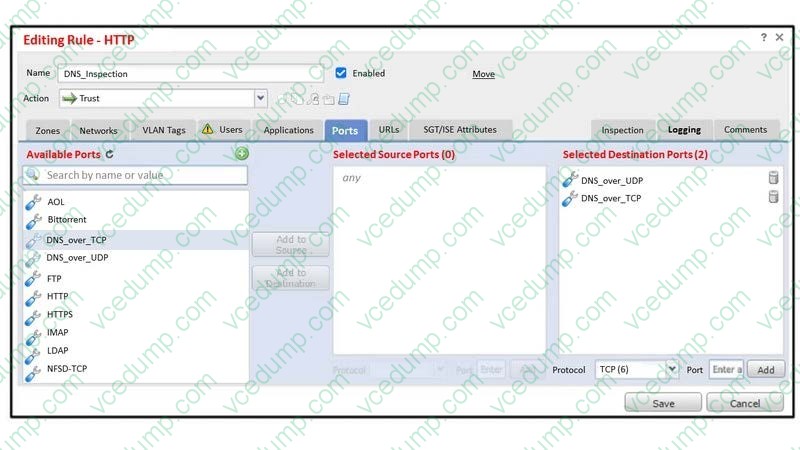
An engineer is modifying an access control pokey to add a rule to inspect all DNS traffic that passes through the firewall After making the change and deploying the pokey they see that DNS traffic is not bang inspected by the Snort engine What is the problem?
A. The rule must specify the security zone that originates the traffic.
B. The rule Is configured with the wrong setting for the source port.
C. The rule must define the source network for inspection as well as the port.
D. The action of the rule is set to trust instead of allow. -
Question 366:
An administrator must use Cisco FMC to install a backup route within the Cisco FTD to route traffic in case of a routing failure with primary route. Which action accomplish this task?
A. Install the static backup route and modify the metric to be less than the primary route
B. Use a default route in the FMC instead of having multiple routes contending for priority
C. Configure EIGRP routing on the FMC to ensure that dynamic routes are always updated
D. Create the backup route and use route tracking on both routes to a destination IP address in the network -
Question 367:
DRAG DROP
Refer to the exhibit.
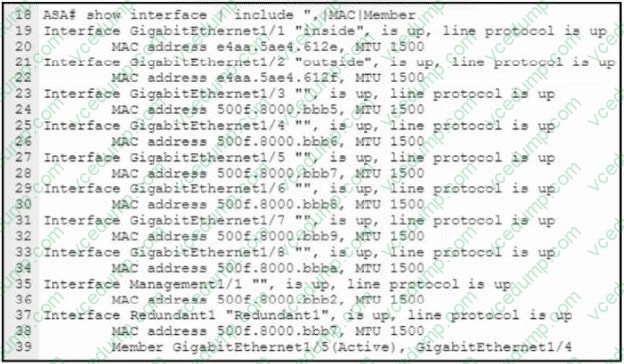
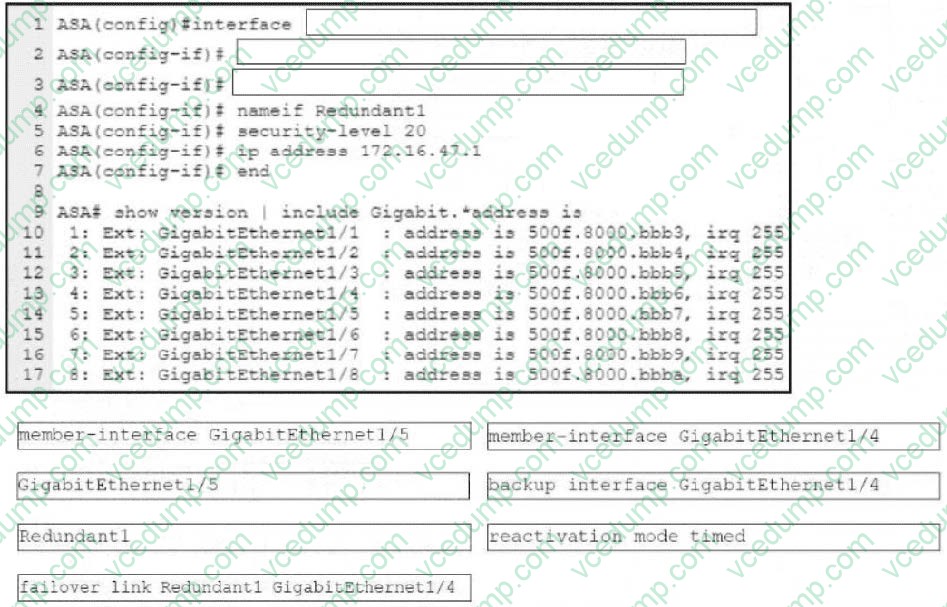
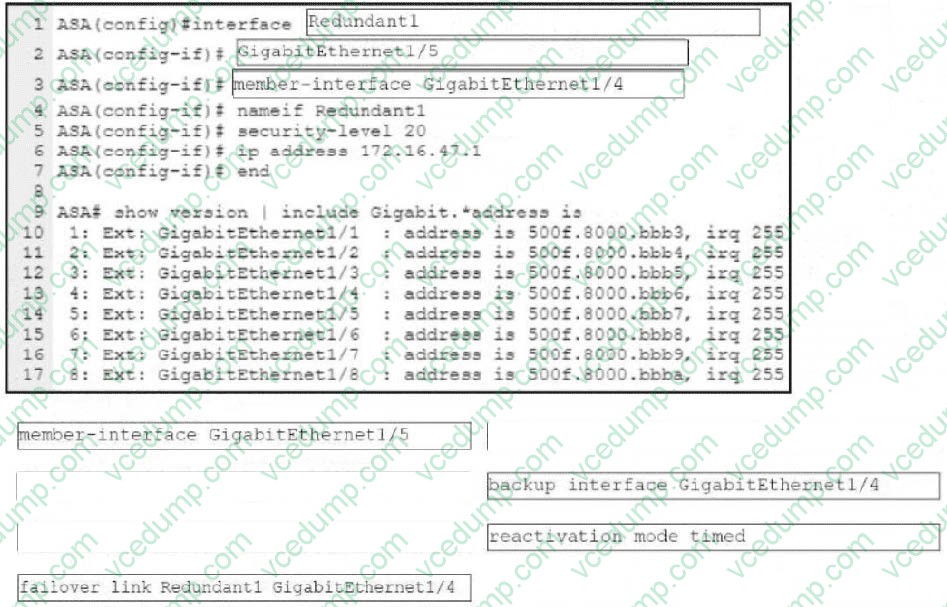
An engineer must configure a connection on a Cisco ASA Firewall with a Cisco Secure Firewall Services Module to ensure that the secondary interface takes over all the functions of the primary interface if the primary interface fails. Drag and drop the code snippets from the bottom onto the boxes in the CLI commands to configure the failover. Not all options are used.
Select and Place:
-
Question 368:
In which two ways do access control policies operate on a Cisco Firepower system? (Choose two.)
A. Traffic inspection is interrupted temporarily when configuration changes are deployed.
B. The system performs intrusion inspection followed by file inspection.
C. They block traffic based on Security Intelligence data.
D. File policies use an associated variable set to perform intrusion prevention.
E. The system performs a preliminary inspection on trusted traffic to validate that it matches the trusted parameters. -
Question 369:
An engineer is configuring a Cisco Secure Firewall Threat Defense device and wants to create a new intrusion rule based on the detection of a specific pattern in the data payload for a new zero-day exploit. Which keyword type must be used to add a line that identifies the author of the rule and the date it was created?
A. gtp_info
B. metadata
C. reference
D. content -
Question 370:
Users report that Cisco Duo 2FA fails when they attempt to connect to the VPN on a Cisco Secure Firewall Threat Defense (FTD) device. IT staff have VPN profiles that do not require multifactor authentication and they can connect to the VPN without any issues. When viewing the VPN troubleshooting log in Cisco Secure Firewall Management Center (FMC), the network administrator sees an error that the Cisco Duo AAA server has been marked as failed. What is the root cause of the issue?
A. AD Trust certificates are missing from the Secure FTD device.
B. Multifactor authentication is not supported on Secure FMC managed devices.
C. The internal AD server is unreachable from the Secure FTD device.
D. Duo trust certificates are missing from the Secure FTD device.
Related Exams:
-
300-710
Securing Networks with Cisco Firepower (SNCF) -
300-715
Implementing and Configuring Cisco Identity Services Engine (SISE) -
300-720
Securing Email with Cisco Email Security Appliance (SESA) -
300-725
Securing the Web with Cisco Web Security Appliance (SWSA) -
300-730
Implementing Secure Solutions with Virtual Private Networks (SVPN) -
300-735
Automating and Programming Cisco Security Solutions (SAUTO) -
300-740
Designing and Implementing Secure Cloud Access for Users and Endpoints -
350-701
Implementing and Operating Cisco Security Core Technologies (SCOR)
Tips on How to Prepare for the Exams
Nowadays, the certification exams become more and more important and required by more and more enterprises when applying for a job. But how to prepare for the exam effectively? How to prepare for the exam in a short time with less efforts? How to get a ideal result and how to find the most reliable resources? Here on Vcedump.com, you will find all the answers. Vcedump.com provide not only Cisco exam questions, answers and explanations but also complete assistance on your exam preparation and certification application. If you are confused on your 300-710 exam preparations and Cisco certification application, do not hesitate to visit our Vcedump.com to find your solutions here.