Which Cisco FMC report gives the analyst information about the ports and protocols that are related to the configured sensitive network for analysis?
Show answer and explanation
Correct answer: D
300-710 Real Exam Questions
447 questions available · Page 1 of 45
Updated Exam DumpsVerified AnswersPass Guarantee
Which Cisco FMC report gives the analyst information about the ports and protocols that are related to the configured sensitive network for analysis?
Correct answer: D
An engineer plans to reconfigure an existing Cisco FTD from transparent mode to routed mode.
Which additional action must be taken to maintain communication Between me two network segments?
Correct answer: B
When reconfiguring an existing Cisco FTD from transparent mode to routed mode, an additional action that must be taken to maintain communication between the two network segments is to update the IP addressing so that each segment is a unique IP subnet. This is because in routed mode, the FTD device acts as a router hop in the network and requires each interface to be on a different subnet. In transparent mode, the FTD device acts as a layer 2 firewall and does not require different subnets for each interface 1.
The other options are incorrect because: Configuring a NAT rule so that traffic between the segments is exempt from NAT is not necessary to maintain communication between the two network segments. NAT is used to translate IP addresses between different networks, but it does not affect the routing of packets.
Moreover, NAT is optional in routed mode and can be disabled if not needed 2.
Deploying inbound ACLs on each interface to allow traffic between the segments is not required to maintain communication between the two network segments. ACLs are used to control access to network resources based on source and destination addresses, protocols, and ports. They do not affect the routing of packets.
Furthermore, ACLs are optional in routed mode and can be configured as needed 3. Assigning a unique VLAN ID for the interface in each segment is not relevant to maintain communication between the two network segments. VLANs are used to create logical groups of hosts that share the same broadcast domain, regardless of their physical location or connection. They do not affect the routing of packets. Besides, VLANs are not supported in routed mode and can only be used in transparent mode 4.
A network administrator registered a new FTD to an existing FMC. The administrator cannot place the FTD in transparent mode.
Which action enables transparent mode?
Correct answer: A
A network engineer must provide redundancy between two Cisco FTD devices. The redundancy configuration must include automatic configuration, translation, and connection updates.
After the initial configuration of the two appliances, which two steps must be taken to proceed with the redundancy configuration? (Choose two.)
Correct answers: A, E
Which CLI command is used to generate firewall debug messages on a Cisco Firepower?
Correct answer: A
References:
https://www.cisco.com/c/en/us/support/docs/security/firepower-ngfw/212330-firepower-management-center-display-acc.html
An administrator must use Cisco FMC to install a backup route within the Cisco FTD to route traffic in case of a routing failure with primary route.
Which action accomplish this task?
Correct answer: D
A network administrator reviews the attack risk report and notices several low-impact attacks.
What does this type of attack indicate?
Correct answer: D
What is a feature of Cisco AMP private cloud?
Correct answer: A
References:
https://www.cisco.com/c/en/us/products/collateral/security/fireamp-private-cloud-virtual-appliance/datasheet-c78-742267.html
Which Cisco Advanced Malware Protection for Endpoints policy is used only for monitoring endpoint actively?
Correct answer: B
References:
https://www.cisco.com/c/en/us/support/docs/security/amp-endpoints/214933-amp-for-endpoints-deployment-methodology.html
Refer to the exhibit.
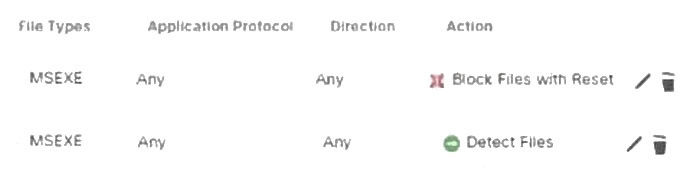
An engineer is configuring access control rules on a Cisco Secure Firewall Threat Defense device. The access control rules must include a file policy with rules that will trigger when MSEXE files are accessed.
Which two actions must be configured in the access rule? (Choose two.)
Correct answers: A, C
The first row in the exhibit shows an action for MSEXE files set to "Block Files with Reset". This action will block the MSEXE files and send a TCP reset to terminate the connection, effectively preventing the files from being accessed or downloaded.
The second row shows an action for MSEXE files set to "Detect Files". This is essentially a monitoring action that allows the system to log and detect MSEXE file access events without blocking them.
In this configuration, combining "Block Files with Reset" and "Detect Files" enables both blocking specific actions and monitoring file access, providing comprehensive control and visibility for MSEXE files.