300-710 Exam Details
-
Exam Code
:300-710 -
Exam Name
:Securing Networks with Cisco Firepower (SNCF) -
Certification
:CCNP Security -
Vendor
:Cisco -
Total Questions
:433 Q&As -
Last Updated
:May 24, 2026
Cisco 300-710 Online Questions & Answers
-
Question 281:
An engineer must export a packet capture from Cisco Secure Firewall Management Center to assist in troubleshooting an issue on a Secure Firewall Threat Defense device. When the engineer navigates to the URL for Secure Firewall Management Center at:
https:///capture/CAPI/pcap/sample.pcap
The engineer receives a 403: Forbidden error instead of being provided with the PCAP file. Which action resolves the issue?
A. Disable the proxy setting on the client browser.
B. Disable the HTTPS server and use HTTP.
C. Enable HTTPS in the device platform policy.
D. Enable the proxy setting in the device platform policy. -
Question 282:
Which rule action is only available in Snort 3?
A. Pass
B. Generate
C. Alert
D. Rewrite -
Question 283:
A security engineer is deploying Cisco Secure Endpoint to detect a zero day malware attack with an SHA-256 hash of 47ea931f3e9dc23ec0b0885a80663e30ea013d493f8e88224b570a0464084628. What must be configured in Cisco Secure Endpoint to enable the application to take action based on this hash?
A. access control rule
B. correlation policy
C. transform set
D. custom detection list -
Question 284:
A network engineer wants to disable the HTTP response page and interactive blocking of the entire access control policy in Cisco Secure Firewall Management Center. What must be selected in Block Response Page and Interactive Block Response Page?
A. Custom
B. View
C. System
D. None -
Question 285:
Refer to the exhibit.
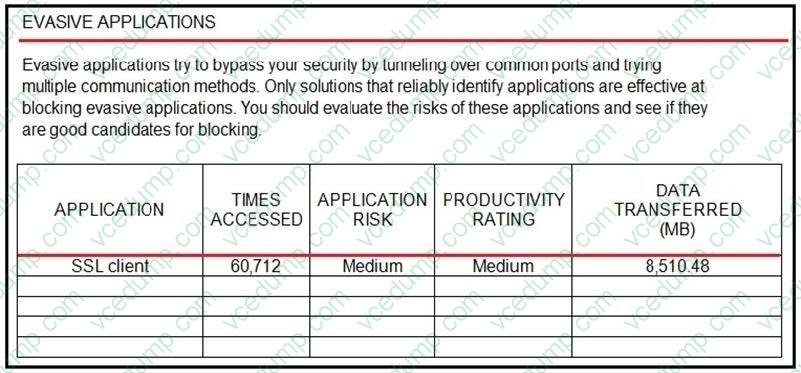
An administrator is looking at some of the reporting capabilities for Cisco Firepower and noticed this section of the Network Risk Report showing a lot of SSL activity that could be used for evasion. Which action will mitigate this risk?
A. Use SSL decryption to analyze the packets.
B. Use Cisco Tetration to track SSL connections to servers.
C. Use encrypted traffic analytics to detect attacks.
D. Use Cisco AMP for Endpoints to block all SSL connection. -
Question 286:
An engineer is configuring URL filtering for a Cisco FTD device in Cisco FMC. Users must receive a warning when they access http://www.badadultsite.com with the option of continuing to the website if they choose to. No other websites should be blocked. Which two actions must the engineer take to meet these requirements? (Choose two.)
A. On the HTTP Responses tab of the access control policy editor, set the Block Response Page to Custom.
B. On the HTTP Responses tab of the access control policy editor, set the Interactive Block Response Page to System-provided.
C. Configure the default action for the access control policy to Interactive Block.
D. Configure an access control rule that matches the Adult URL category and set the action to Interactive Block.
E. Configure an access control rule that matches an URL object for http://www.badadultsite.com/ and set the action to Interactive Block. -
Question 287:
The security engineer reviews the syslog server events of an organization and sees many outbound connections to malicious sites initiated from hosts running Cisco Secure Endpoint. The hosts are on a separate network from the Cisco FTD device. Which action blocks the connections?
A. Modify the policy on Cisco Secure Endpoint to enable DFC.
B. Modify the access control policy on the Cisco FMC to block malicious outbound connections
C. Add the IP addresses of the malicious sites to the access control policy on the Cisco FMC
D. Add a Cisco Secure Endpoint policy with the Tetra and Spero engines enabled -
Question 288:
An organization has a Cisco IPS running in inline mode and is inspecting traffic for malicious activity. When traffic is received by the Cisco IRS, if it is not dropped, how does the traffic get to its destination?
A. It is retransmitted from the Cisco IPS inline set.
B. The packets are duplicated and a copy is sent to the destination.
C. It is transmitted out of the Cisco IPS outside interface.
D. It is routed back to the Cisco ASA interfaces for transmission. -
Question 289:
A network engineer is configuring URL Filtering on Firepower Threat Defense. Which two port requirements on the Firepower Management Center must be validated to allow communication with the cloud service? (Choose two.)
A. outbound port TCP/443
B. inbound port TCP/80
C. outbound port TCP/8080
D. inbound port TCP/443
E. outbound port TCP/80 -
Question 290:
An analyst is investigating a potentially compromised endpoint within the network and pulls a host report for the endpoint in question to collect metrics and documentation. What information should be taken from this report for the investigation?
A. client applications by user, web applications, and user connections
B. number of attacked machines, sources of the attack, and traffic patterns
C. threat detections over time and application protocols transferring malware
D. intrusion events, host connections, and user sessions
Related Exams:
-
300-710
Securing Networks with Cisco Firepower (SNCF) -
300-715
Implementing and Configuring Cisco Identity Services Engine (SISE) -
300-720
Securing Email with Cisco Email Security Appliance (SESA) -
300-725
Securing the Web with Cisco Web Security Appliance (SWSA) -
300-730
Implementing Secure Solutions with Virtual Private Networks (SVPN) -
300-735
Automating and Programming Cisco Security Solutions (SAUTO) -
300-740
Designing and Implementing Secure Cloud Access for Users and Endpoints -
350-701
Implementing and Operating Cisco Security Core Technologies (SCOR)
Tips on How to Prepare for the Exams
Nowadays, the certification exams become more and more important and required by more and more enterprises when applying for a job. But how to prepare for the exam effectively? How to prepare for the exam in a short time with less efforts? How to get a ideal result and how to find the most reliable resources? Here on Vcedump.com, you will find all the answers. Vcedump.com provide not only Cisco exam questions, answers and explanations but also complete assistance on your exam preparation and certification application. If you are confused on your 300-710 exam preparations and Cisco certification application, do not hesitate to visit our Vcedump.com to find your solutions here.