300-710 Exam Details
-
Exam Code
:300-710 -
Exam Name
:Securing Networks with Cisco Firepower (SNCF) -
Certification
:CCNP Security -
Vendor
:Cisco -
Total Questions
:433 Q&As -
Last Updated
:May 24, 2026
Cisco 300-710 Online Questions & Answers
-
Question 191:
A company is deploying Cisco Secure Firewall Threat Defense with IPS. What must be implemented in inline mode to pass the traffic without inspection during spikes and ensure that network traffic is kept?
A. Change the interface mode to Routed
B. Select Propagate Link State
C. Increase the MTU to 9000
D. Set the Snort Failsafe option -
Question 192:
Which two routing options are valid with Cisco Firepower Threat Defense? (Choose two.)
A. BGPv6
B. ECMP with up to three equal cost paths across multiple interfaces
C. ECMP with up to three equal cost paths across a single interface
D. BGPv4 in transparent firewall mode
E. BGPv4 with nonstop forwarding -
Question 193:
An organization does not want to use the default Cisco Firepower block page when blocking HTTP traffic. The organization wants to include information about its policies and procedures to help educate the users whenever a block occurs. Which two steps must be taken to meet these requirements? (Choose two.)
A. Edit the HTTP request handling in the access control policy to customized block
B. Modify the system-provided block page result using Python
C. Create HTML code with the information for the policies and procedures
D. Change the HTTP response in the access control policy to custom
E. Write CSS code with the information for the policies and procedures -
Question 194:
A network administrator notices that SI events are not being updated. The Cisco FTD device is unable to load all of the SI event entries and traffic is not being blocked as expected. What must be done to correct this issue?
A. Restart the affected devices in order to reset the configurations.
B. Redeploy configurations to affected devices so that additional memory is allocated to the SI module.
C. Replace the affected devices with devices that provide more memory.
D. Manually update the SI event entries to that the appropriate traffic is blocked. -
Question 195:
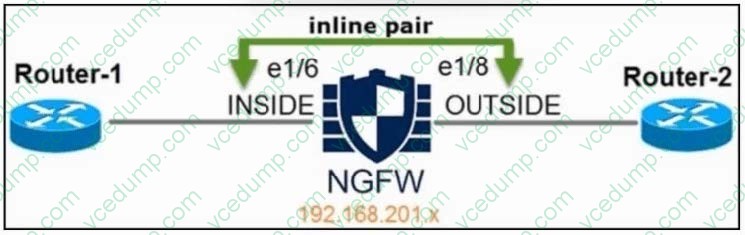
Refer to the exhibit. An engineer is configuring an instance of Cisco Secure Firewall Threat Defense with interfaces in IPS Inline Pair mode. What must be configured on interface e1/6 to accomplish the requirement?
A. propagate link state disabled
B. inline set MTU set to 1500
C. FailSafe disabled
D. security zone set to OUTSIDE_ZONE -
Question 196:
Which two actions can be used in an access control policy rule? (Choose two.)
A. Block with Reset
B. Monitor
C. Analyze
D. Discover
E. Block ALL -
Question 197:
What is a behavior of a Cisco FMC database purge?
A. User login and history data are removed from the database if the User Activity check box is selected.
B. Data can be recovered from the device.
C. The appropriate process is restarted.
D. The specified data is removed from Cisco FMC and kept for two weeks. -
Question 198:
An engineer plans to reconfigure an existing Cisco FTD from transparent mode to routed mode. Which additional action must be taken to maintain communication Between me two network segments?
A. Configure a NAT rule so mat traffic between the segments is exempt from NAT.
B. Update the IP addressing so that each segment is a unique IP subnet.
C. Deploy inbound ACLs on each interface to allow traffic between the segments.
D. Assign a unique VLAN ID for the interface in each segment. -
Question 199:
Refer to the exhibit.
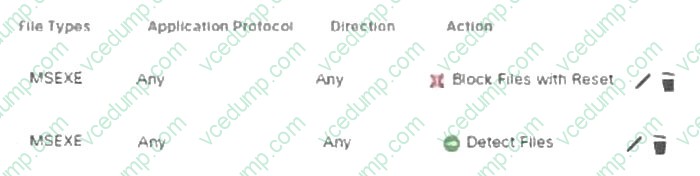
An engineer is configuring access control rules on a Cisco Secure Firewall Threat Defense device. The access control rules must include a file policy with rules that will trigger when MSEXE files are accessed. Which two actions must be configured in the access rule? (Choose two.)
A. block files with reset
B. interactive block
C. monitor
D. allow
E. trust -
Question 200:
On the advanced tab under inline set properties, which allows interfaces to emulate a passive interface?
A. transparent inline mode
B. TAP mode
C. strict TCP enforcement
D. propagate link state
Related Exams:
-
300-710
Securing Networks with Cisco Firepower (SNCF) -
300-715
Implementing and Configuring Cisco Identity Services Engine (SISE) -
300-720
Securing Email with Cisco Email Security Appliance (SESA) -
300-725
Securing the Web with Cisco Web Security Appliance (SWSA) -
300-730
Implementing Secure Solutions with Virtual Private Networks (SVPN) -
300-735
Automating and Programming Cisco Security Solutions (SAUTO) -
300-740
Designing and Implementing Secure Cloud Access for Users and Endpoints -
350-701
Implementing and Operating Cisco Security Core Technologies (SCOR)
Tips on How to Prepare for the Exams
Nowadays, the certification exams become more and more important and required by more and more enterprises when applying for a job. But how to prepare for the exam effectively? How to prepare for the exam in a short time with less efforts? How to get a ideal result and how to find the most reliable resources? Here on Vcedump.com, you will find all the answers. Vcedump.com provide not only Cisco exam questions, answers and explanations but also complete assistance on your exam preparation and certification application. If you are confused on your 300-710 exam preparations and Cisco certification application, do not hesitate to visit our Vcedump.com to find your solutions here.