300-425 Exam Details
-
Exam Code
:300-425 -
Exam Name
:Designing Cisco Enterprise Wireless Networks (ENWLSD) -
Certification
:CCNP Enterprise -
Vendor
:Cisco -
Total Questions
:286 Q&As -
Last Updated
:Jul 10, 2026
Cisco 300-425 Online Questions & Answers
-
Question 101:
Refer to the exhibit.
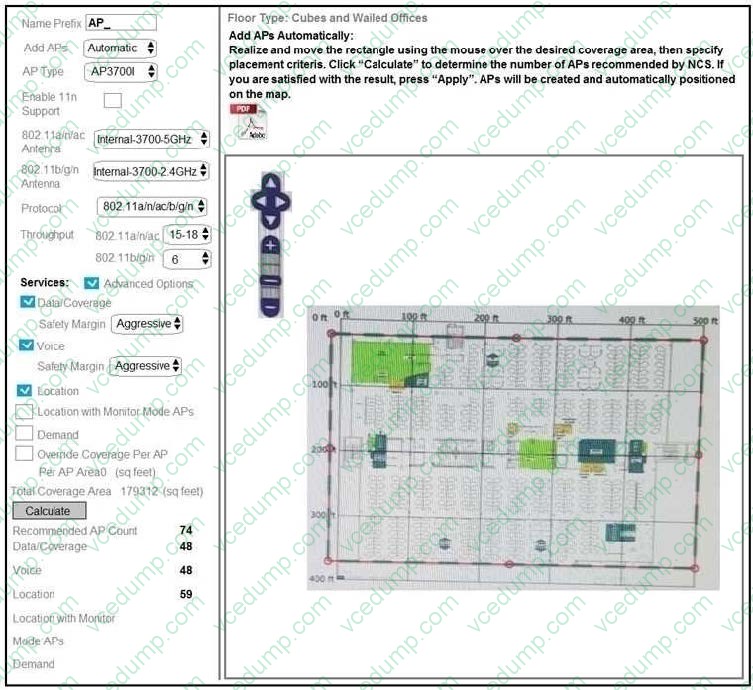
Which two statements about Cisco Prime Infrastructure are true? (Choose two.)
A. It presents the recommended number of APs for the selected coverage area based on the selections made.
B. Planning mode requires a special license in Cisco Prime Infrastructure.
C. It shows the map editor feature in Cisco Prime Infrastructure.
D. Controllers must be synchronized with Cisco Prime Infrastructure for planning mode to work.
E. It shows the planning mode feature in Cisco Prime Infrastructure. -
Question 102:
An engineer is designing a point-to-multipoint mesh network. Which two AP configurations must be completed for a site survey? (Choose two.)
A. MAP hostnames
B. Rx power
C. mesh on 2.4 GHz band
D. bridge group name
E. Tx power -
Question 103:
An engineer must create data link redundancy for the company's Cisco Wireless LAN controller. The engineer has decided to configure LAG-based redundancy instead of port-based redundancy. Which three features of LAG-based redundancy influenced this decision? (Choose three.)
A. Packets are always sent out on the same port they are received on.
B. All interface traffic passes as long as one port is up.
C. The same port has multiple untagged dynamic interfaces.
D. Interface connection to two separate nonstacked switches is available.
E. Full bandwidth of all links is available.
F. Ports are grouped into multiple LAGs. -
Question 104:
A wireless engineer is performing a post verification of a wireless network. Which two metrics does the engineer verify to ensure that the wireless network can support voice services? (Choose two.)
A. The coverage area must have a noise floor that does not exceed-87 dBm.
B. The client device must have at least an-67 dBm RSSI.
C. The rate of retransmitted packets must be 15 percent or below.
D. The rate of retransmitted packets must be 20 percent or below.
E. The client device must have at least an-65 dBm RSSI. -
Question 105:
A customer has a Cisco wireless network that supports VoWLAN services. The customer wants supported voice clients to receive roaming recommendations and suggestions from APs. This functionality must not impact non-VoWLAN clients. What should be enabled on the VoWLAN SSID?
A. 802.11r Fast Transition
B. 802.11k neighbor lists
C. CCKM with 802.1X
D. 802.11v BSS Transition Management -
Question 106:
A customer has restricted the AP and antenna combinations for a design to be limited to one model integrated antenna AP for carpeted spaces and one model external antenna AP with high gain antennas for industrial, maintenance, or storage areas. When moving between a carpeted area to an industrial area, the engineer forgets to change survey devices and surveys several APs. Which strategy will reduce the negative impact of the design?
A. Resurvey and adjust the design.
B. Deploy unsurveyed access points to the design.
C. Deploy the specified access points per area type.
D. Increase the Tx power on incorrectly surveyed access points. -
Question 107:
A wireless engineer is designing a wireless network to support real-time applications over wireless. Which IEEE protocol must the engineer enables on the WLC so that the number of packets that are exchanged between an access point and client are reduced and fast roaming occurs?
A. 802.11w
B. 802.11r
C. 802.11i
D. 802.11k -
Question 108:
An engineer must speed up the reauthentication delays that are being experienced on the wireless infrastructure by deploying a key-caching mechanism. Which mechanism must be configured?
A. PEAP
B. FT
C. PMF
D. GTK-randomization -
Question 109:
An engineer is deploying new APs to serve IEEE 802.11g through 802.11ac clients and wants to use the Ekahau Site Survey tool to verify RF coverage. Management wants the engineer to verify and create coverage maps as quickly as possible. Which configuration accomplishes the goal?
A. passive mode with two wireless adapters
B. passive mode with one wireless adapter
C. active mode with two wireless adapters
D. active mode with one wireless adapter -
Question 110:
While performing an AP-on-a-stick survey with a cell boundary of -67 dBm, an engineer is consistently reading SNR less than 15 dB in a particular area within the cell boundary. What is causing this issue?
A. Another signal is interfering with the AP.
B. The engineer forgot to compensate for the wall type in that area.
C. The AP transmit power is too low.
D. The engineer is too far from the AP.
Related Exams:
-
300-410
Implementing Cisco Enterprise Advanced Routing and Services (ENARSI) -
300-415
Implementing Cisco SD-WAN Solutions (ENSDWI) -
300-420
Designing Cisco Enterprise Networks (ENSLD) -
300-425
Designing Cisco Enterprise Wireless Networks (ENWLSD) -
300-430
Implementing Cisco Enterprise Wireless Networks (ENWLSI) -
300-435
Automating and Programming Cisco Enterprise Solutions (ENAUTO) -
300-440
Designing and Implementing Cloud Connectivity (ENCC) -
350-401
Implementing and Operating Cisco Enterprise Network Core Technologies (ENCOR)
Tips on How to Prepare for the Exams
Nowadays, the certification exams become more and more important and required by more and more enterprises when applying for a job. But how to prepare for the exam effectively? How to prepare for the exam in a short time with less efforts? How to get a ideal result and how to find the most reliable resources? Here on Vcedump.com, you will find all the answers. Vcedump.com provide not only Cisco exam questions, answers and explanations but also complete assistance on your exam preparation and certification application. If you are confused on your 300-425 exam preparations and Cisco certification application, do not hesitate to visit our Vcedump.com to find your solutions here.