300-420 Exam Details
-
Exam Code
:300-420 -
Exam Name
:Designing Cisco Enterprise Networks (ENSLD) -
Certification
:CCNP Enterprise -
Vendor
:Cisco -
Total Questions
:395 Q&As -
Last Updated
:May 29, 2026
Cisco 300-420 Online Questions & Answers
-
Question 301:
Which two statements describe source trees in a multicast environment? (Choose two.)
A. Source trees guarantee the minimum amount of network latency for forwarding multicast traffic
B. Source trees create an optimal path between the source and the receivers
C. Source trees use a single common root placed at some chosen point in the network
D. Source trees can introduce latency in packet delivery
E. Source trees can create suboptimal paths between the source and the receivers -
Question 302:
A company must automate a set of complex changes aligned with DR testing in the network. These changes are specific, and the DR playbook will be adjusted in the future. The playbook has diverse routing and switching assets in scope as well as multiple vendor and hardware platforms. A developer will create a thin, web front-end microservice and integrate with an Open daylight controller to push changes to the network. Which YANG model should be used?
A. Use a single native vendor YANG model to minimize development time
B. Use an open YANG model to allow the reuse of code and standardize the implementation across platforms
C. Use multiple native vendor YANG models to provide code consistency.
D. Develop an individualized YANG model to minimize development resources and time to market. -
Question 303:
Refer to the exhibit.
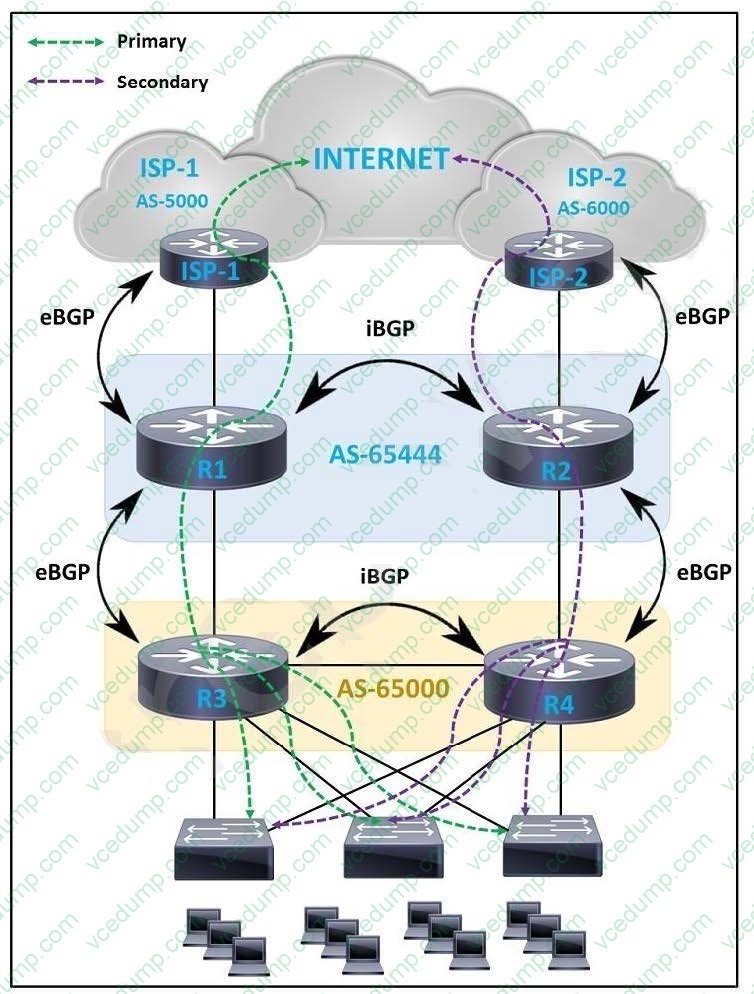
An engineer must design a WAN solution so that ISP-1 is always preferred over ISP-2. The path via ISP-2 is considered as a backup and must be used only when the path to ISP-1 is down. Which solution must the engineer choose?
A. R1: -Routes advertised to ISP-1: 0x AS-path prepend -Routes received from ISP-1: HIGH local-preference -Routes advertised to R2: no action -Routes received from R2: community NO-EXPORT R2: -Routes advertised to ISP-2:5x AS-path prepend -Routes received from ISP-2: LOW local-preference -Routes advertised to R1: community NO-ADVERTISE -Routes received from R1: no action
B. R1: -Routes advertised to ISP-1: 0x AS-path prepend -Routes received from ISP-1: HIGH local-preference -Routes advertised to R2: community NO-EXPORT -Routes received from R2: no action R2: -Routes advertised to ISP-2: 5x AS-path prepend -Routes received from ISP-2: LOW local-preference -Routes advertised to R1: no action -Routes received from R1: no action
C. R1: -Routes advertised to ISP-1: 0x AS-path prepend -Routes received from ISP-1: LOW local-preference -Routes advertised to R2: community NO-ADVERTISE -Routes received from R2: no action R2: -Routes advertised to ISP-2: 5x AS-path prepend -Routes received from ISP-2: HIGH local-preference -Routes advertised to R1: no action -Routes received from R1: community NO-ADVERTISE
D. R1: -Routes advertised to ISP-1: 5x AS-path prepend -Routes received from ISP-1: LOW local-preference -Routes advertised to R2: community NO-ADVERTISE -Routes received from R2: no action R2: -Routes advertised to ISP-2: 0x AS-path prepend -Routes received from ISP-2: HIGH local-preference -Routes advertised to R1: community NO-EXPORT -Routes received from R1: no action -
Question 304:
Refer to the exhibit.
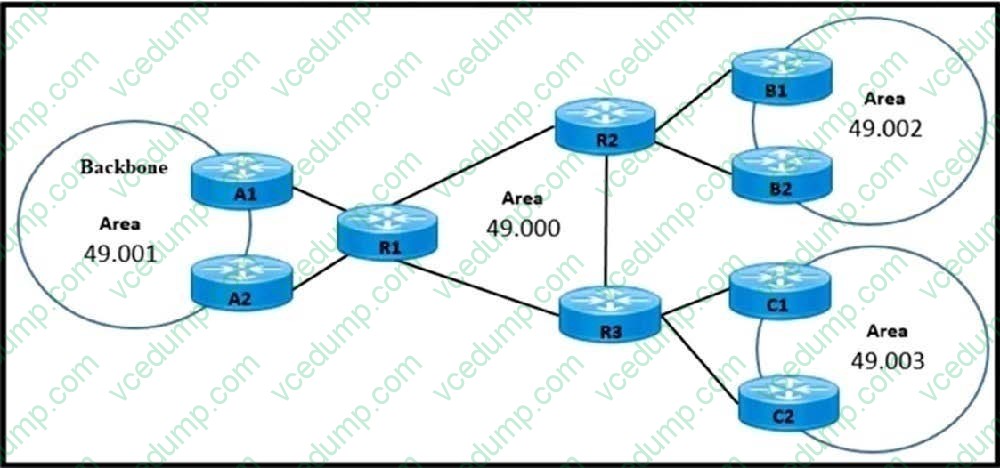
An architect is designing an ISIS solution with these requirements:
1.The backbone area will grow to 50 routers in the next 12 months.
2.Routers A1 and A2 must avoid suboptimal routing.
3.Summarization and route-leaking should be allowed in areas 49.002 and 49.003. Which solution must the architect select?
A. area 49.000 L2, area 49.001 L1, area 49.002 L1, and area 49.003 L1
B. area 49.000 L1, area 49.001 L2, area 49.002 L2, and area 49.003 L2
C. area 49.000 L1, area 49.001 L1, area 49.002 L2, and area 49.003 L2
D. area 49.000 L2, area 49.001 L2, area 49.002 L1, and area 49.003 L1 -
Question 305:
A customer with an IPv4 only network topology wants to enable IPv6 connectivity while preserving the IPv4 topology services. The customer plans to migrate IPv4 services to the IPv6 topology, then decommission the IPv4 topology. Which topology supports these requirements?
A. dual stack
B. 6VPE
C. 6to4
D. NAT64 -
Question 306:
Which feature of Cisco SD-WAN Secure Direct Cloud Access divides user traffic into different zones and VPNs or VRFs?
A. application-awareness routing
B. perimeter control
C. centralized data policy
D. secure segmentation -
Question 307:
Which nonproprietary mechanism can be used to automate rendezvous point distribution in a large PIM domain?
A. Embedded RP
B. BSR
C. Auto-RP
D. Static RP -
Question 308:
An existing network solution is using BFD in echo mode. Several of the network devices are experiencing high CPU utilization which an engineer has determined is related to the BFD feature. Which solution should the engineer leverage to reduce the CPU load?
A. Implement slow timers between peers with low CPU resources.
B. Implement BED asynchronous mode between peers with low CPU resources.
C. Enable BFD multi-hop on the devices with low CPU resources.
D. Utilize carrier delay on all routers in the network. -
Question 309:
Which three key differentiators that DNA Assurance provides that our competitors are unable to match? (Choose three.)
A. Network time travel
B. Support for Overlay Virtual Transport
C. Apple Insights
D. Proactive approach to guided remediation
E. On-premise and cloud-base analytics
F. VXLAN support -
Question 310:
Refer to the exhibit.
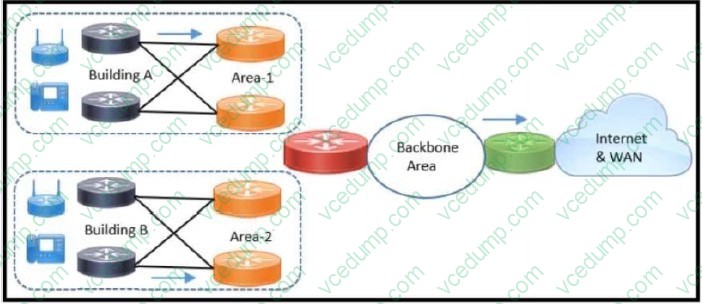
An architect must design an OSPF solution for an enterprise customer. The design must meet these requirements:
1.Limit the link flap impact to Area-1 and Area-2.
2.Any link failure must have minimal impact on voice and video traffic
Which two OSPF solutions must the architect include in the design? (Choose two.)
A. Enable manual route summarization and configure all nonbackbone areas as stub networks
B. Advertise default routes from the backbone to nonbackbone areas
C. Reduce the frequency of DR and BDR elections
D. Increase hello and hold timers
E. Tune LSA and SPF throttling timers
Related Exams:
-
300-410
Implementing Cisco Enterprise Advanced Routing and Services (ENARSI) -
300-415
Implementing Cisco SD-WAN Solutions (ENSDWI) -
300-420
Designing Cisco Enterprise Networks (ENSLD) -
300-425
Designing Cisco Enterprise Wireless Networks (ENWLSD) -
300-430
Implementing Cisco Enterprise Wireless Networks (ENWLSI) -
300-435
Automating and Programming Cisco Enterprise Solutions (ENAUTO) -
300-440
Designing and Implementing Cloud Connectivity (ENCC) -
350-401
Implementing and Operating Cisco Enterprise Network Core Technologies (ENCOR)
Tips on How to Prepare for the Exams
Nowadays, the certification exams become more and more important and required by more and more enterprises when applying for a job. But how to prepare for the exam effectively? How to prepare for the exam in a short time with less efforts? How to get a ideal result and how to find the most reliable resources? Here on Vcedump.com, you will find all the answers. Vcedump.com provide not only Cisco exam questions, answers and explanations but also complete assistance on your exam preparation and certification application. If you are confused on your 300-420 exam preparations and Cisco certification application, do not hesitate to visit our Vcedump.com to find your solutions here.