300-075 Exam Details
-
Exam Code
:300-075 -
Exam Name
:Implementing Cisco IP Telephony and Video -
Certification
:Cisco Certifications -
Vendor
:Cisco -
Total Questions
:522 Q&As -
Last Updated
:Dec 10, 2021
Cisco 300-075 Online Questions & Answers
-
Question 361:
Refer to the exhibit.
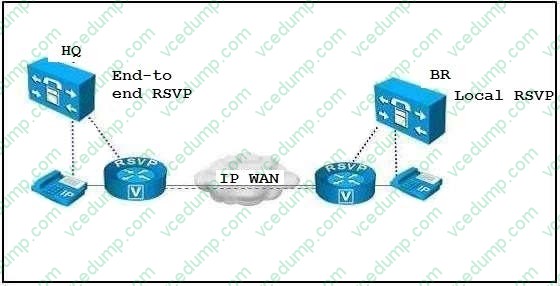
The HQ Cisco Unified Communications Manager has been configured for end-to-end RSVP.
The BR Cisco Unified Communications Manager has been configured for local RSVP. RSVP between the locations assigned to the IP phones and SIP trunks at each site are configured with mandatory RSVP. When a call is placed from the IP
phone at HQ to the BR phone at the BR site, which statement is true?
A. The Cisco Unified Communications Manager at HQ will fall back to local RSVP and place the call. No RSVP end-to-end will occur.
B. RSVP end-to-end will occur.
C. The Cisco Unified Communications Manager at HQ will use end-to-end RSVP. The BR Cisco Unified Communications Manager will use local RSVP.
D. The call will fail.
E. The call will proceed as a normal call with no RSVP reservation. -
Question 362:
Which two statements regarding the Cisco VCS search and transformation process are true? (Choose two.)
A. You cannot set up search rules according to the protocol SIP or H.323.
B. Transforms do not use priority numbers.
C. The Cisco VCS applies the search rules in priority order (all rules with priority 1 are processed first, then priority 2, and so on).
D. Presearch transforms are applied before call policy is configured and before user policies is applied.
E. Presearch transforms are applied after call policy is configured but before user policies is applied.
F. The Cisco VCS applies the search rules in priority order (all rules with priority 255 are processed first, then rules with priority 254, and so on.) -
Question 363:
Which two statements about Zones on Cisco Expressways are correct? (Choose two.)
A. You can register endpoints to default zone.
B. Bandwidth for calls between endpoints in the same zone cannot be restricted.
C. Endpoints are associated to default subzone or any customized subzone depending on the IP address of the endpoint.
D. A neighbor zone connects Cisco Expressway Core to other systems via SIP or H.323.
E. A neighbor zone connects Cisco Expressway Core to Cisco Expressway for NAT, PAT, and firewall traversal. -
Question 364:
IP telephony users from a branch office report a loss of services when their network link fails. Where are the two most obvious steps to take in Cisco Unified Communications Manager to troubleshoot the problem? (Choose two.)
A. Go to System > SRST, and then confirm and validate the SRST gateway configuration.
B. Go to System > System Parameters, and then enable the Remote Survivability option.
C. Go to System > Device Pool for the remote branch, and then validate that the correct SRTS reference is in place.
D. Go to System > Device Pool, and then select the valid SRST reference and the Local Route Group option.
E. Verify that the gateway is configured to operate in SRST mode. -
Question 365:
An engineer is working on a Cisco VCS Control routing configuration and wants users to be able to dial ccnpcollab and have calls routed to [email protected]. Which option achieves this aim?
A. search rules
B. transforms
C. access rules
D. call policy -
Question 366:
What is the difference between an MGCP gateway and a SIP gateway?
A. An MGCP gateway that dial peers be configured before PSTN calls can be placed and received. The SIP gateway requires no dial peers.
B. An MGCP gateway can be added in Cisco Unified Communications Manager under the Gateway Type field using the gateway model. The SIP gateway can connect to Cisco Unified Communications Manager only through a SIP trunk.
C. A SIP gateway requires a call agent for PSTN calls to be placed and received. An MGCP gateway does not require a call agent for PSTN calls to be placed and received.
D. An MGCP gateway can register with Cisco Unified Communications Manager. A SIP gateway will show status of "Unknown".
E. The SIP gateway must be configured in Cisco Unified Communications Manager using a valid IP address on the gateway. The MGCP gateway must be configured in Cisco Unified Communications Manager using the domain name. -
Question 367:
What is the default DSCP value for Cisco TelePresence calls in Cisco Unified Communications Manager?
A. 34
B. 26
C. 32
D. 24
E. 46 -
Question 368:
Which three commands can be used to verify SRST fallback mode? (Choose three.)
A. show telephony-service all
B. show telephony-service ephone-dn
C. show telephony-service ephone
D. show telephony-service voice-port
E. show telephony-service tftp-bindings -
Question 369:
Which three steps are necessary to configure mobile and remote access on Cisco VCS Control? (Choose three.)
A. Configure Cisco VCS for Cisco Unified Communications.
B. Configure DNS and NTP.
C. Discover Cisco Unified Communications Manager and IMandP Servers.
D. Register voice gateways with Cisco Unified Communications Manager
E. After the discovery confirm the connectivity between Cisco VCS Control with Cisco Unified Communications Manager and IMandP.
F. Configure Directory Services for Cisco Unified Communications. -
Question 370:
To which subzone can you apply bandwidth limitations?
A. default
B. cluster
C. manually configured subzones
D. default, traversal, and all manually configured subzones
Related Exams:
-
300-745
Designing Cisco Security Infrastructure (300-745 SDSI) v1.0 -
350-101
Implementing and Operating Cisco Wireless Core Technologies (350-101 WLCOR)v1.0 -
352-011
Cisco Certified Design Expert Practical -
500-052
Cisco Unified Contact Center Express -
500-173
Designing the FlexPod Solution (FPDESIGN) -
500-201
Deploying Cisco Service Provider Mobile Backhaul Solutions -
500-210
SP Optical Technology Field Engineer Representative -
500-220
Engineering Cisco Meraki Solutions (ECMS) v2.2 -
500-230
Cisco Service Provider Routing Field Engineer -
500-240
Cisco Mobile Backhaul for Field Engineers
Tips on How to Prepare for the Exams
Nowadays, the certification exams become more and more important and required by more and more enterprises when applying for a job. But how to prepare for the exam effectively? How to prepare for the exam in a short time with less efforts? How to get a ideal result and how to find the most reliable resources? Here on Vcedump.com, you will find all the answers. Vcedump.com provide not only Cisco exam questions, answers and explanations but also complete assistance on your exam preparation and certification application. If you are confused on your 300-075 exam preparations and Cisco certification application, do not hesitate to visit our Vcedump.com to find your solutions here.