2V0-41.24 Real Exam Questions

VMware NSX 4.x Professional V2

115 questions available · Page 1 of 12

Updated Exam DumpsVerified AnswersPass Guarantee

Get Complete Exam Dumps
Question 1 Single choice

What can the administrator use to identify overlay segments in an NSX environment if troubleshooting is required?

  1. A

    Geneve ID

  2. B

    VMI ID

  3. C

    Segment ID

  4. D

    VLANID

Show answer and explanation

Correct answer: B

Explanation

In an NSX environment, each overlay segment is uniquely identified by a VNI ID (Virtual Network Identifier). The VNI is used to distinguish different overlay networks within the NSX environment and is essential for troubleshooting, as it helps administrators identify specific segments where traffic is encapsulated and isolated.

Question 2 Multiple choice

What are two functions of the Service Engines in NSX Advanced Load Balancer? (Choose two.)

  1. A

    It collects real-time analytics from application traffic flows.

  2. B

    It stores the configuration and policies related to load-balancing services.

  3. C

    It performs application load-balancing operations.

  4. D

    It deploys web servers to perform load-balancing operations.

  5. E

    It provides a user interface to perform configuration and management tasks.

Show answer and explanation

Correct answers: A, C

Explanation

References:
https://docs.vmware.com/en/VMware-NSX-Advanced-Load-Balancer/22.1/Administration_Guide/GUID-84139C37-0129-40A7-A7AB-5A93E1F65B6D.html

Question 3 Single choice

An NSX administrator is creating a NAT rule on a Tier-0 Gateway configured in active-standby high availability mode.

Which two NAT rule types are supported for this configuration? (Choose two.)

  1. A

    Port NAT

  2. B

    1:1 NAT

  3. C

    Destination NAT

  4. D

    Reflexive NAT

  5. E

    Source NAT

Show answer and explanation

Correct answer: C

Explanation

In an NSX environment with a Tier-0 Gateway configured in active-standby high availability mode, Destination NAT (DNAT) and Source NAT (SNAT) are supported NAT rule types. These allow for traffic redirection by modifying the destination or source IP addresses as needed, which is commonly used in configurations involving external access and internal IP address translation.

Question 4 Drag & drop

DRAG DROP

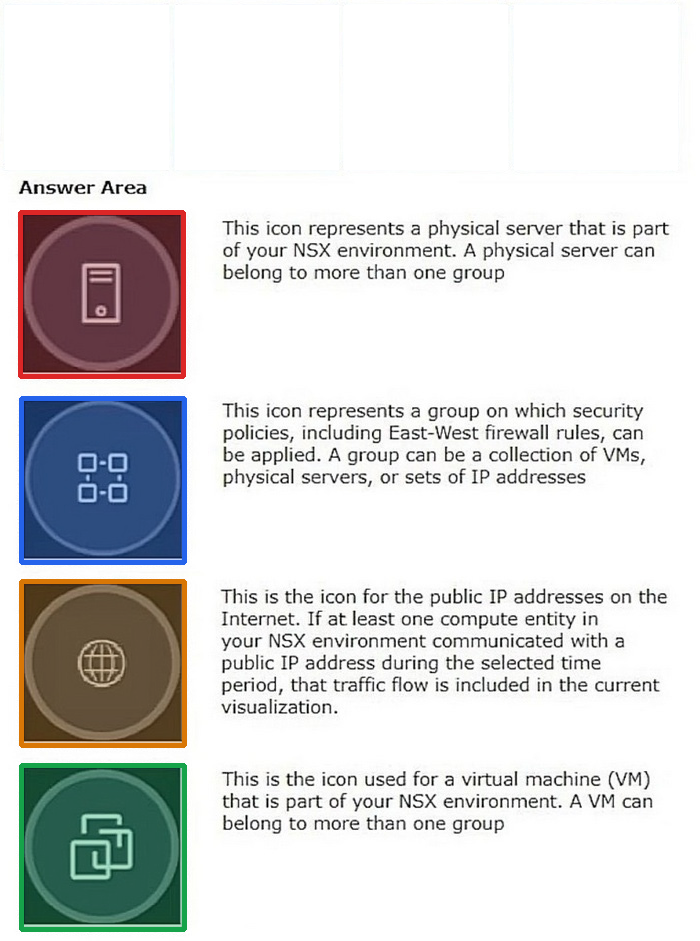
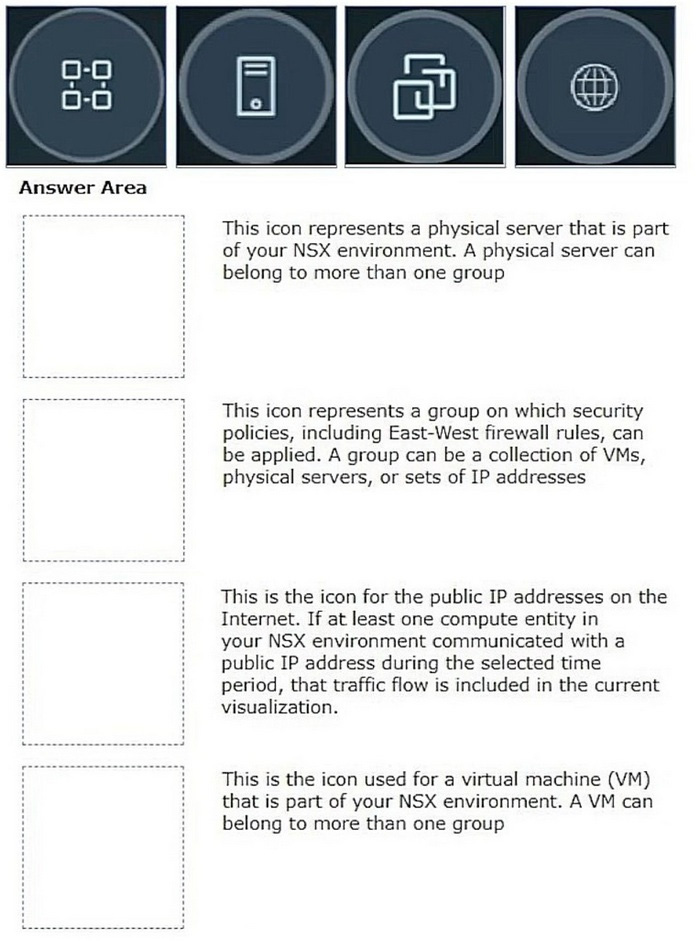
Drag and drop the NSX graphic element icons on the left found in an NSX Intelligence visualization graph to Its correct description on the right.

Question diagram
Show answer and explanation
Correct answer diagram
Explanation

https://docs.vmware.com/en/VMware-NSX-Intelligence/4.0/user-guide/GUID-DC78552B-2CC4-410D-A6C9-3FE0DCEE545B.html

Question 5 Single choice

When collecting support bundles through NSX Manager, which files should be excluded for potentially containing sensitive information?

  1. A

    Core Files

  2. B

    Controller Files

  3. C

    Audit Files

  4. D

    Management Files

Show answer and explanation

Correct answer: A

Explanation

Core Files should be excluded when collecting support bundles through NSX Manager because they may contain sensitive information, such as memory dumps that could reveal sensitive data from processes at the time of an issue. Excluding core files helps ensure that potentially sensitive data is not unintentionally shared.

Question 6 Multiple choice

Which two choices are solutions offered by the VMware NSX portfolio? (Choose two.)

  1. A

    VMware Tanzu Kubernetes Grid

  2. B

    VMware Tanzu Kubernetes Cluster

  3. C

    VMware NSX Advanced Load Balancer

  4. D

    VMware NSX Distributed IDS/IPS

  5. E

    VMware Aria Automation

Show answer and explanation

Correct answers: C, D

Explanation

VMware NSX is a portfolio of networking and security solutions that enables consistent policy, operations, and automation across multiple cloud environments
The VMware NSX portfolio includes the following solutions: VMware NSX Data Center: A platform for data center network virtualization and security that delivers a complete L2-L7 networking stack and overlay services for any workload VMware NSX Cloud: A service that extends consistent networking and security to public clouds such as
AWS and Azure VMware NSX Advanced Load Balancer: A solution that provides load balancing, web application firewall, analytics, and monitoring for applications across any cloud VMware NSX Distributed IDS/IPS: A feature that provides distributed intrusion detection and prevention for workloads across any cloud VMware NSX Intelligence: A service that provides planning, observability, and intelligence for network and micro-segmentation VMware NSX Federation: A capability that enables multi-site networking and security management with consistent policy and operational state synchronization VMware NSX Service Mesh: A service that connects, secures, and monitors microservices across multiple clusters and clouds1 VMware NSX for Horizon: A solution that delivers secure desktops and applications across any device, location, or network1 VMware NSX for vSphere: A solution that provides network agility and security for vSphere environments with a built-in console in vCenter VMware NSX-T Data Center: A platform for cloud-native applications that supports containers, Kubernetes, bare metal hosts, and multi-hypervisor environments1 VMware Tanzu Kubernetes Grid and VMware Tanzu Kubernetes Cluster are not part of the VMware NSX portfolio. They are solutions for running Kubernetes clusters on any cloud3 VMware Aria Automation is not a real product name. It is a fictional name that does not exist in the VMware portfolio.

https://blogs.vmware.com/networkvirtualization/2020/01/nsx-hero.html/
Question 7 Multiple choice

Which two of the following are used to configure Distributed Firewall on VDS? (Choose two.)

  1. A

    vSphere API

  2. B

    NSX API

  3. C

    NSX CU

  4. D

    vCenter API

  5. E

    NSX UI

Show answer and explanation

Correct answers: B, E

Explanation

According to the VMware NSX Documentation, these are two of the ways that you can use to configure Distributed Firewall on VDS:

NSX API: This is a RESTful API that allows you to programmatically configure and manage Distributed Firewall on VDS using HTTP methods and JSON payloads. You can use tools such as Postman or curl to send API requests to the NSX Manager node.
NSX UI: This is a graphical user interface that allows you to configure and manage Distributed Firewall on VDS using menus, tabs, buttons, and forms. You can access the NSX UI by logging in to the NSX Manager node using a web browser.
https://docs.vmware.com/en/VMware-NSX/4.1/administration/GUID-0DEF9F18-608D-4B5C-9175-5514750E901B.html

Question 8 Single choice

Which VMware NSX Portfolio product can be described as a distributed analysis solution that provides visibility and dynamic security policy enforcement for NSX environments?

  1. A

    NSX Manager

  2. B

    NSX Distributed IDS/IPS

  3. C

    NSX Intelligence

  4. D

    NSX Cloud

Show answer and explanation

Correct answer: C

Explanation

NSX Intelligence is a distributed analytics solution within the VMware NSX Portfolio that provides visibility and dynamic security policy enforcement in NSX environments. It enables detailed traffic analysis, identifies security threats, and helps in the automated creation and enforcement of security policies based on observed network traffic patterns and behaviors.

Question 9 Single choice

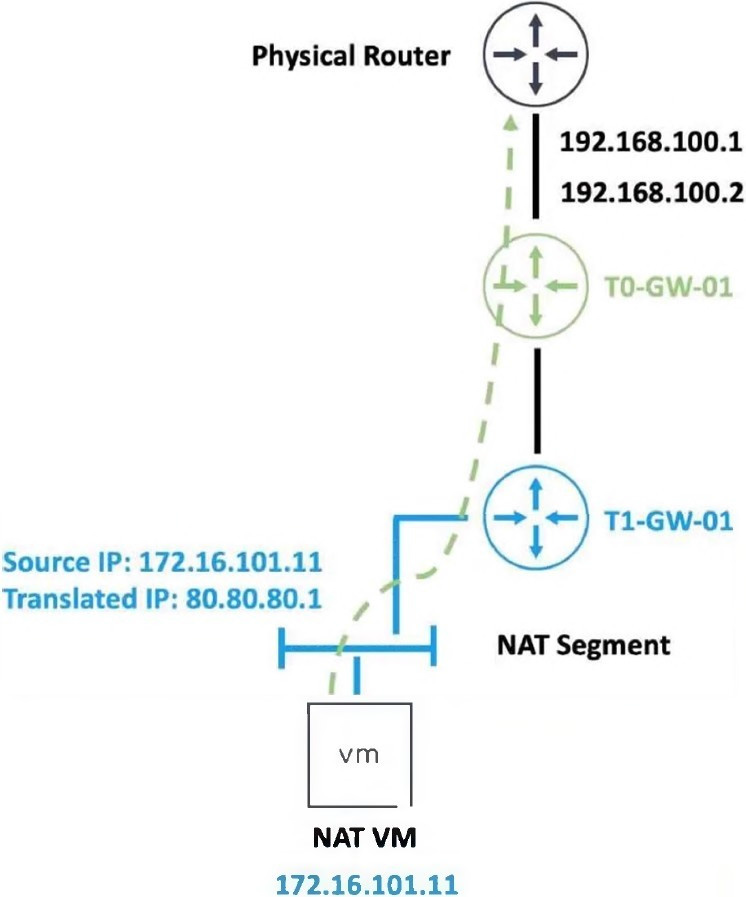
Refer to the exhibit.

An administrator would like to change the private IP address of the NAT VM 172.16.101.11 to a public address of 80.80.80.1 as the packets leave the NAT-Segment network.

Which type of NAT solution should be implemented to achieve this?

  1. A

    NAT64

  2. B

    Reflexive NAT

  3. C

    DNAT

  4. D

    SNAT

Show answer and explanation

Correct answer: D

Explanation

Source NAT (SNAT) is used to translate the private IP address (172.16.101.11) of the NAT VM to a public IP address (80.80.80.1) as the packets leave the NAT-Segment network. SNAT changes the source IP of outbound packets, allowing private IP addresses within the internal network to be mapped to public IP addresses for communication with external networks.

Question 10 Single choice

An NSX administrator is creating a Tier-1 Gateway configured in Active-Standby High Availability Mode. In the event of node failure, the failover policy should not allow the original failed node to become the Active node upon recovery.

Which failover policy meets this requirement?

  1. A

    Enable Preemptive

  2. B

    Non-Preemptive

  3. C

    Preemptive

  4. D

    Disable Preemptive

Show answer and explanation

Correct answer: B

Explanation

In Non-Preemptive failover policy, once a failover occurs and a new Active node is designated, the original failed node will not automatically become the Active node upon recovery. This setting ensures that the failover does not revert to the original node after it comes back online, maintaining the stability of the network by keeping the current Active node as is.